
"All real works of art look as though they were done in joy."
―
As a painter, Robert Henri doesn't interest art historians much. His portraits of street scenes, children, and the occasional landscape didn't blow up painting or shatter paradigms with shock and awe or what have you.
Though he died in 1929, Henri's work today is as alive and spontaneous as when he made it. Robert Henri (he pronounced his last name HEN-rye) is a painter with whom every artist should be familiar – because his words and his paintings are a testament to why we paint in the first place.

Robert Henri (1865–1929), Laughing Child (1907), oil on canvas, 51.4 x 60.3 cm, Whitney Museum of American Art, New York, NY. Wikimedia Commons.
"The object isn't to make art," he said, "it's to be in that wonderful state which makes art inevitable." By that he meant that ultimately, art isn't a pastime or even a discipline, but an experience, and the natural outcome of a life enriched by creativity of any kind. Such a life, he felt, would by definition be lived intensely and in awe, with a heightened sense of being alive.

Robert Henri (1865–1929), West Coast of Ireland (1913), oil on canvas, 66 x 81.3 cm, Everson Museum of Art, Syracuse, NY. Wikimedia Commons.
Learn the tools of art – and let the artist in you come alive. "When the artist is alive in any person, whatever his kind of work may be, he becomes an inventive, searching, daring, self-expressive creature," Henri told students at the New York School of art, where he taught from 1902 to 1908. As a result, he said, the creative person "becomes interesting to other people. He disturbs, upsets, enlightens, and opens ways for better understanding. Where those who are not artists are trying to close the book, he opens it and shows there are still more pages possible."
"Art is, after all, only a trace," he said, "like a footprint which shows that one has walked bravely and in great happiness."

Robert Henri, Concarneau Beach, oil on linen, 1899. In this oil sketch, Henri boldly uses a loaded brush and big and juicy gestural brushstrokes to record the artist's sense of wonder and vigorous life.
Henri was interested in art as a means of living life, not as a means of making a living, Money and collectors would follow, he surmised, as others saw and felt in the work the plain evidence of a life lived fully. "Deep calls unto deep," as Emerson said, and works of the heart and soul will inevitably touch the heart and soul of another.
By definition then, art isn't an elitist specialization but something available to anyone willing to live a fuller, freer life. "Genius is not a possession of the limited few, but exists in some degree in everyone.," Henri said. "Where there is natural growth, a full and free play of faculties, genius will manifest itself."

Robert Henri, Island Trees, oil on wood panel, 1911
Not everyone is willing or capable of acting on the creative impulse, but its wellsprings exist for all.
"There are moments in our lives, there are moments in a day, when we seem to see beyond the usual- become clairvoyant. We reach then into reality. Such are the moments of our greatest happiness. Such are the moments of our greatest wisdom. It is in the nature of all people to have these experiences; but in our time and under the conditions of our lives, it is only a rare few who are able to continue in the experience and find expression for it."
Those are the artists, passionate about life and the joy of expressing it, whom Henri calls "masters of such as they have."

Robert Henri (1865–1929), Café du Dome (On the Boulevard Montparnasse) (1892), oil on canvas, 66 x 81.3 cm, Private collection. The Athenaeum.
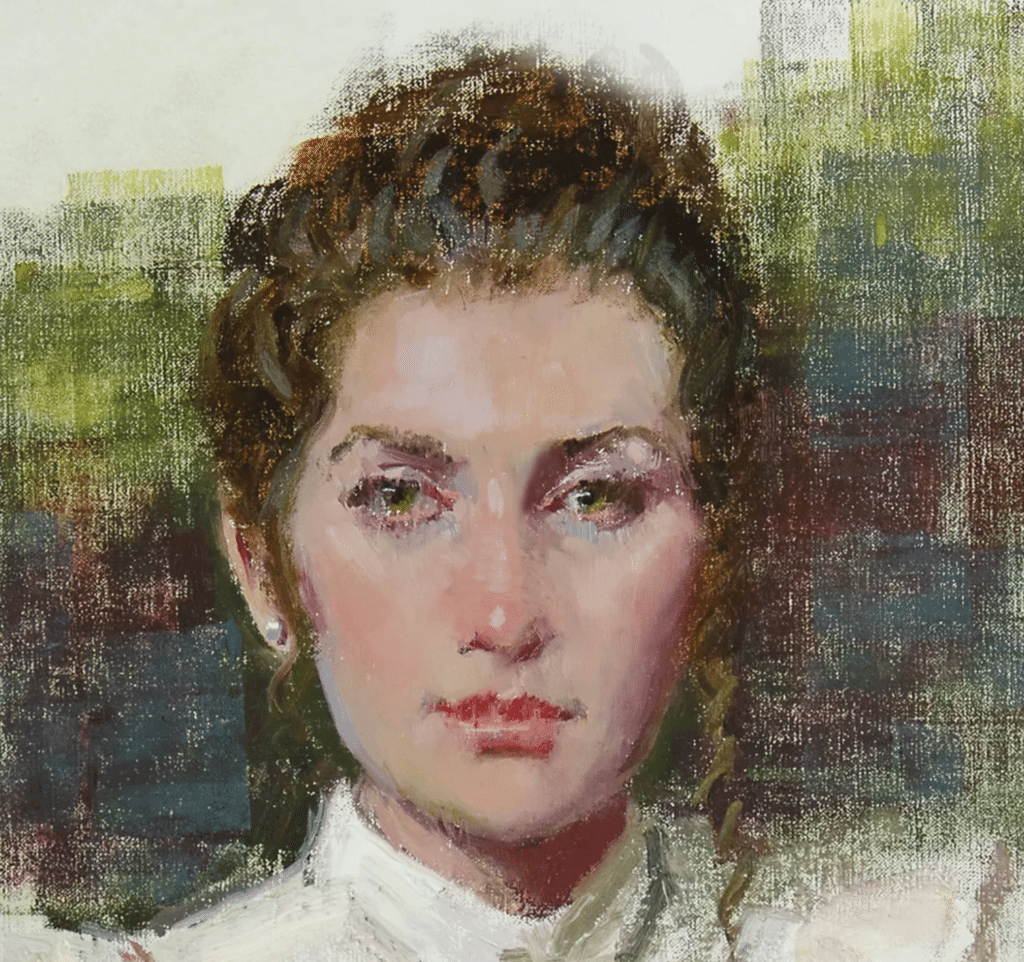
William A. Shneider, demonstrates how he made this expressive portrait in oil
Henri eventually specialized in portraits, using a a free, expressive approach to capturing fresh visions of his subjects. If this is of interest to you too, there's a teaching video that explains and demonstrates this approach step by step. William A. Schneider: Expressive Oil Portraits may be just the thing for you.
Get Your Paintbrush Working for You

Visit EricRhoads.com (Publisher of INSIDE ART) to learn about opportunities for artists and art collectors, including: Art Retreats – International Art Trips – Art Conventions – Art Workshops (in person and online) – And More!