Ocean waves offer the painter what all the best subjects do – they’re full of life and dynamic motion, mesmerizing depths and transparency, intricate lights, luminous shadows, and lush, intriguing colors… And that’s all before considering the ocean’s deep associations of mystery and allure, raw power, timelessness, and peerless natural beauty.
But there’s a catch – with oceans and seascapes come waves! How do you paint a wave? Here we offer two down-and-dirty, two-step processes.
First, the “wing it” approach:
- Paint a flat thin shadow darker than the surrounding ocean mid-tones
- Pull down into it a wave top that’s lighter than the surrounding ocean in a curving motion. Tip in some near-white foam with a palette knife.
And here is the more “studied” approach:
- Know your basic wave anatomy
- Study (make copies and follow along with a demo or two) other artists’ excellent paintings of waves.

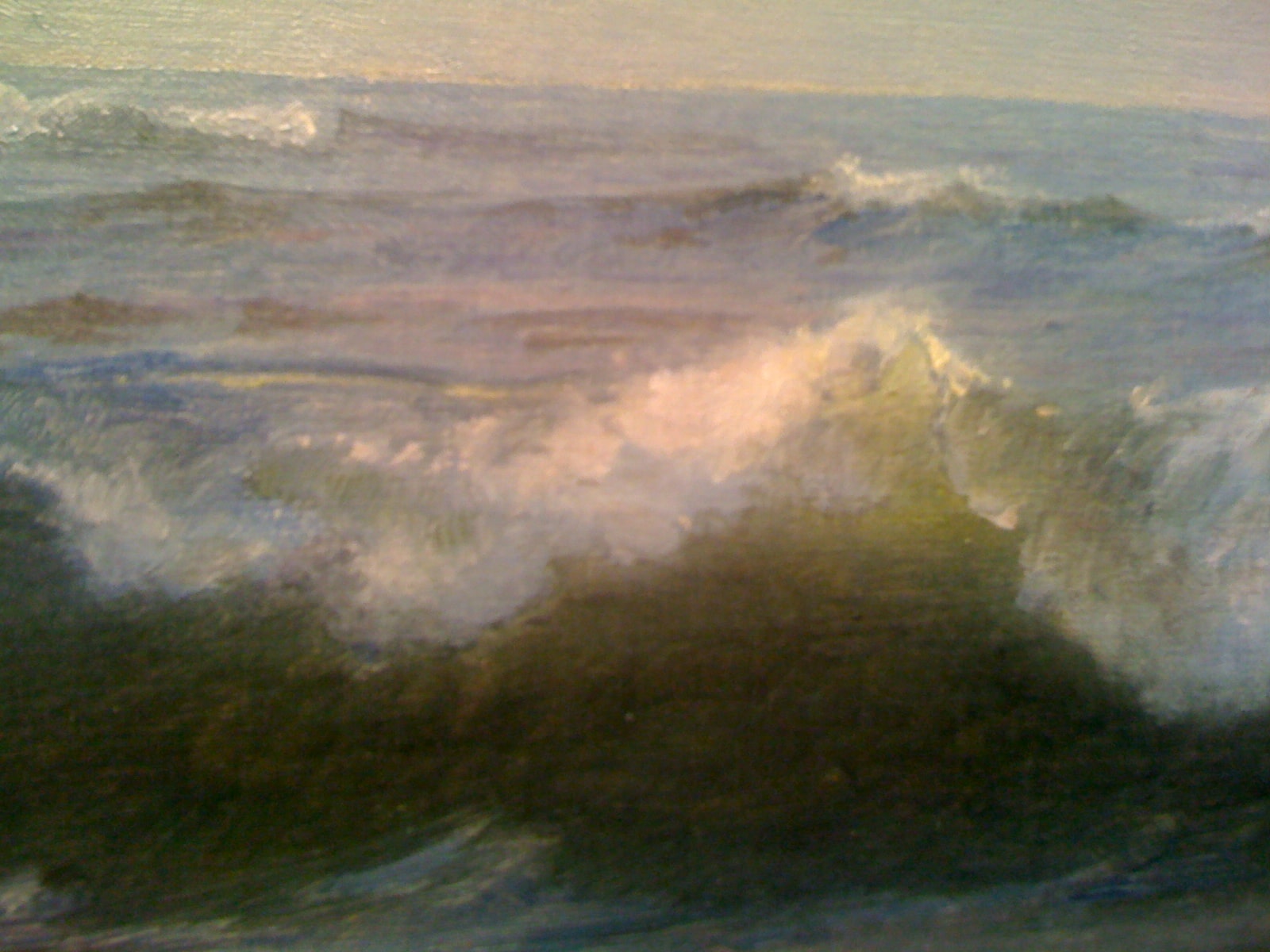
Detail of a wave by William Trost Richards
It may seem confusing to be giving you two separate tw0-step processes, but bear with me. The latter “studied” approach is the one we’ll explore here. And yet, in practice it doesn’t have to be all that much more complicated than the “wing it” approach once you have those basics down.
So, to dive in, painting convincing ocean waves requires reviewing the physics of seawater in motion. Think of a wave coming in to the shore as a cylinder rolling along in forward motion. As it travels along (parallel to the shore, btw), the cylinder’s force gathers up water from below and cycles it up and into the air until gravity makes it begin to fall forward, back down to the water’s surface.
The wave will do this continuously until it reaches the shore and there’s no more water to draw upward and cycle around, whereupon the cylinder collapses head-over-heels, as it were, pitching forward as if the rug were pulled out from under it, a victim of its own momentum. That’s when we see the curl come crashing down, like so:
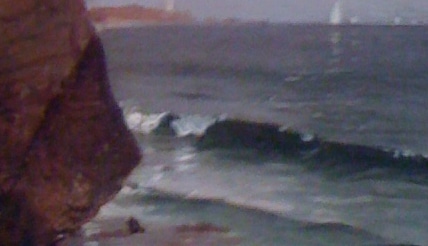
This detail from a 19th c. seascape is out of focus so you can see the three key components of a painted wave: 1. the dark shadow under the curl, 2. the bright foam at the forward edge of the curl and 3. the reflection of the foam in the water beneath it. Just copying this little scrap of painting will teach you pretty much all you need to know to make basic waves.
As the wave curls over to crash, it’s still drawing water toward it. So in theory, when you paint the “walls of water” still standing beside the breaking crest, your brushstrokes and any foam or light and shadow should reflect the tubular movement, from the angle at which we’re viewing the wave and the direction the water is moving as it’s being drawn upward from the sea’s surface
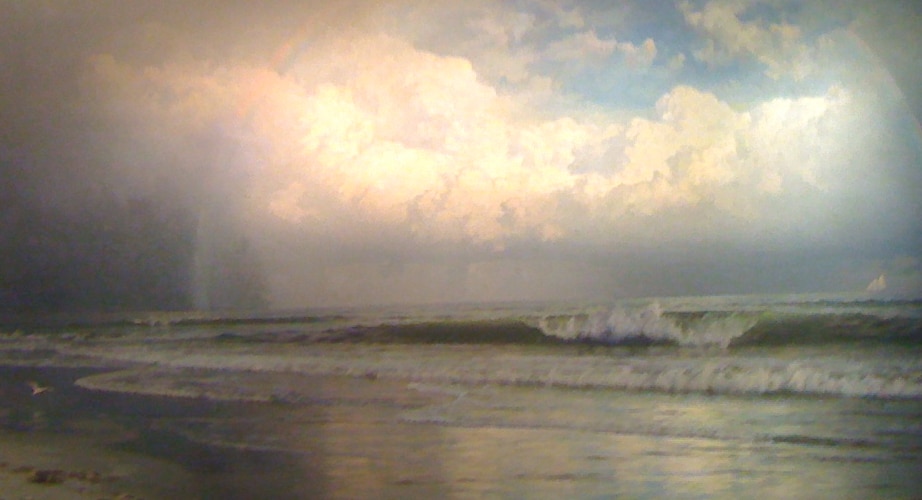
William Trost Richards seascape – detail below

Detail – wave by William Trost Richards seascape above
As outlined in the first two-stepper I gave you above, we use light and shadow to define the wave’s top-to-bottom form. Most importantly, as the wave curls forward, light hits the forward part of the crest (and the foam there). It also filters through the translucent
back of the wave, which appears lit from within, and a dark shadow appears just beneath the curl. The water is too thick at the wave’s crest to let much light in, so that bit is darker than the sea behind it unless it’s carrying foam (visible in the detail above).
Yes, there’s more to it than that! But after the basic shape, a lot of it comes down to getting the values right – painting the shadows the right shade of darker and the foam the right shade of lighter than the surrounding ocean water. Although it’s the part that most intimidates beginners, the detailed foam is largely window dressing, really – it has to be done carefully afterwards with a small brush.

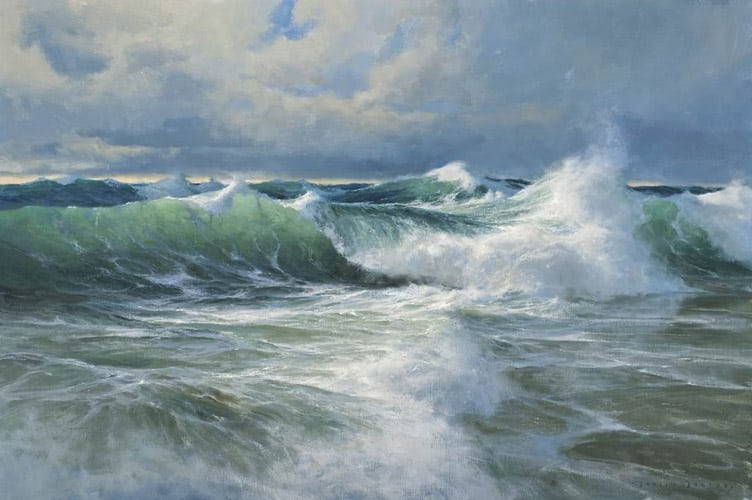
One more tip: avoid the temptation to make too many waves of the same size and shape; you only need one main wave and a supporting actor or two – as in the historical examples above as well as the following paintings by contemporary oil painter Don Demers.
Don Demers’ “Mastering the Sea” DVD is sold out, but you can still stream the popular instructional video and watch it right on your computer here.
d