When Claude Monet was in his 60s, his eyesight began to fail, the result of cataracts developing in both of his eyes. It got so bad he had to label his paint tubes – he could no longer see color properly. Critics argued over whether the wilder, browner, sometimes jarring colors and mark-making of Monet’s later paintings were intentional or just the sad graspings of an old man losing his sight.
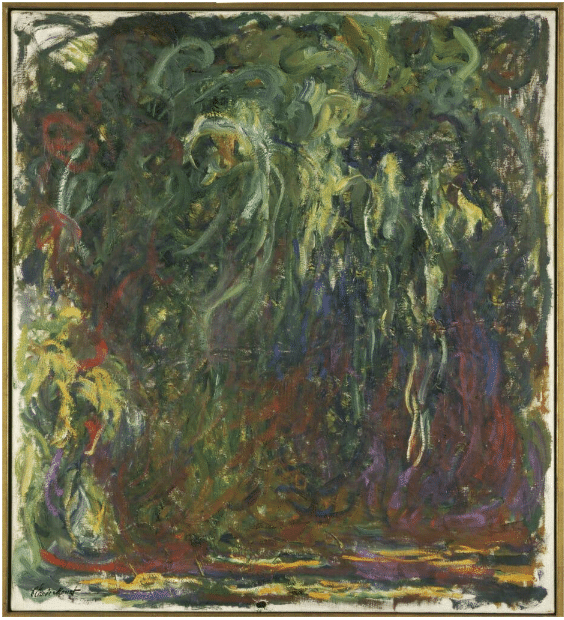
Claude Monet, Le Saule pleureur (1920-22) Musée d’Orsay, donation Philippe Meyer, 2000, Photograph copyright RMN-Grand Palais (Musée d’Orsay) : Michèle Bellot.
In a peer-reviewed paper published in 2015 by the British Journal General Practice, London ophthalmologist Anna Gruener convincingly settled the question. During periods of successfully restored eyesight between medical treatments, she noted, when Monet could actually see what he had been painting, he destroyed as many of those canvases as friends and dealers were unable to rescue.
“Monet’s late works were the result of cataracts and not conscious experimentation with a more expressionistic style,” Gruner wrote. “Nonetheless, it is his late works, created under the influence of his cataracts, that link impressionism with modern abstract art.”
That’s the paradox – the same applies to Turner. The radical works, the late paintings that depart the most from previous conventions, have the most influence on future artists, but they only happen when painting’s primary physical tool – the painter’s eyesight – forces the artist’s hand. It’s as if the truly innovative work
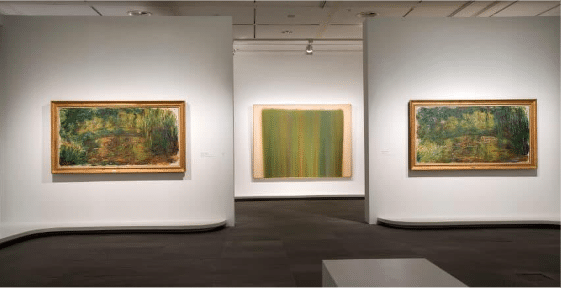
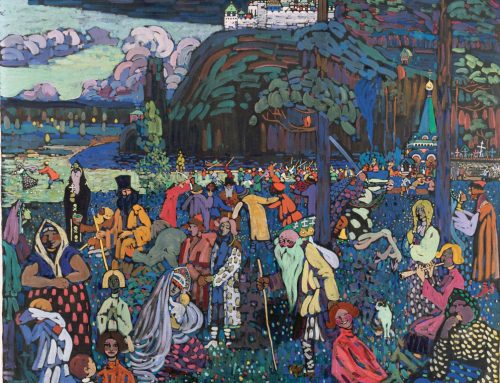
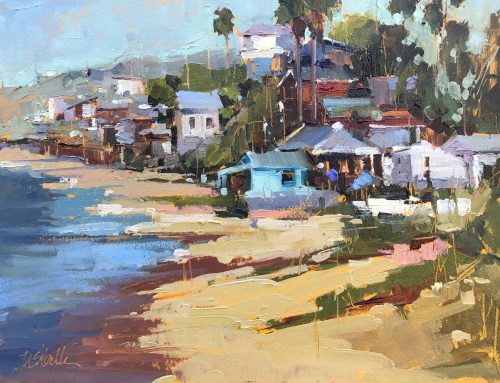
Two late Monet waterlilies flank a 1950s abstract expressionist painting by Morris Lewis during the exhibition “The Water Lilies: American Abstract Painting and the last Monet” at the Musée de l’Orangerie in Paris. © Musée de l’Orangerie. Photo Sophie Crépy-Boegly
For 20 years Monet went back and forth with various eye doctors, trying drops and new fangled glasses that worked for a little while then stopped working. Increasingly despondent and unproductive, Monet refused to have surgery done on his eyes; he’d seen cataract operations fail for several of his friends and colleagues, including Honore Daumier and Mary Cassatt.

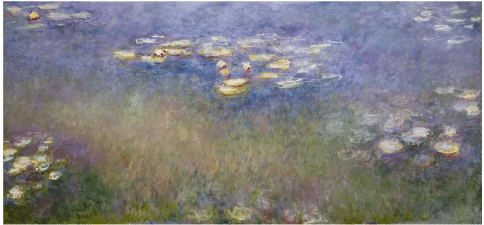
Claude Monet, Nymphéas bleus (1916-19) Musée d’Orsay, Photograph copyright Musée d’Orsay, RMN-Grand Palais – Patrice Schmidt.
He was afraid the operation would result in total blindness. “I prefer to make the most of my poor sight, and even give up painting if necessary,” he wrote to his friend, Georges Clemenceau, the former prime minister of France and also a physician, “but at least be able to see a little of these things that I love.”
However, Monet did finally have successful eye surgery in 1923. In the poem Monet Refuses the Operation, poet Lisel Mueller re-imagines his resistance to surgery as a passionate response to the world’s inability to appreciate how exceptional artistic vision actually is. Monet, in her pem, believes he is seeing beyond the surface of things to the spiritual essences within and beyond them. The poem is occasionally taught in schools throughout the U.S.
Monet Refuses the Operation
Doctor, you say there are no haloes
around the streetlights in Paris
and what I see is an aberration
caused by old age, an affliction.
I tell you it has taken me all my life
to arrive at the vision of gas lamps as angels,
to soften and blur and finally banish
the edges you regret I don’t see,
to learn that the line I called the horizon
does not exist and sky and water,
so long apart, are the same state of being.
Fifty-four years before I could see
Rouen cathedral is built
of parallel shafts of sun,
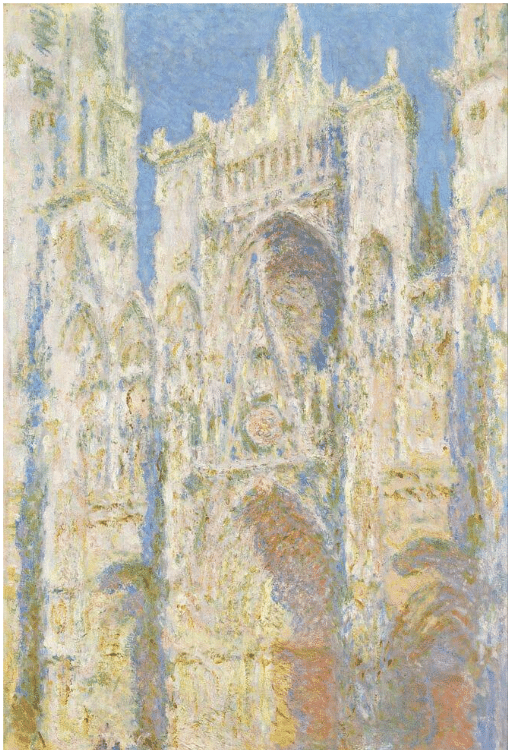
Claude Monet, Rouen Cathedral, West Face in Sunlight
and now you want to restore
my youthful errors: fixed
notions of top and bottom,
the illusion of three-dimensional space,
wisteria separate
from the bridge it covers.
What can I say to convince you
the Houses of Parliament dissolve
night after night to become
the fluid dream of the Thames?
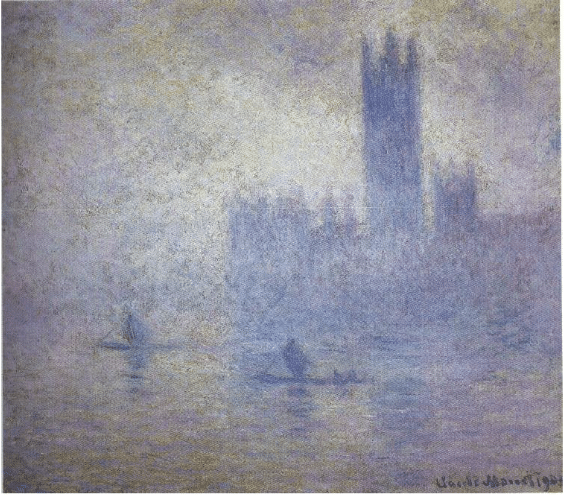
Claude Monet, Houses of Parliament London
I will not return to a universe
of objects that don’t know each other,
as if islands were not the lost children
of one great continent. The world
is flux, and light becomes what it touches,
becomes water, lilies on water,
above and below water,
becomes lilac and mauve and yellow
and white and cerulean lamps,
small fists passing sunlight
so quickly to one another
that it would take long, streaming hair
inside my brush to catch it.
To paint the speed of light!
Our weighted shapes, these verticals,
burn to mix with air
and change our bones, skin, clothes
to gases. Doctor,
if only you could see
how heaven pulls earth into its arms
and how infinitely the heart expands
to claim this world, blue vapor without end.
– Lisel Mueller, “Monet Refuses the Operation” from Second Language. Copyright © 1996 by Lisel Mueller. Reprinted by permission of Louisiana State University Press.
Source: Second Language (Louisiana State University Press, 1996)
Mueller’s book Second Language is available on Amazon.
If you’re a Monet fan (and who isn’t?) you can gain insight into his methods with the video Painting Monet’s Garden with Charles H. White