… And the Salty Inside Joke Some Say it Hides
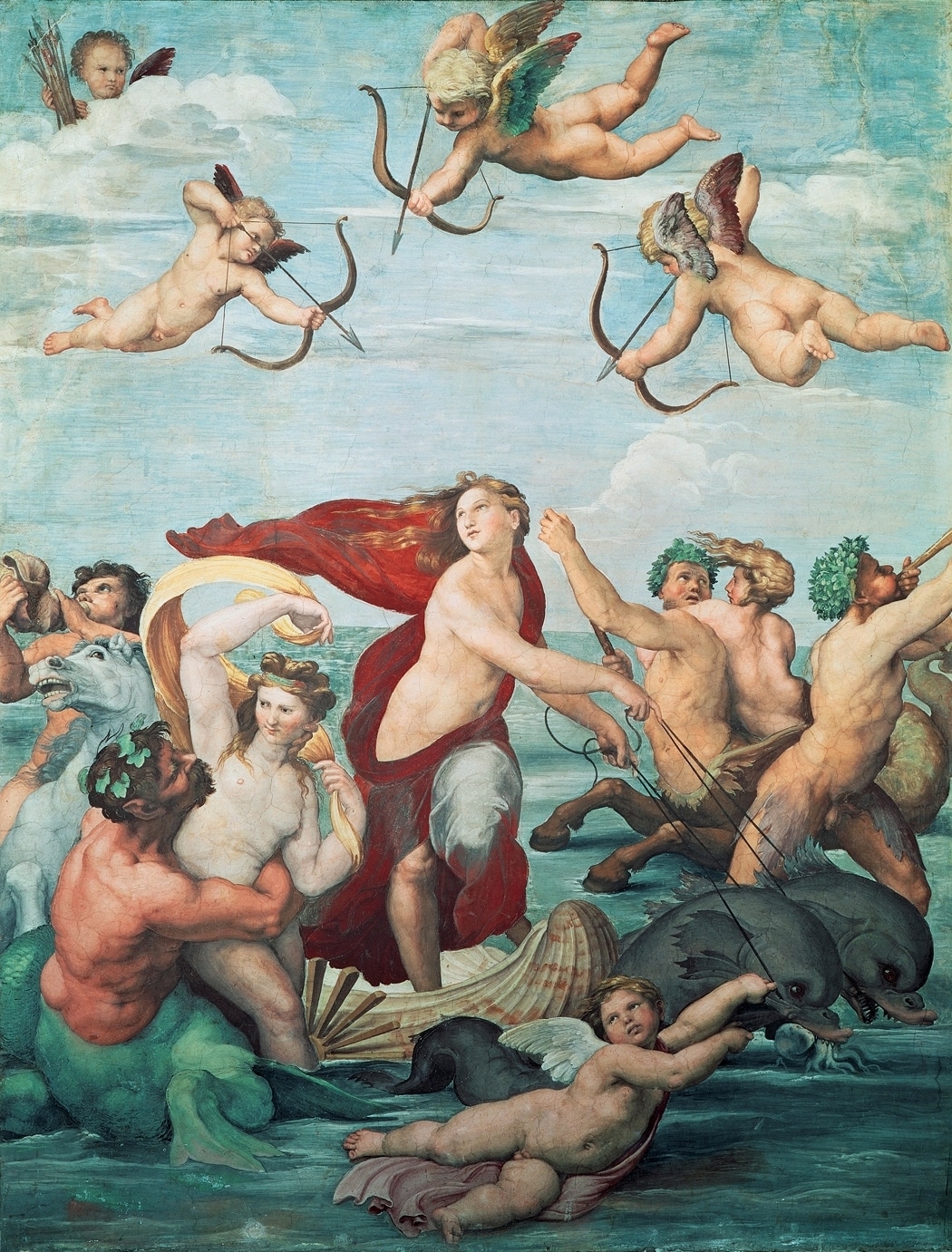
In 1512, Italian Renaissance painter Raphael created this masterpiece for a wall in the villa owned by one of the richest men of the age, a banker named Farnesi. But it’s more than expensive decoration, and it’s more than the lighthearted arrangement of cupids and characters from mythology that it seems. This painting’s imagery celebrates an enormous, world-changing event: the European embrace of the classical Greek mind, which put the Dark Ages on a course heading out of religious intolerance and straight into the modern world. It also hides an inside joke.
Raphael’s subject is a nereid (Greek ocean spirit) named Galatea, a daughter of Poseidon, God of the Sea. The beautiful nymph had the misfortune of being married to the ornery and jealous one-eyed giant Polyphemus, the cyclops, who threw a giant marble pillar on top of her illicit shepherd lover, Acis, when he caught the two exchanging devotions. Raphael depicts not the tragic event itself but its aftermath, the moment of Galatea’s apotheosis, that is, her transformation into an immortal, goddess-like being, so she may dwell among the eternal gods as a reward for her suffering in life.
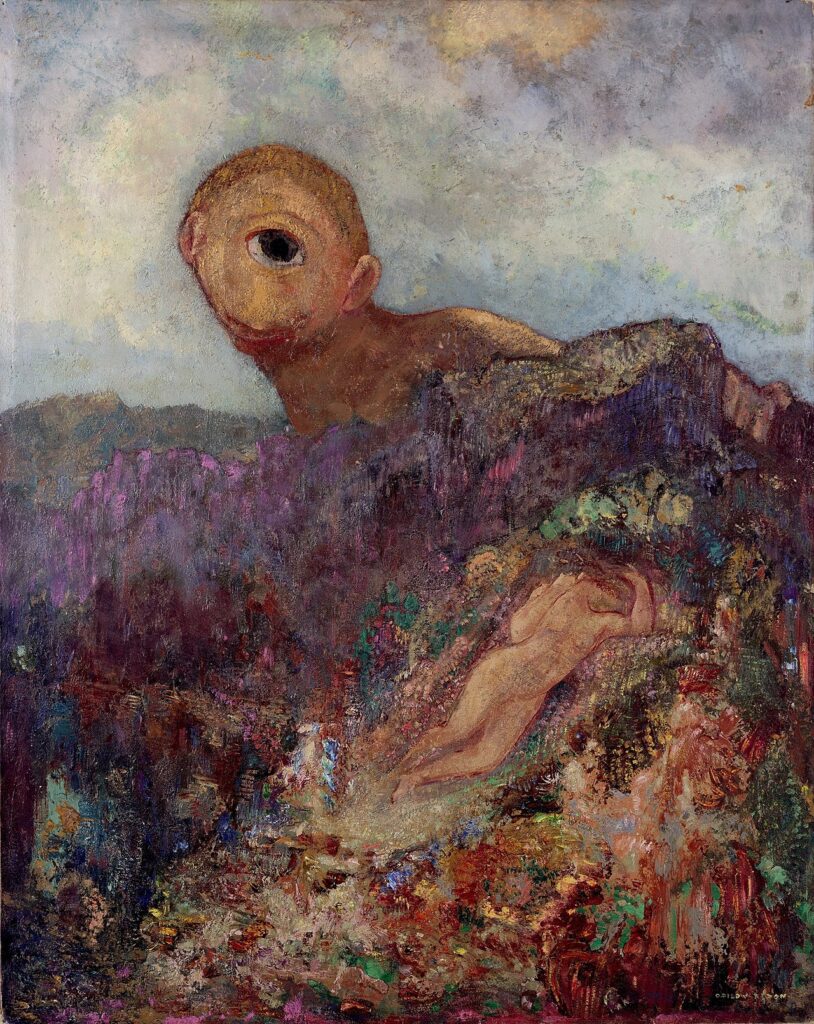
Odilon Redon, The Cyclops (Keeping Watch Over Galatea), oil, 1889-1914
In Raphael’s painting, two of the three conspicuous cupids (called by art historians putti) aim “love darts” directly at Galatea’s head. Galatea (the only one actually wearing clothes) rides upon a shell borne by two dolphins. To her left a lusty man-fish (a sort of sea-centaur, with the torso of a man, body of a horse, and tail of a fish) abducts a sea nymph (the target of the third putti’s arrow, so we know she’ll soon accept his advances). To Galatea’s right an actual (winged?) centaur is overtaken by an amorous (and of course nude) nymph whose intense gaze freely confesses adoring love.
Amidst all this salty frolic, Galatea’s face is turned toward Heaven with a mild, innocent expression that suggests she’s above all the lusty goings on about her. Galatea serenely rides the waves upon a seashell chariot drawn by paired dolphins in a perhaps deliberate echo of Botticelli’s c. 1486 Birth of Venus, which would be sure to associate Galatea with the Goddess of Love.
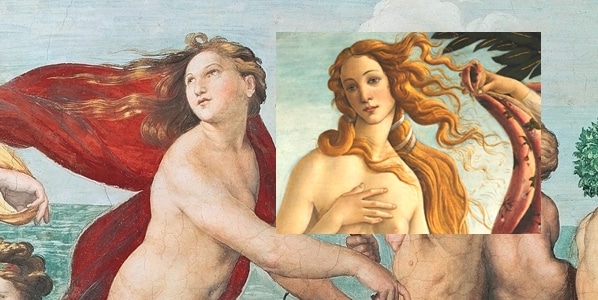
Raphael’s Galatea is likely at least in part the rockstar artist’s answer to the challenge of Botticelli’s classical (Birth of) Venus – these Renaissance geniuses were always trying to outdo each other.
So the painting celebrates love, but specifically it highlights the triumph of ideal or Platonic love, as described by Plato in his newly translated masterpiece, the Symposium. This is a higher love, the highest, the love of the Spirit rather than the flesh. The message is that a whole new way life has come to town – the pure and blessed life of the mind.
At the time, rumor had it Galatea was modeled on a famous courtesan (i.e. high-class prostitute) who called herself Imperia (and who just happened to be the lover of the rich guy who paid for the painting). Some historians say this fact points to an ironic joke that the artist and Farnesi shared. However, the author Vasari, an insider who wrote about the lives of the Renaissance artists, insisted Raphael represented not any specific woman but “Beauty herself.”
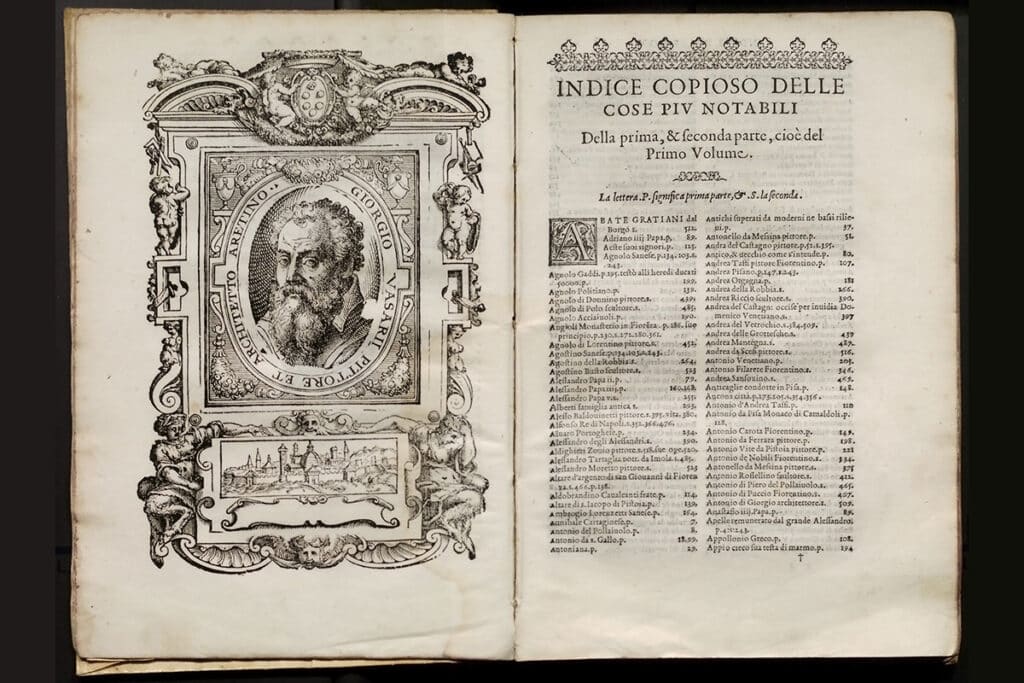
Giorgio Vasari’s Lives of the Artists, kind of a Rolling Stone Magazine for the 15th century.
In terms of technique, Raphael designed the composition using a series of diagonals and a giant invisible X. Where they cross, in the center of the fresco, Galatea turns her fair eyes toward Heaven. And while Raphael may have borrowed some of the muscularity for his figures’ volume from Michelangelo’s Sistine Chapel ceiling, which had just been unveiled to universal amazement, the softness, light, and beauty of that Madonna-like nymph in the center is all his own.
Indeed, Raphael painted dozens of madonnas, depictions of the Virgin Mary holding the infant Jesus. In his day these were very much in demand for their happy marriage of classicism and realism (his models were Tuscan country girls) and their elegant chastity, all of which also radiate from Galatea. In another similarity between Galatea and Mother Mary, Raphael painted all his madonnas wearing red (albeit with a blue mantle).

Two Madonnas. Can you guess which one was painted by Raphael?
So what we have here is a promiscuous pagan (remember, Galatea’s myth is about how she was caught cheating on her one-eyed hubby) depicted as a chaste Madonna amidst over-sexed sea deities, all being used to symbolize a new era of intellect, humanism, and Holy, Idealized Love, the rebirth of rational enlightenment from the ruins of antiquity.
In general, it’s a neat illustration of how in the great paintings of the world, something of the world of their making lives on in them, for us, for all time.
The figurative tradition as practiced by the Renaissance masters such as Raphael and Botticelli lives on in work and teaching of contemporary artist Michael Mentler. If you are ready to follow a series of proven steps and learn the fundamentals of creating a figure study, including how to establish proportion, work with forms, and how to use balance and movement to breathe life into your work, download this video now.