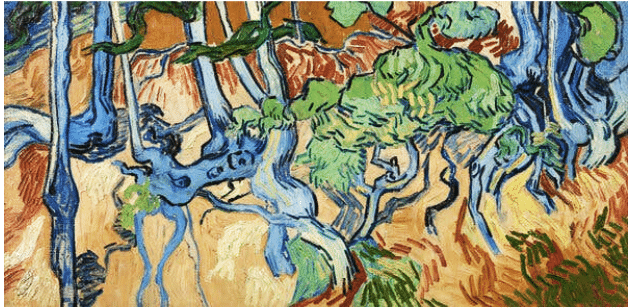
At first it looks like abstraction: a beautiful entanglement of color, shape, movement, and rhythm, rich with forceful brush-work and painterly impasto. It’s perhaps not entirely unlike Jackson Pollock’s1952 abstraction, “Blue Poles” (below).
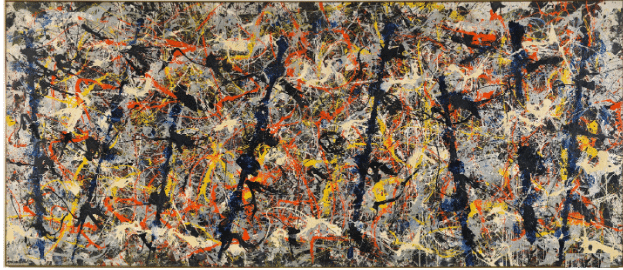
Jackson Pollock, “Blue Poles,” 1952
However, a closer look at Van Gogh’s painting reveals the subject: tree roots, soil, plants, leaves and the golds and ochres of sandy soil. This is Van Gogh’s final painting. His last work was not, as many have been led to believe, “Crows Over a Wheat Field” or “Wheatfields with Crows.”
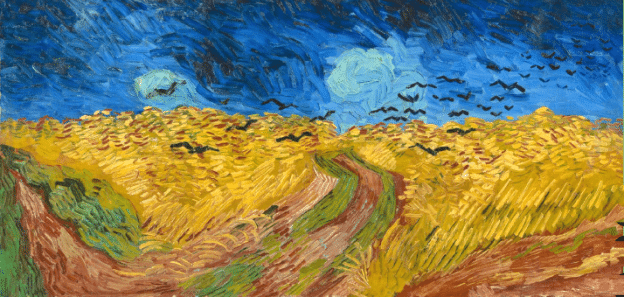
Vincent van Gogh
As great as that painting is, it was misrepresented as his final “statement” by the 1950s Hollywood movie about him titled “Lust for Life.” The 1890 “Tree Roots” (top of page) is decisively established as his last painting.
The spot where Van Gogh made “Tree Roots” has now been identified as the Rue Daubigny in Auvers-sur-Oise. It wasn’t the first time he’d painted roots and gnarled trees. Van Gogh painted plenty of trees and woods and often cropped his compositions in an unusual way. He had the ability to find compositions where no one else would have found them.
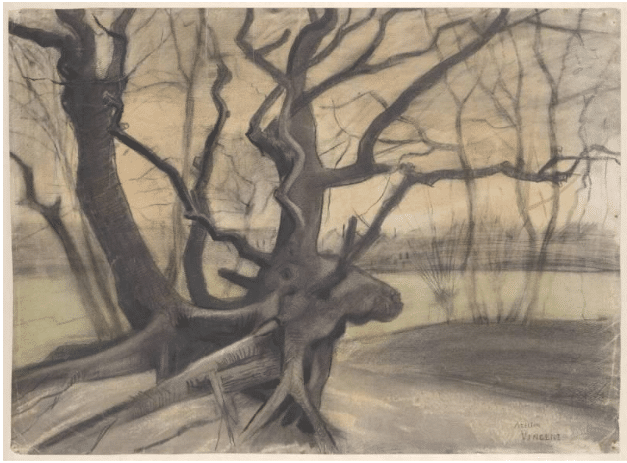
Vincent Van Gogh, “Boomwortels in een zandgrond” (Tree Roots in a Sandy Ground (‘Les racines’),”1882. Pencil, black chalk, brown and grey wash, and opaque watercolor on watercolor paper. 51,5 × 70,7 cm
Van Gogh made the above drawing eight years earlier than the “Tree Roots” at the top of the page. “Van Gogh grew up with the idea that the divine manifests itself in both humankind and nature,” says the museum that owns the drawing. “In these tree roots,” they write, quoting Van Gogh’s description of the artwork to his brother Theo in a letter: “In ‘those gnarled black roots with their knots’, he recognizes something of ‘life’s struggle’, namely the ‘frantically and fervently rooting itself, as it were, in the earth, and yet being half torn up by the storm’.” So we have the artist’s own words about how to read his tree root paintings.
This earlier drawing, says the museum, already suggests Van Gogh’s abiding love for nature, his “outlook on life,” they note, his idiosyncratic choices, and his quickly developing “self-taught craftsmanship.”
And while the later painting, “Tree Roots” from 1890, does the same things even more so, it turns out it too had a basis in reality.
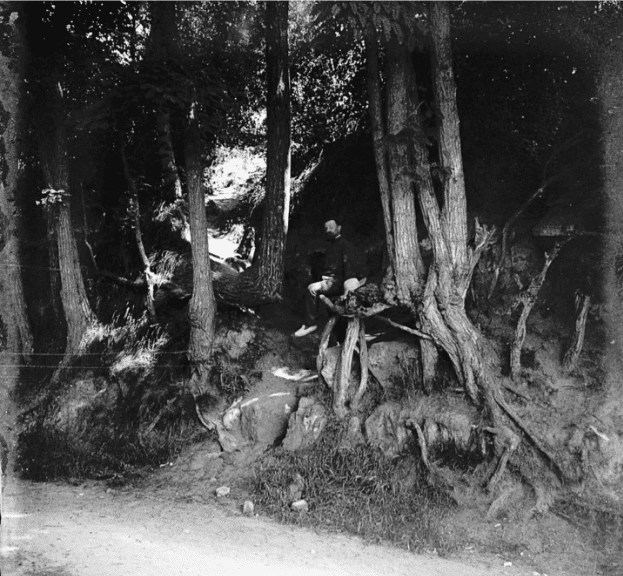
Above is an historical photo that confirms the exact location of Vincent van Gogh’s final painting, “Tree Roots.” The photo was discovered at the Pontoise Museum blog and reposted by the Van Gogh Museum.
The initial discovery of the actual tree roots Van Gogh painted was first made public in 2020 by Wouter van der Veen, (Scientific Director of Institut Van Gogh) in Auvers-sur-Oise, France. He happened to be looking at an image of a well-known vintage postcard of a wooded avenue, when he suddenly made the connection: the precise location van Gogh painted “Tree Roots,” on the very day he suffered the gunshot wound that ended his life.
The Van Gogh Museum this week published a digital version of the photo partially overlaid with colors from the van Gogh.
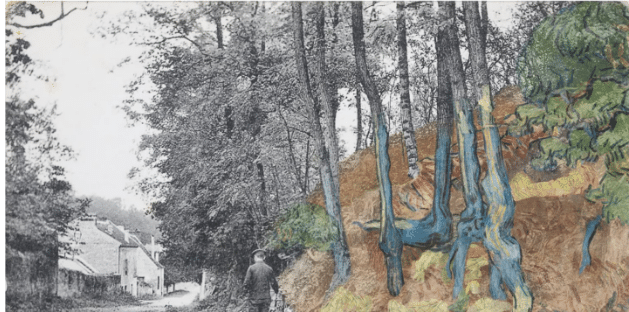
The postcard from around 1900, discovered in 2020, “combined with” the painting.
However, we have to be careful. This image isn’t just colorized, it’s merged. Digital manipulations like this may be as deceptive as they are instructive. We should be cautious about pointing to the photo and saying, “Look at that! You thought Van Gogh was a visionary but that’s what it really looked like! – he was just doing the reference!” Because this is in no way the case.
Rather, studying the painting and the photos side by side shows the opposite – that is, it reveals how much inspiration and inner vision Van Gogh needed to be able to use the scene to create the beautiful work of art that he did.
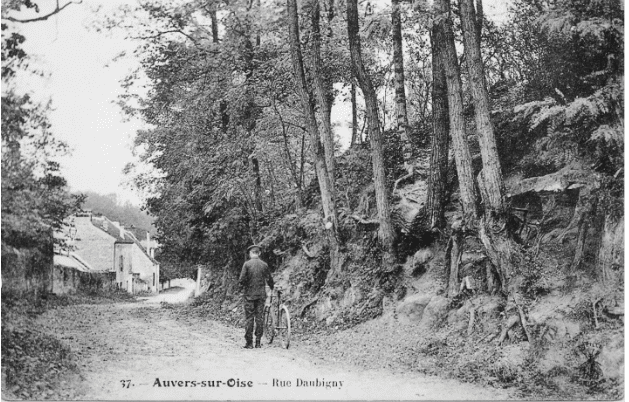
This is the untouched postcard that led to the discovery. Look how different the tree roots are from what Van Gogh painted. It is precisely not, as the museum’s recent social media post wrongly suggests, “just a question of putting in some style…. colour, line and brushstrokes were sufficient to turn a simple subject into a true work of art.” Not at all. There’s much more artistic vision, much more “there” there than that. Which is why it is a trap to concentrate too exclusively on technique, style, surface. We have to learn to look deeper and to read art for what it says, not just how it looks or how, or where, it’s made.
Van Gogh scholar Van der Veen knows this. He confirms what Vincent himself said about his paintings of tree roots: “The painting illustrates the struggle of life, and a struggle with death. That’s what he leaves behind. It is a farewell note in colors.”
It’s also a major landmark in the history of painting. Van Gogh’s “Tree Roots” went beyond nineteenth-century representational conventions, anticipating abstraction as it stretched the bounds to say what the artist had to say – a profound testimony to the union of beauty and tragedy, order and chaos, that is human life as it is, was, and always will be.
You can learn a lot about an artist by trying on their style. If you’re ready to try it yourel, check out the teaching videos by Dena Peterson, including “Loving Van Gogh: How to Paint like Vincent Van Gogh.”