
“Debauched!” went the outcry, “vice-ridden,” “drunken indecency!” “The worst type of harlotry!” Bostonians were livid, and it was the scandal of the decade. It was 1896, the last gasp of the Victorian era, and the Women’s Christian Temperance Union threw all they had at Bacchante and Infant Faun by Frederick MacMonnies, a decorative sculpture you’re likely to overlook on any number of average museum tours.
The sculpture depicts a naked bacchante, a female worshipper of Bacchus (the Roman wine god), holding grapes in one hand and a child in the other. The theme recalls the ancient Greek marble, Hermes and the Infant Dionysus, unearthed by German archaeologists in 1877. In that damaged, the god Hermes once dangled a bunch of grapes before baby Bacchus (god of wine).
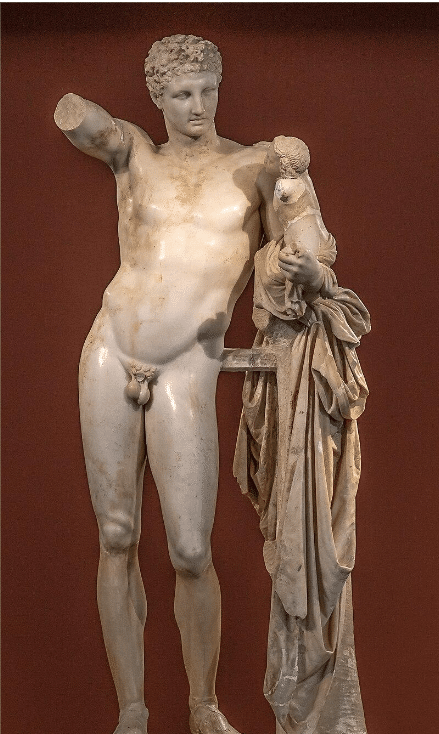
Praxiteles (traditionally attributed to), Hermes and the Infant Dionysus, 4th century B.C., Olympia Museum, Greece
There’s one of MacMonnies’ memorials to “reckless abandon” at the Metropolitan Museum of Art (the original); you’ll find additional versions at the Smithsonian, the Museum of Fine Arts Boston, the Art Institute of Chicago, the Brooklyn Museum, the Indianapolis Museum of Art, the Cleveland Museum of Art, the Museum of Fine Arts Houston, the Museum of Fine Art Virginia, the Boston Public Library, and at the Clark Institute of Art in Williamstown, Mass. That’s a lot of debauchery right there; especially when you consider that the model the artist used was a joyful 19-year-old mother, with and her baby. What could be more natural?
“Her twinkling eyes, joyous mouth, spiraling form, lively silhouette, and richly textured surface combine to produce one of the most vibrant images in American art,” say the 2023 curators of the Met in New York. The sculpture was so celebrated when unveiled at the French Academy in 1894, that the City of Paris wanted to buy it for the Luxembourg Gardens, so MacMonnies made a cast of it just for them.

A bronze of Frederick William MacMonnies’ Bacchante and Infant Faun at the Clark.
The work of art, a life-size nude, was a gift from architect Charles McKim to the trustees of the Boston Public Library, who were happy to accept it as the final touch in the new building’s courtyard garden. (MacMonnies considered the fountain it was supposed to adorn a tribute to his beloved deceased wife). The Neoclassical style in sculpture was common enough at the time.
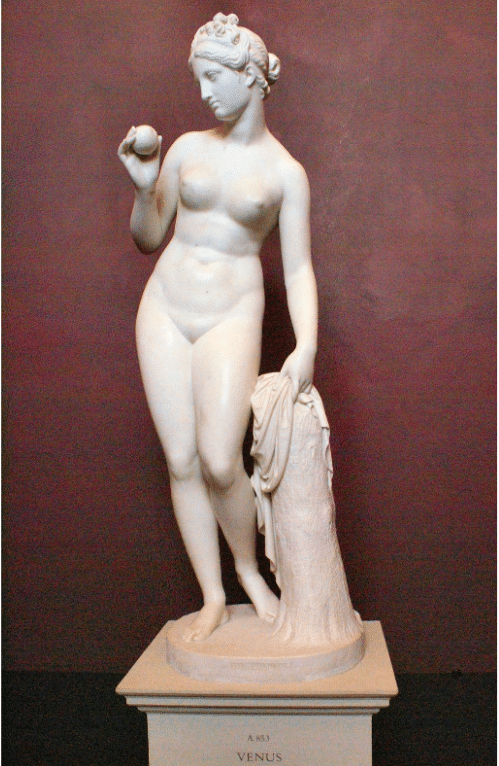
Bertel Thorvaldsen, Venus with the Apple Awarded by Paris, 1874. Perfectly acceptable and, after all, is it all that different from MacMonnies’ Bacchante?
Supporters described MacMonnies’ sculpture as an innocent expression of irrepressible grace and joy. But not so fast! While some praised the Bacchante for its vital image of life ringing with the “spirit of joyousness and spontaneity,” politicians got the women in the Temperance Union up in arms about this dangerous “menace to the commonwealth.” One incensed opponent in a public talk said anyone in support of it was guilty of “treason to purity and sobriety and virtue, and Almighty God.”
Not only was it a symbol of alcohol leading Youth astray; at the heart of the issue, some art historians say, is that the sculpture was not an idealized, classical nude. It was a naked girl, sculpted from life, and that’s different! But other historians say forget it; a conservative faction of the Boston elite felt their cultural dominance was slipping, and policing culture, especially what could and couldn’t be in public art and entertainment, was their way of trying to hold onto their slipping social capital. MacMonnies’ Bacchante was just a scapegoat, a political football, a bystander (or by-dancer) caught in the fray.

MacMonnies’ revenge: A copy of the scandalous Bacchante and Infant Faun installed in the courtyard of the Boston Public Library; I don’t know for sure, but there’s a good bet the Trustees ended up buying this version after cancelling the original, which first came to them as a gift.
After Boston “cancelled” the sculpture, its architect owner, disgusted by the political brouhaha, took it back and donated it to the Met, where no one batted an eye (then or now).

If you are interested in a contemporary approach to the classical nude model in drawing and painting, you may wish to peruse Juliette Aristides’ Secrets of Classical Painting teaching video here.