
Andrew Wyeth (1917-2009), drew inspiration from wells of emotion.
Wyeth called Spindrift (1950) a “portrait” of one of his Maine acquaintances. It’s done in tempera on panel, and the colors are opaque and muted and the surface is matte.
Half in and half out of the water, housing a bucket of freshly harvested oysters, the boat has the feeling of being left momentarily. Hard use has battered the oars, the sea and weather have worn the boat’s paint off, and years of oarlock rust have stained the boards.
Wyeth began to infuse his work with this sort of somber and enigmatic quality that persisted throughout his career following the untimely death of his father at a railroad crossing in 1945. It’s that quality which transforms a seemingly “simple” painting of a boat into a feast for heart and mind.
Because Wyeth painted it horizontally, without much in the way of the linear interest a more dynamic perspective would have provided, the boat seems at once stately and somehow naked – laid bare. If you see it in person, the painting can really make you feel like you’re sneaking a look at somebody’s stuff when they aren’t there.
To the left of the hull we glimpse the silhouette of a swallow in flight, providing a counterpoint of motion to the stationery dory. It seems a minor detail, but in fact the whole painting presents a balance between motion and stillness. The stationary/in motion dichotomy is apropos of a temporarily abandoned object whose owner is absent yet present in the object itself, and soon to return at that.
The overall lack of bright color or dramatic contrast in favor of a somber tonality suggests a possibly symbolic role for the open boat: poised between motion and immobility, the cold grays of the ocean and the warmer grays of the sand, life (the quick-passing swallow) and death (the dour wash of grays, the absence, the wear) cross paths.
Wyeth wrote of it: “Henry Teel would come in from hauling lobster pots about 10:30 in the morning, pull his dory up on the beach, stow his oars and tackle neatly, and go indoors to cook himself a meal. This is a portrait of Henry without showing the man himself: these are all the things he used, shaped by his life and by the sea.”
Wyeth loved objects whose glory lay in the past, things that told him about time, and surviving loss, and about the people whose lives came close to his. He was more emotional than Hopper, investing rural American objects and architecture with the adagio of a minor-key sonata.
He’s a bit like Robert Frost, in that many people find him approachable because he’s a straight-up realist in style and clearly steeped in unpretentious rural American iconography. Yet like Frost’s poems, Wyeth’s paintings are more complex and often, perhaps, darker than many realize.
The Currier Museum in Manchester, New Hampshire, which owns this work, has this to add:
“Painted only a few years after the death of the artist’s father, Wyeth’s image of an empty boat may serve on some level as a memorial to a beloved parent. “Spindrift” is a nautical term describing spray blown from the sea by ocean winds. As a title, its meaning may embody any number of associations. Given the context of his father’s death, it is perhaps evocative of dissolution and the evanescence of life.” All things must pass.
The Untold Story: Wyeth’s November First
The following piece on Wyeth restores text mistakenly omitted as originally published in Inside Art.
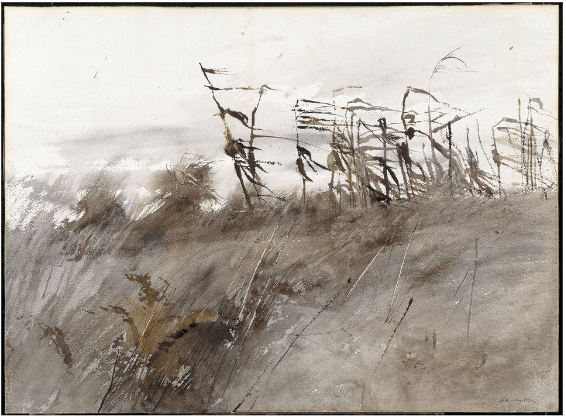
Andrew Wyeth, November First 1950, watercolor on paper mounted on paperboard, 55.2 x 75.4 cm, Smithsonian Museum of American Art
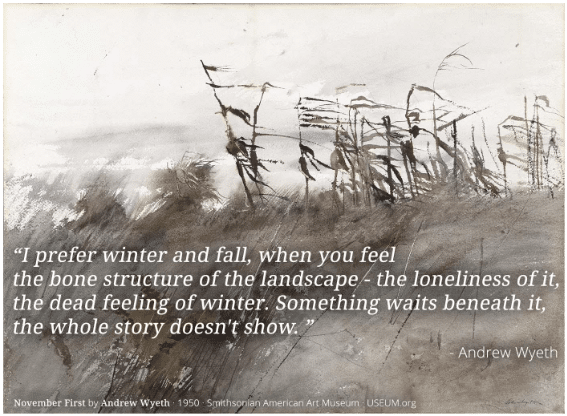
“I prefer winter and fall, when you feel the bone structure of the landscape – the loneliness of it, the dead feeling of winter. Something waits beneath it, the whole story doesn’t show.”
-Andrew Wyeth
What hidden “stories” wait beneath the winter and autumn landscapes Andrew Wyeth loved to paint?
Wyeth’s watercolor November First takes tattered cornstalks swaying in the wind and subtly raises them to the level of visual poetry. A close reading of November First can yield some clues as to how that happens and why it’s a great painting.
It’s not the subject, nor is it the style – it’s the subject combined with the feeling with which Wyeth paints it that raises this painting beyond merely descriptive landscape.
Starting with the composition, the way Wyeth positions the viewer at such a low level below the subject diminishes the human element from the start. The hill’s rise and tilt to one side leaves us staring up at the sharp-edged barbs and spears of the stalks against a bright patch of sky drained of color. Here is where we find the painting’s darkest darks and the starkest contrasts. There’s nothing much else to hold onto – the scene is devoid of any hint of shelter or other manmade elements.
Wyeth left quite a bit of raw, rough-edged patches and lines throughout. Of course, he was capable of the most photo-like realism, but here his brushwork is purposefully rough, rapid, and gestural. Separately from and in concert with the formal qualities of composition, color, etc., Wyeth’s paint handling in November First expresses a feeling for the harsh realities of nature and life. It’s as if the artist is channeling something rather than notating precise details.
The Smithsonian Museum of American Art, which owns the painting, notes that this cornfield was located near Wyeth’s studio in Chadds Ford, PA, behind the house of Dr. Margaret Handy, the pediatrician who cared for Wyeth’s two children. The location in this case is worth mentioning; it’s not hard to imagine Wyeth, worried about his kids, side-eyeing the withered stalks scratching against each other in the wind.
You can’t help, even if only on an unconscious level, to anthropomorphize and translate those cornstalks into figures. If those were people coming over the crest of that hill, what kind of people and what shape do you suppose they’d be in? I think they’d be desperate, lost maybe, clothed in rags, struggling to survive, soldiers perhaps, or refugees.
The contrasts and the constricted palette contribute to that “whole story” – something to do with the inevitable cycles of decay and renewal – that’s never fully told. We all know it though, that feeling of time passing, mortality and new life intertwining, something a parent might feel for a second or two walking a sick child to the family doctor’s door.
If you’re interested in painting winter landscapes in watercolor, you might want to follow along with master painter Sterling Edwards in his video Brushwork Techniques for Expressive Watercolor, in which Sterling focuses on improving your brushwork and getting feeling into a snowy landscape. Watch a four-minute preview here.