The word umber is not related to “hombre,” often heard in old Westerns, as in “that’s one mean hombre,” meaning a tough or shady guy, a dude with a dark side. It sounds like it should be though, because the pigment is an exceptionally shadowy character.
In painting, umber refers to a dusky brown pigment, one of the “earths” (a category that also includes sienna, burnt and raw, yellow and brown ochre, and the noble terre verte, or green earth, used in wall paintings since Roman times). Umbers are made from mineral-rich clay or other ground deposits of one kind or another, particularly iron oxide and manganese oxide, which are found all over the world.
Umber is useful in painting in many different ways. Raw umber was and is a traditional choice for toning a canvas before beginning a painting on top of it. Artists have long used umbers for initial sketches in place of charcoal.
The word is related to the French ombre (as in terre d’ombre), or Italian ombra (as in terra di ombra), both from the Latin umbra meaning “shade” or “shadow.” There’s a region in central Italy called Umbria from which some sources say the material to make the pigment first came (such seems to be the case with Sienna (Italy) about which look for a future post).
Umbria is a region bordering Tuscany known for medieval hill towns, dense forests and local cuisine, particularly foraged truffles and wines. (Hilltop city Perugia, the regional capital, is the site of medieval Palazzo dei Priori, housing the Galleria Nazionale dell’Umbria art museum.) Whatever bright colors they possess, many old master paintings have also a good proportion of earths in the mix, more than you might realize unless you stop and think about it. At first glance this Italian painting in the National Gallery of Umbria appears quite colorful; but look again and you’ll see just how much of it umber has a hand in.
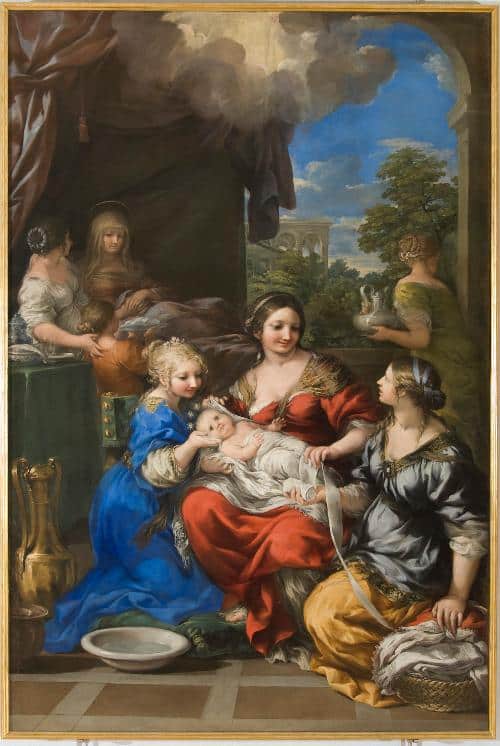
Pietro Berrettini detto Pietro da Cortona, Natività della Vergine, 1673, Galleria Nazionale dell’Umbria
“Brown earth” is about as basic as it gets. It’s been in use since prehistoric times, and it was mentioned in the earliest painting treatises. However, according to the Natural Pigments company (which sells a range of historically accurate and authentic umbers) the name did not appear until the 1500s. Writers of the 17th century mentioned “calcining” it (by roasting or exposing to strong heat) before use, and the term burnt umber entered literature around this time (followed by “raw” umber to distinguish between the original and modified versions). Old masters added umber to their colors to create transitions between lighter and darker shades of a particular hue.
You can add small touches of umber, raw or burnt, to any color to “calm it down,” that is, to knock back the intensity (chroma) of that color’s hue. These days most painters use a color’s complement to do this; it’s an Impressionist trick, whereas the old masters were all about the earths. Either way works! Interestingly, umber and colors it’s mixed with have the property of drying more quickly than others. This can result in an uneven matte/gloss surface when dry, but it’s nothing a layer of varnish won’t even out later.

In this self-portrait by Rembrandt van Rijn (1659). the artist used umber to create rich and complex browns in ground layers, which also had the effect of speeding the drying of his paintings.
Burnt umber lets you create “a darker dark” than raw umber does. Mixing burnt umber with ultramarine blue creates a rich and silky black that’s better than “lamp” or carbon/bone black, because by varying the blue/burnt umber proportion, you control what shade or temperature it is. Added to white, this “ultra-umber” mix makes a range of pretty and very useful grays that run the gamut from cool (bluish) to neutral to warm (a bit more on the reddish brown side).
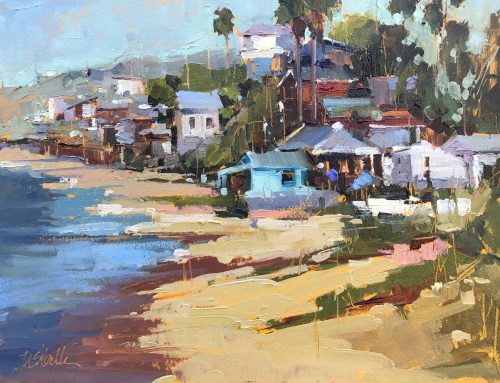
It’s a very easy way to mix your own blacks, and the mix is a miracle-worker for the wet sand and shadows of seascapes as well.

Contemporary tonalist seascape painted entirely with burnt umber, ultramarine blue, and titanium white
Watch: Artist Sharon Sprung on the TODAY Show

As part of Women’s History Month, NBC’s Sheinelle Jones recently did a segment with contemporary artist Sharon Sprung.
“I had a wonderful time speaking with her about my portraits of trailblazing women leaders in American history,” Sprung said.
Watch “Artist Sharon Sprung on sharing life lessons through her paintings” here. “Artist Sharon Sprung paints portraits of important women in American history, including former first lady Michelle Obama. She sits down with TODAY’s Sheinelle Jones about using her craft to share stories of life lessons.”

In September ’22, we featured Sprung when her portrait painting of Michelle Obama was unveiled at the White House along with Robert McCurdy’s portrait of President Barack Obama. Read the story and watch the CBS footage of the unveiling here.