Prior to the latter half of the nineteenth century, the “official” academic channels of professional painting considered still life to be at the bottom of the totem pole. It didn’t have the heroic content of history painting, the dignity of portraiture, or the classical pedigree of mythological subject matter. Only gradually did still life painting come to be considered fully “legit.”
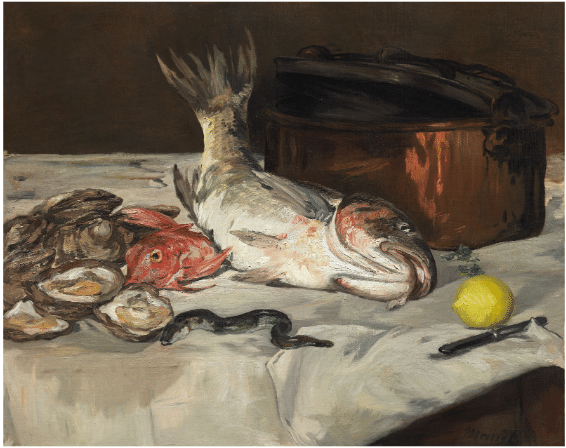
Manet’s “Fish” (above) from 1864 like many period still-life compositions, Manet’s fish owes a debt to 17th century Dutch models.
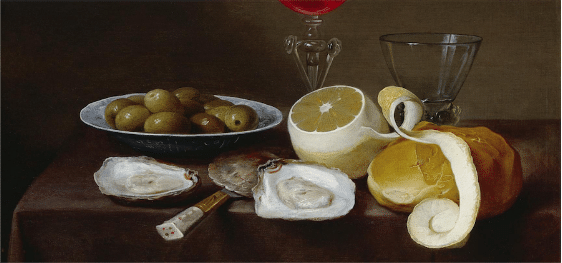
From a 17th century Dutch still life.
Ah, but how different the two paintings feel when you consider them side by side! In Manet, “the directness of execution, bold brushwork, and immediacy of vision displayed in the canvas,” says the Chicago Institute of Art which owns the picture, “suggest why the public found Manet’s work so unorthodox and confrontational.”
“…While “Fish” is indeed an image of “dead nature” (nature morte is the French term for still life), there is nothing still about the work: the produce seems fresh and the handling of paint vigorous. Further enlivening the composition is the placement of the carp, which offsets the strong diagonal of the other elements. Manet never submitted his still lifes to the official French Salon but rather sold them through the burgeoning network of art galleries in Paris and gave them to friends.”
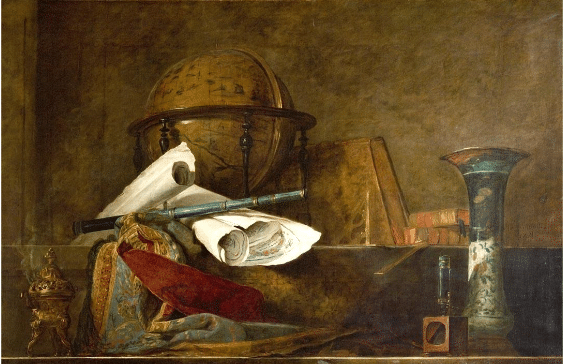
Jean Siméon Chardin, The Attributes of Exploration (1731), oil on canvas, 141 x 219 cm
Manet, like many of his century, also owed something to 18th century French painter Jean Siméon Chardin. Renowned in his lifetime and by generations of artists who came after, Jean Siméon Chardin was primarily a painter of scenes from everyday life. But his approach to the still life, and its influence on 19th century French artist and admirers such as Henri Fantin-Latour (and later Manet and Cezanne) continues to win him his admirers in our own time.
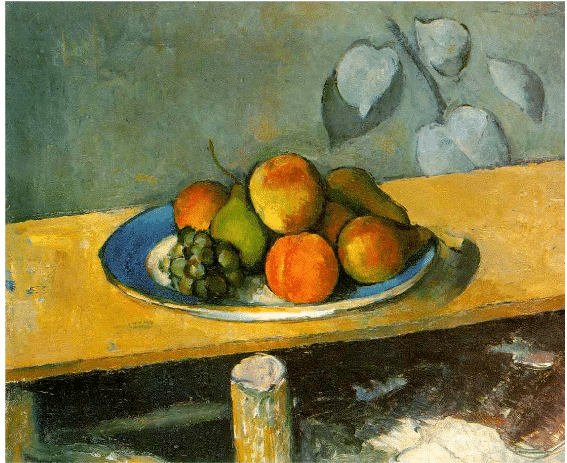
Paul Cezanne, Apples, Peaches, Pears and Grapes, 1879-80.
Cezanne’s still lifes combine bold color, a tilted, ambiguous picture plane, and multiple viewpoints in the same painting (which is as totally radical today as it was then).
Chardin’s still life paintings, though not wholly groundbreaking, both followed and departed from the work of the Dutch masters. Those earlier painters loaded their compositions with symbols and suggestions of the personal attributes of their patrons (mostly related to wealth and commerce) as well as larger philosophical themes and allegories related to religion, history, sexuality, human mortality, and the afterlife. Chardin used allegory sometimes too, but he also contentedly put symbolism aside and simply set a mood.
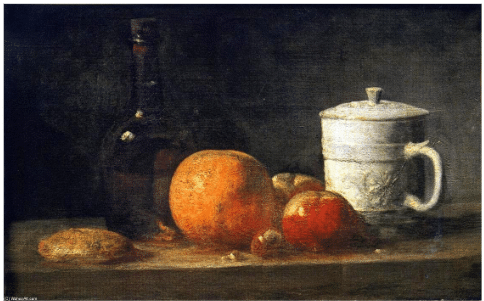
Jean Siméon Chardin, Still Life with Ceramic Tankard, c. 1740
Chardin, like Fantin-Latour after him, often chose vignette-like groupings and contrasted his subjects, lit brightly by a strong directional light, with darkened backgrounds that made them shine with an unexpected radiance.
These depictions of oranges and peaches, cups, knives, and porcelain tableware, opened the way for subject matter consisting of simple, uncomplicated (non-allegorical) arrangements of common, ordinary objects raised to a higher level.
Art historians have described both Chardin’s and Latour’s reverent treatment of the objects and their presentation in their compositions as akin to religious painting.
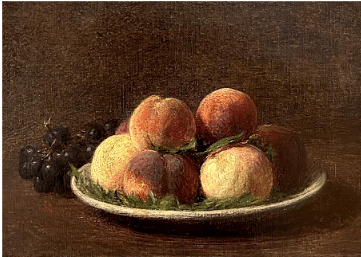
Henri Fantin-Latour, Still Life with Plate of Peaches, 1899
Yet, Chardin’s most famous still life is The Ray, a strictly naturalistic piece that was the young artist’s entrée to the Paris Salon. It’s a strange image – a partly cut-open skate hangs on a kitchen hook while a (presumably hungry) cat with a sort of demonic smile bristles at a dead fish.
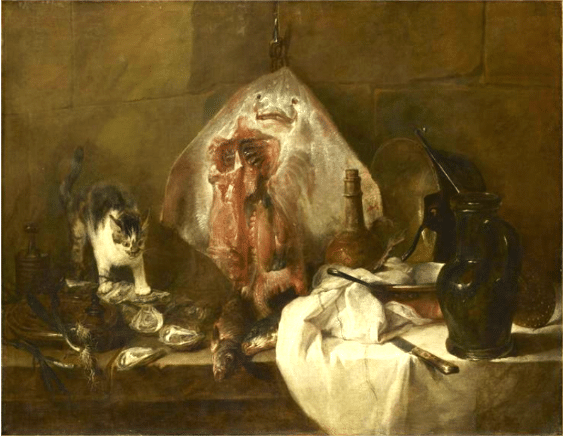
Jean Siméon Chardin, The Ray (1727), oil on canvas, 114.5 x 146 cm., Louvre
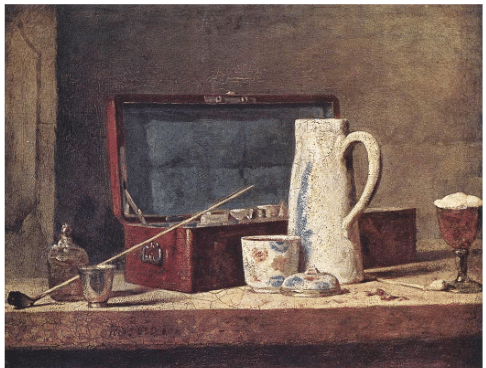
Chardin still life with pitcher, c. 1750
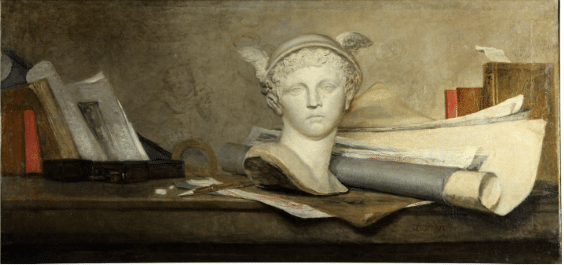
Jean Siméon Chardin, Still Life with Attributes of the Arts, c. 1750
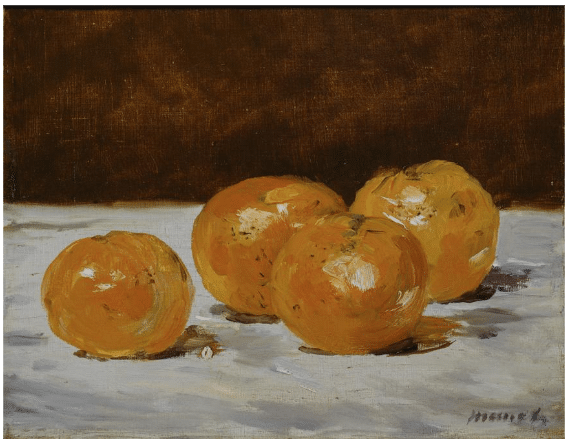
Eduard Manet, Four Mandaring Oranges, 1882
Manet painted still life works at a time when the genre was gradually being accepted due in part to the growth of a new middle class, whose tastes ran to intimate, moderately priced works. With Manet and after, we have arrived at the modern still life.
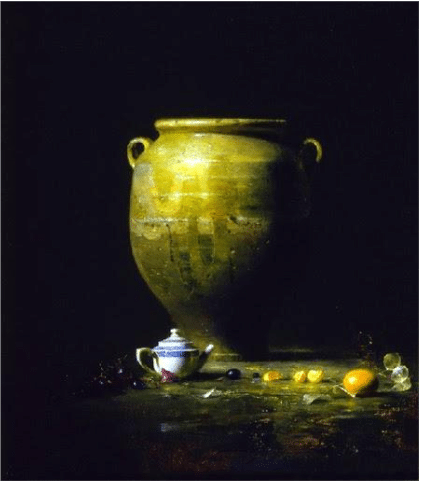
David Leffel still life (c. 1990s)
David Leffel’s revered still life paintings link up with this tradition. You can learn from David how to capture the drama of classical still life painting, here.
There’s a wide range of contemporary still painting approaches, of course, and the Streamline video library has over a dozen different videos in as many styles, all of which you can view here.