
By John Hughes
The answer to that question is design, but that doesn’t mean that the details aren’t important also. Details tend to have more or less importance, depending on the artistic sensibilities of different artists. There is really no right or wrong answer, but the details can certainly be overdone and paintings like that are easy to spot, if one has an eye for design. It’s not difficult to cross the line into “too much detail”, especially when those extra details do nothing to enhance the overall design of a painting. In all actuality the details are part of the design, so pitting these two against each other is really a non-starter in the first place.
The reason the question even comes up is because I have often been asked by painting students, something to the effect of: “What about the details?” Well, I usually try to explain that the details have a different level of importance to different artists. Some will opt for a lot of detail, while others will minimize the details of a scene, to practically none at all. So as the old saying goes–The devil is in the details! And in the case of painting, they can occupy too much of our focus, or not enough, and that can be a bad thing.
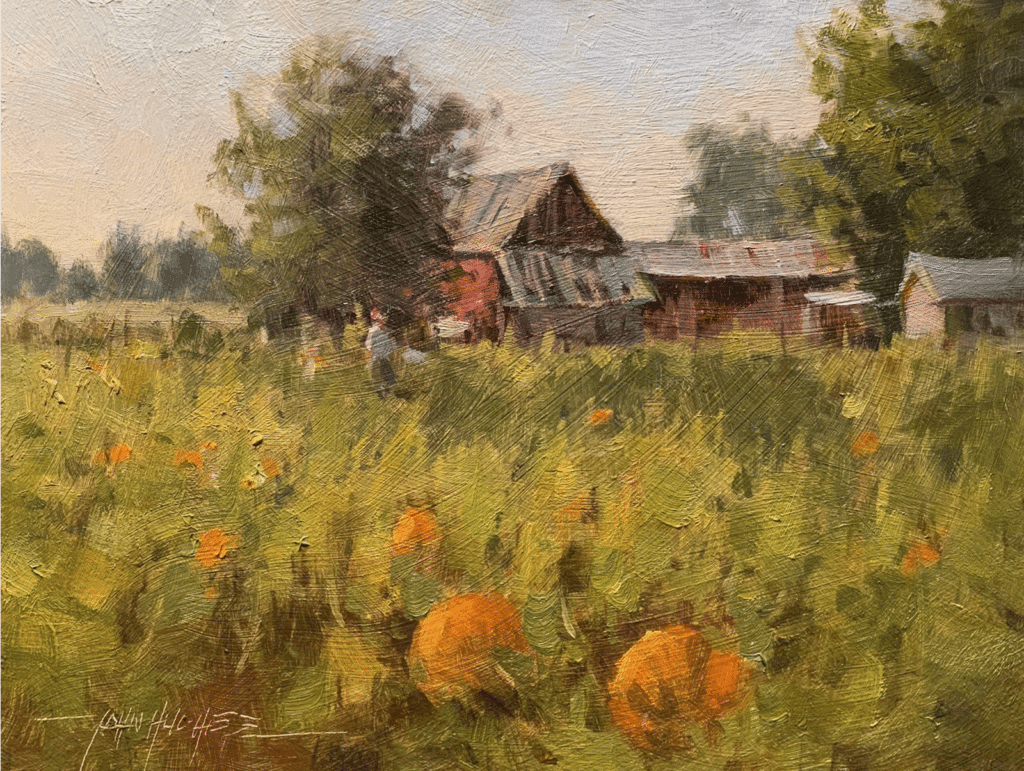
John Hughes, Dibble Farm, oil, 9×12 inches
I think details can be an impediment, which gets in the way of seeing the design possibilities of a scene, if we are not all careful! It’s easy to become seduced by the details of a certain view, to the detriment of a simplified design! For that reason alone it would be wise to forget about the details and concentrate on arranging a motif into an interesting pattern of lights, mid-tones and darks, before getting too far into the weeds of interesting enhancements. In this way, the details will be integrated into the design without there being any confusion about which is more important. An easy way to keep this idea in perspective is (SDSD), which stands for Simplified Design, Selective Details.
The order of these two principles is as instructive as the messages which they convey. When you first arrive on the site of your next painting, if you keep this in mind you will be able to concentrate your efforts on the important things first and rely on your taste as an artist to selectively put in embellishments to the design, in the form of details. When you do get to the details you will be much more in tune with the proposition of; how much is too much, and how much is too little? This is because you will be thinking about the all-important design possibilities right from the start.
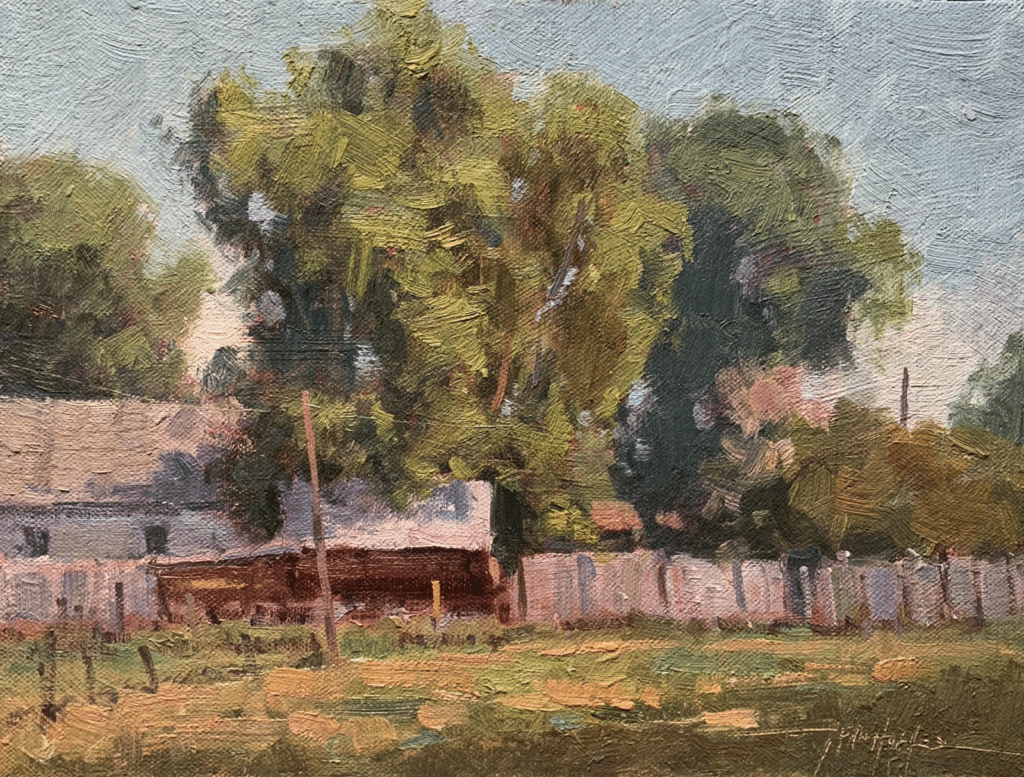
John Hughes, Spring City Morning, oil, 9×12
Every painting, like good writing, should have a beginning, middle and an end. It’s also been said that painting a canvas is a lot like building a house; first comes the foundation, then the framing, the plumbing electrical and drywall, before any of the enhancements such as cabinets, molding, paint and carpeting are installed. The reason for this is obvious, but what are the first things a potential buyer usually sees and is also smitten by? Right, the last items on the list!
Painters, in this sense can be just like home buyers if they are not careful. Getting derailed by the details of your scene first, and being overly concerned about those things, before the possibilities of design enter your mind, is a prescription for disaster! So keep the order of importance in mind at all times (SDSD), and you will be in a good position to execute an effective landscape, which is built on a beginning, middle and end.
If you’d like to fast-track your understanding of design in painting, check out Mary Garrish’s video, 6 Elements of Design. Mary’s video workshop shows how to start with a strong foundation and how to learn to use line, shape, value, color, edges, and texture to create your best paintings yet.
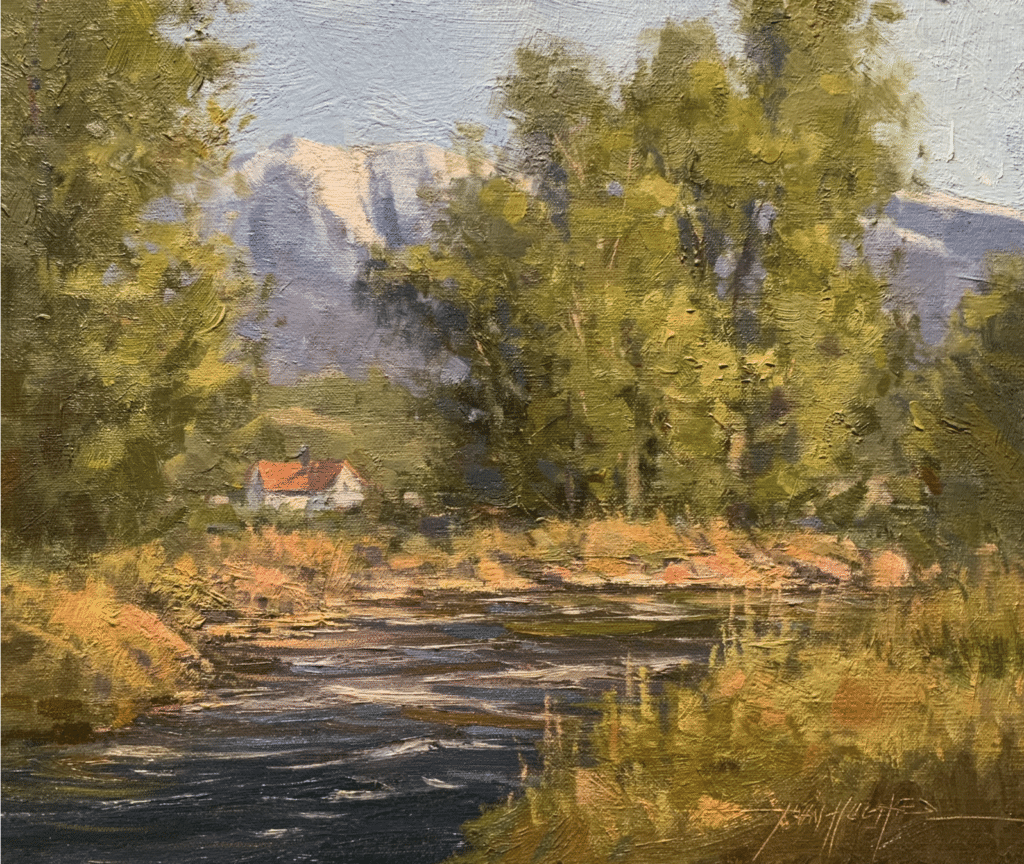
John Hughes, Spring on the Provo, oil, 10×11 inches
For Paco Martín, Fame Grows like a Vine

Paco Martín, “The Dance of the Leaves,” colored pencil, 39.5 x 29.5 in.
Colored pencil realist Paco Martin has won Third Place Overall in the February Plein Air Salon.
Paco Martín has been passionate about colored pencils since the time he was in Elementary School in Madrid, Spain. He kept his passion alive during his school years and through College, even when he pursued a Bachelor’s degree in Forestry Engineering and later a Master’s Degree in Renewable Energy. Despite his immersion in Mathematics, Physics, and Chemistry, he still found time for his colored pencil artwork as well as music and guitar playing, which is his second passion. Martin has been making a name for himself as a highly skilled realist in Madrid, Spain, and exhibiting work in the United States, Canada, Germany, and the UK.
The Plein Air Salon offers a monthly First Place cash prize, plus all winners will be entered into the judging for the annual cash prizes, including the $15,000 grand prize for the best painting of the year, and they’ll see their painting on the cover of PleinAir Magazine. Could you be the next winner? Read up about it here.