
There’s a surprising story behind Monet’s Poplars series.
Not that he was some sort of all-powerful art god or something (spoiler: he was), but Claude Monet once diverted a branch of the Epte River. Though it sounds like something only heroes like Hercules can generally be found doing, diverting rivers was just the kind of thing Monet did when he wanted to paint something.
In 1893, Monet acquired land at the bottom of Clos Normand, where the River Epte (pronounced ɛpt) empties into the Seine at Giverny. By digging and thus moving the Ru, a smaller branch of the Epte, he created the pond that rather efficiently became his famous water garden with its lilies and Japanese footbridge.
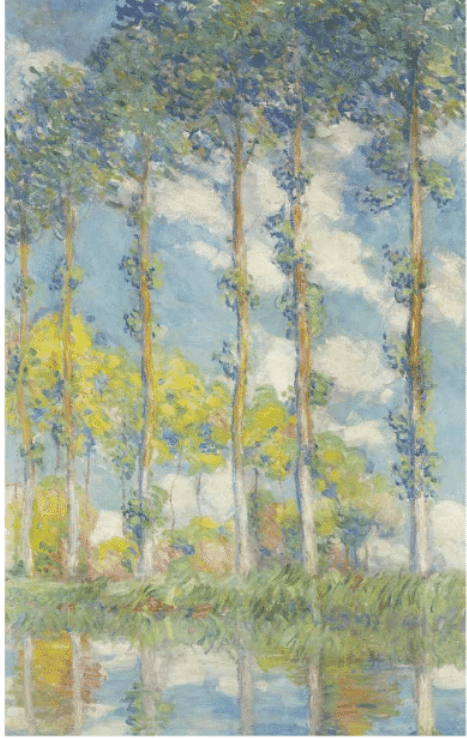
Claude Monet. Les peupliers. Huile sur toile. 116,2 × 72,2 cm, 1891
In this way, the artist made faraway things he liked to paint come to him, avoiding the inconvenience of traveling halfway round the world to paint them. That garden, of course, now winks from the walls of the world’s greatest museums.
The river itself (the Epte) also appears in a number of Monet’s works, most notably in his gorgeous series of poplar trees, the title of which is often given as some variation of Peupliers au bord de l’Epte.
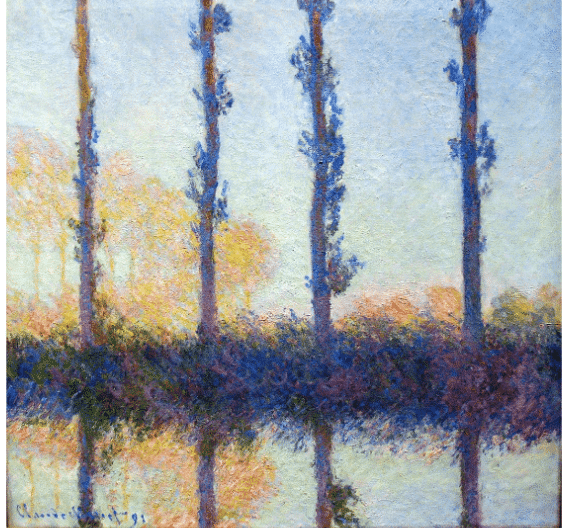
Claude Monet, The Four Trees, (Four Poplars on the Banks of the Epte River near Giverny, 1891, Metropolitan Museum of Art.
Monet painted the Poplars series in 1891 and 92. He’d painted the tree before, in Meadow with Poplars painted in 1875. He did another one, titled Poplars in the Sun, in 1887 (shown below). These early paintings are not part of the Poplars series, but they might have, um, seeded the idea.
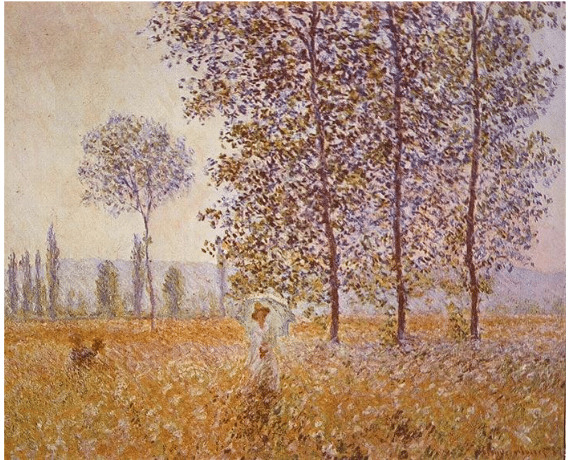
Claude Monet, Poplars in the Sun, 1887
Apparently, Monet was at work on three paintings with different compositions of the same trees (in the end, there were at least 23 paintings in all) when he learned the trees were going to be cut down. So, he did what any self-respecting art god would do – he bought them.
Monet made most of the Poplars paintings in the summer and fall of 1891. He saw them while rowing toward the “floating studio” he kept moored further up river. They stood single file along an “s-curve” in the Epte, and you just have to look at the paintings to see why he fell hard for them.
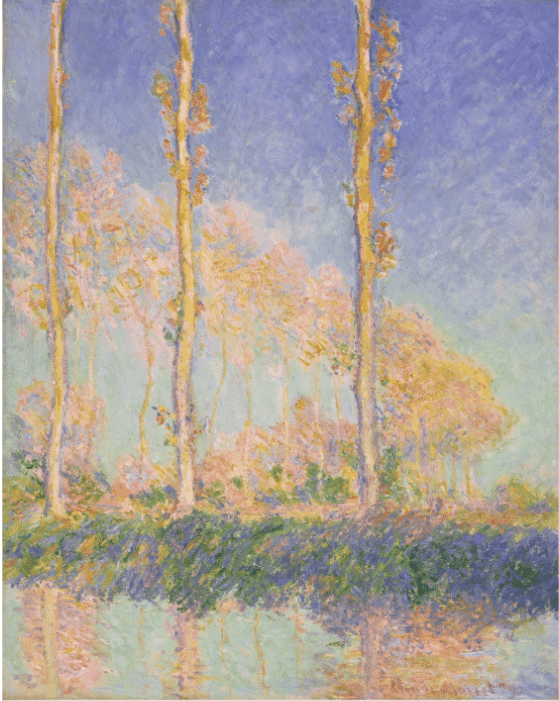
Claude Monet, Three Poplar Trees, 1891 (height: 92 cm (36.2 in); width: 73 cm (28.7 in). Philadelphia Museum of Art.
The trees, which belonged to the commune of Limetz, were indeed auctioned off for lumber. Monet therefore was forced into buying the trees to keep them standing long enough to finish painting them. Once he’d completed the series, he sold the trees back to the lumber merchant who wanted them.
Thus the world still has that graceful, elliptical geometry of light, leaf, breeze and branch, and we have one very determined, and very successful, never-say-die painter to thank for it.
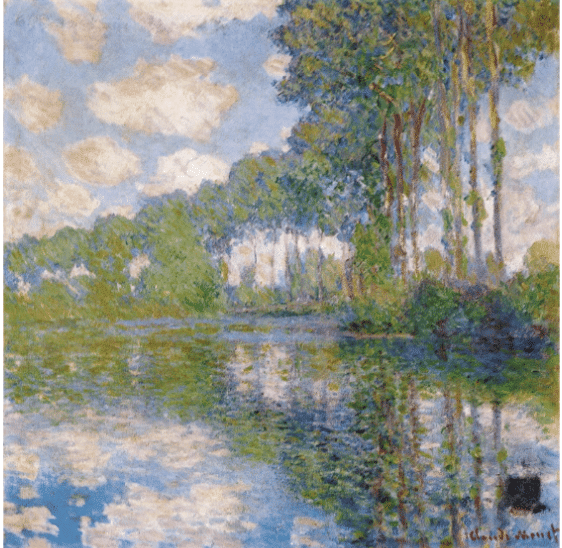
Claude Monet, Poplars on the Epte, 1900, Nat’l Gallery Scotland
It’s often said that the series may depict poplars, but it’s really about light and color and the relationships between them. The poplars were merely the vehicle for Monet to explore these elements.
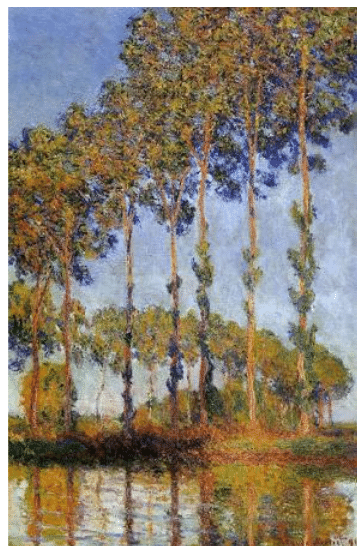
Claude Monet, A Row of Poplars, 1891-2
But if that’s true, why didn’t he just pick some random bushes or a field full of haystacks? Oh wait – he did. The “Poplars” series falls between Monet’s “Haystacks” series and his many paintings, at different times of the day and evening, of Rouen Cathedral. There’s a wide divide between a haystack and a cathedral; maybe the trees formed a halfway bridge between the humble natural form of the rural and the soaring architecture of the urban Gothic.
Personally, I find it hard to believe the trees meant so little to him as a subject. After all, he was willing to shell out for them just to keep looking at and painting them. There’s an undying charm and elegance, a special beauty to these Poplar paintings that academic concerns like how a subject looks different in different light will never, thank goodness, be able to explain.
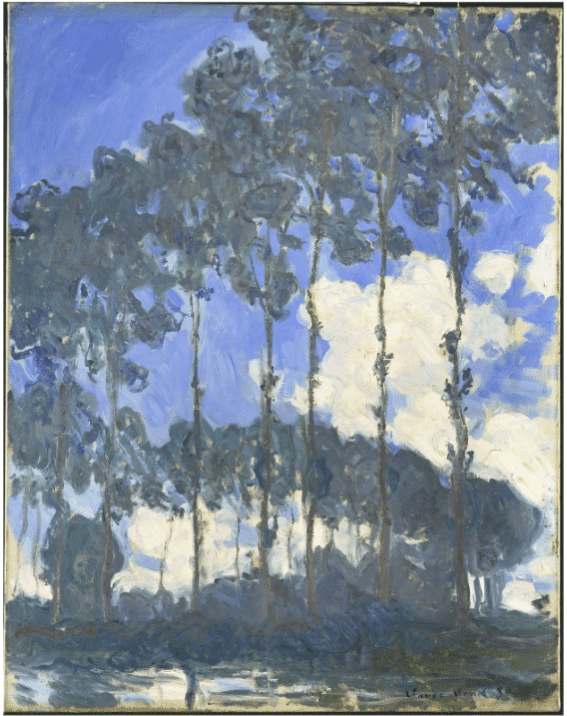
Claude Monet, Peupliers au bord de l’Epte, 1891.
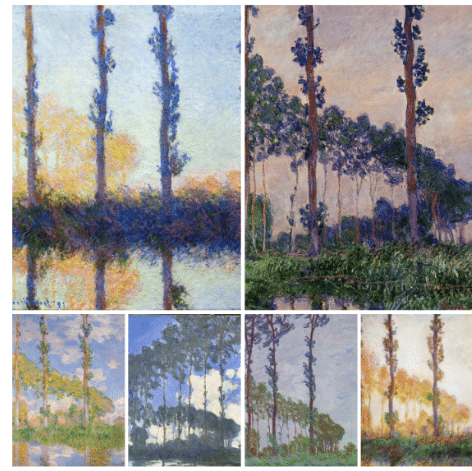
In 2015, the National Gallery in London exhibited five paintings from the series, together for the first time in a single room. The paintings were also shown at The Philadelphia Museum of Art when the exhibition traveled from London to the United States, where people stood in long lines to see them.
Why do you think Monet was so crazy about these trees?

Poplars (Wind effect), 1891, height: 100 cm (39.3 in); width: 73.5 cm (28.9 in)
If there’s a certain stand of trees that’s got a special place in your heart, you may want to learn how the pros put them on canvas. If so, check out this video on mastering trees by Paul Kratter.