For more than 50 years, Walt Gonske has been painting the same churches. The same adobe walls, bleached by New Mexico’s high-desert sun. The same weathered cemeteries, scattered with wooden crosses, statues of the Virgin Mary, and bursts of plastic flowers left by families who buried their dead there. And yet, he says, he has never painted the same painting twice.
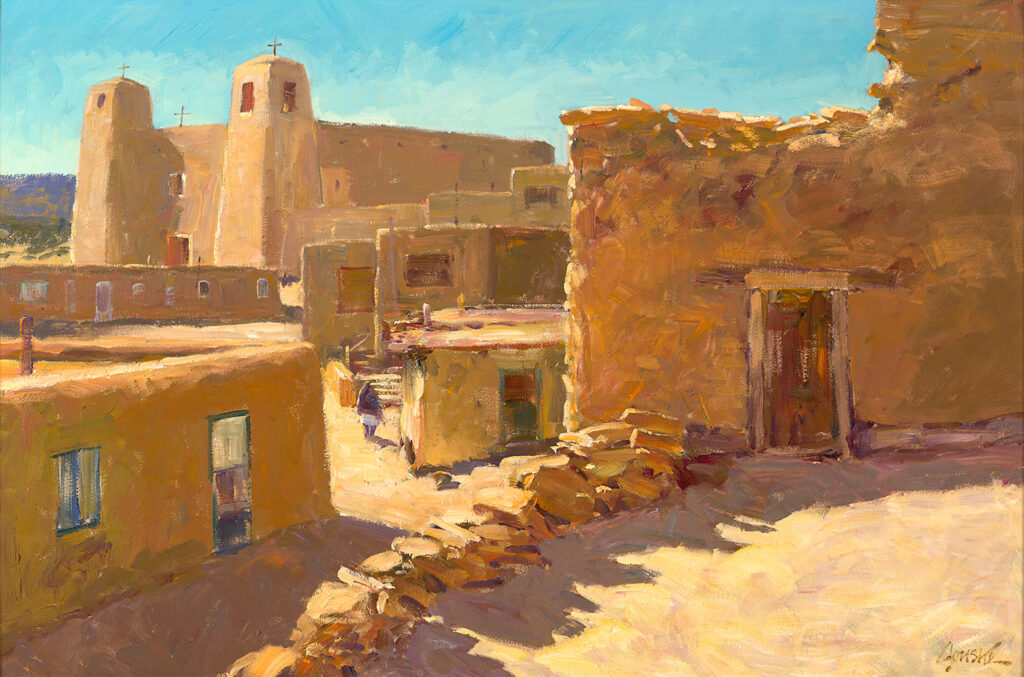
“Sky City – Old Acoma Pueblo” (n.d., oil on linen, 24 x 36 in.)
FROM NEW YORK TO NEW MEXICO
Gonske didn’t grow up anywhere near Taos. He trained as a commercial illustrator in New York before a visit to his sister in Taos Ski Valley changed the course of his life. By 1972, he’d moved west for good, chasing a landscape and a light he couldn’t find anywhere else.
Early on, he painted the way he’d been trained: carefully, methodically, working toward a predetermined result. The paintings were technically sound — and emotionally flat. “It didn’t have the emotional impact I felt when I was first out there,” he says. The fix wasn’t technique. It was intention. He stopped recording what he saw and started responding to what he felt, pushing color and value past observation and into feeling.
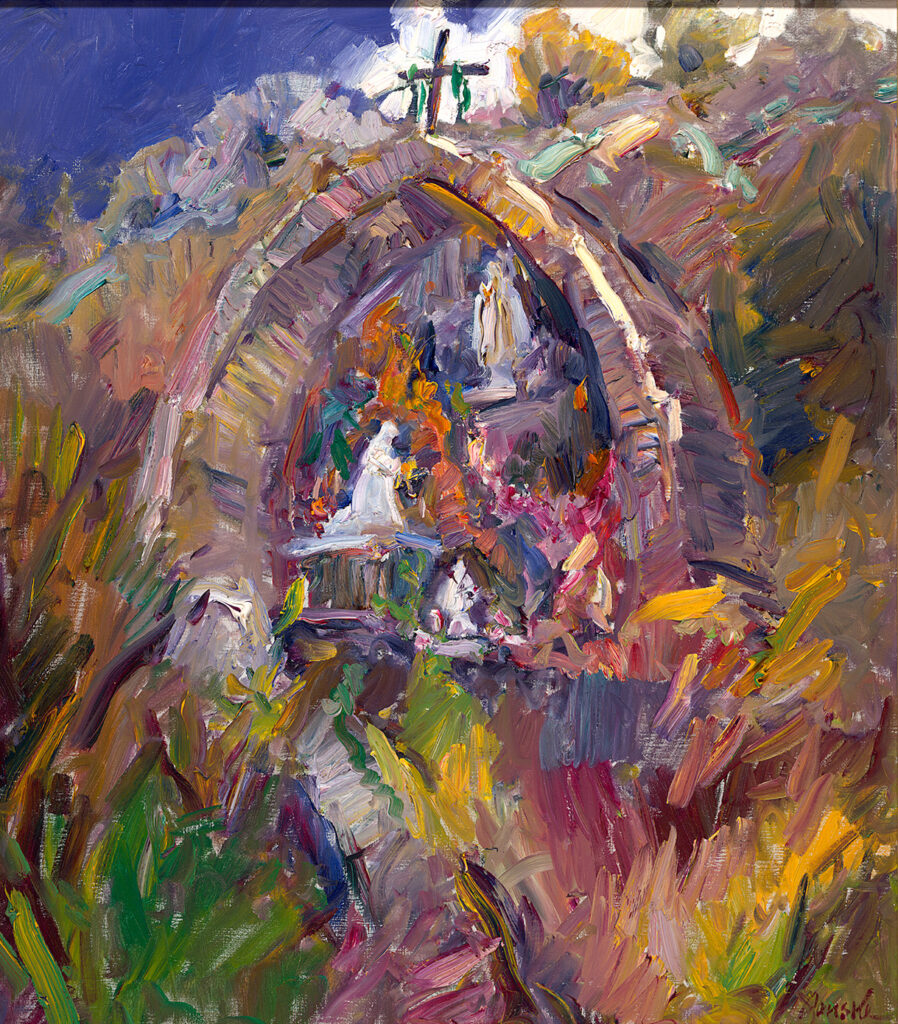
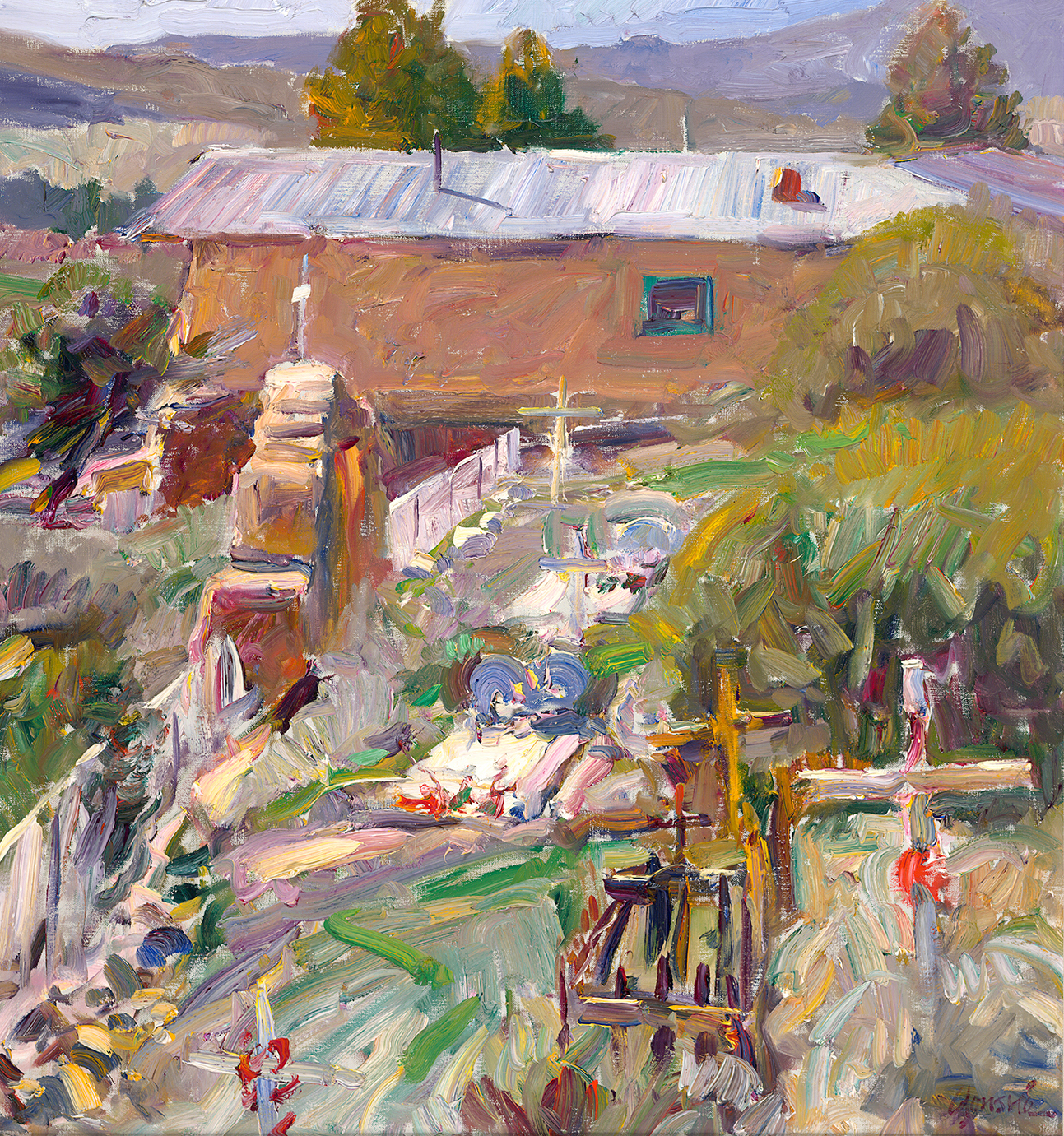
“Shrine Overlooking Los Ojos” (n.d., oil on linen, 34 x 30 in.)
The churches of northern New Mexico gave him endless material for that pursuit — thick-walled sanctuaries that seem to belong to the landscape as organically as a rock formation. The cemeteries surrounding them, he discovered almost by accident (after a friend’s painting of one caught his eye), turned out to be just as rich: vivid, personal, full of human story.
Gonske paints it all from his fourth custom-built “paintmobile,” a mobile studio on a Ford truck chassis that lets him complete large, fully resolved paintings in a single outdoor session. He’s carried that same direct, fast, feeling-first approach to churches in South America, proving the method travels.
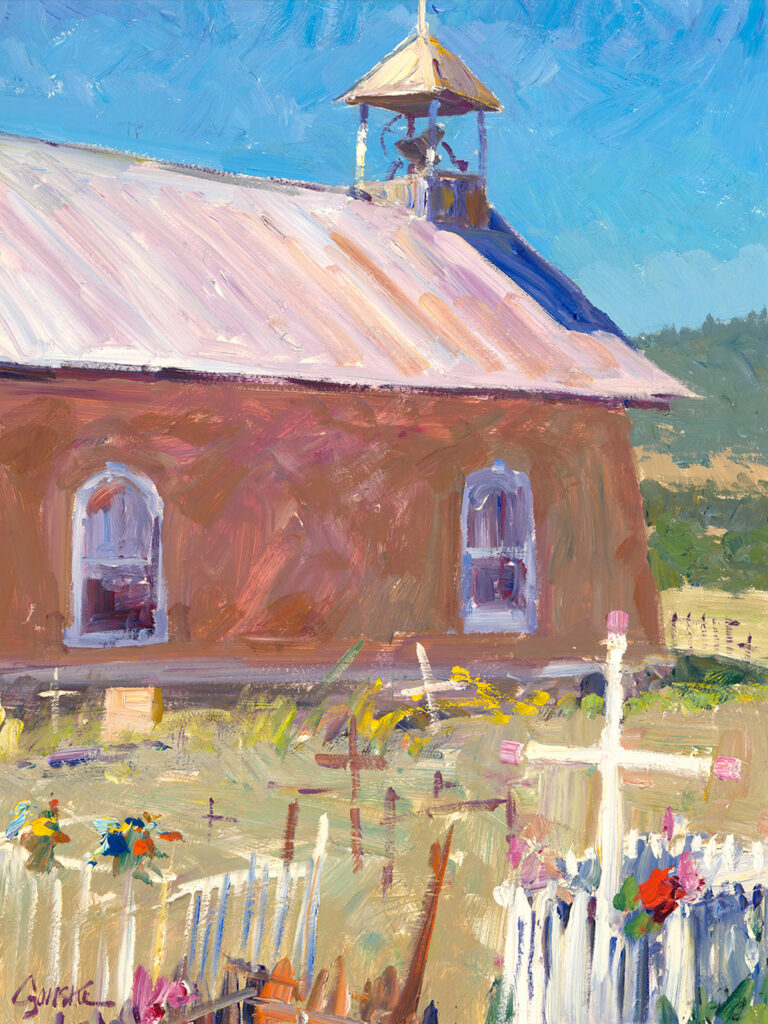
“The Llano Church” (n.d., oil on panel, 24 x 18 in.)
FROM THE TAOS SOCIETY TO THE TAOS SIX
Gonske’s place in the Southwestern painting tradition is well established and hard-won — and it is a tradition with deep roots. In September of 1898, artist Bert Phillips turned to his fellow painter Ernest Blumenschein and said: “For heaven’s sake, tell people what we have found! Send some artists out here. There is a lifetime’s work for 20 men.” By 1915, six of those artists had formed the Taos Society of Artists and forever changed the trajectory of Southwestern art.
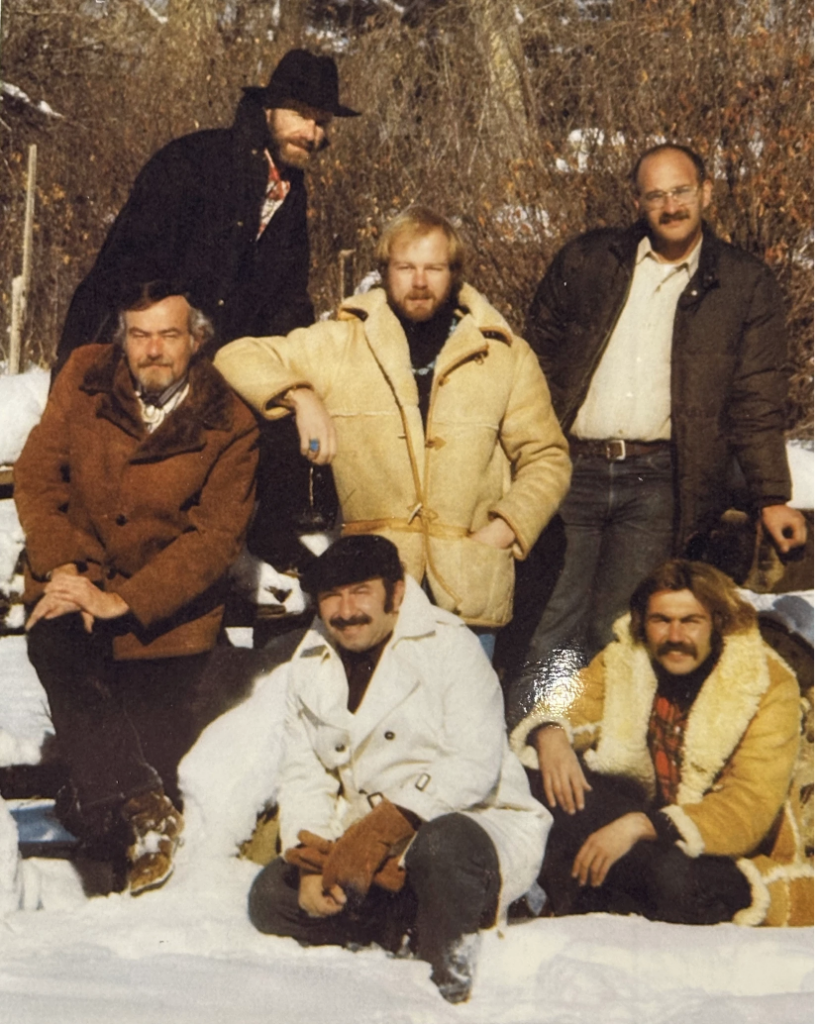
The Taos Six: (left to right, standing) Julian Robles, Rod Goebel, Ron Barsano; (left to right, sitting) Robert Daughters, Ray Vinella, Walt Gonske.
More than half a century later, history repeated itself. When Gonske arrived in Taos in the early ’70s, the regional art scene had lost some of its earlier momentum — and a new generation of painters set out to reclaim it. As a founding member of The Taos Six — alongside Rod Goebel, Ray Vinella, Ron Barsano, Robert Daughters, and Julian Robles — Gonske was part of a deliberate effort to assert the vitality and seriousness of contemporary Taos painting, carrying forward the spirit of those original six artists who had recognized that this landscape was unlike any other on earth. Decades later, he still steers the paintmobile down the same back roads, stops at the same churches, and — every time — has no idea what the painting will become before he starts. For Gonske, that’s not uncertainty. It’s the whole point.
“Light and Glory: The Art of Walt Gonske” — a survey of the artist’s Church Series, including New Mexican church façades, rural cemeteries, and paintings from his travels in South America — is on display this month at Nedra Matteucci Galleries in Santa Fe.