“Nothing is stronger than nature. With nature in front of us we can do everything well.” (Joaquin Sorolla)
Despite living far from the ocean, Spanish realist Joaquín Sorolla y Bastida (known colloquially as “Sorolla,” which is pronounced suh-ROY-ya) surely had saltwater running through his veins.
Much like his contemporary John Singer Sargent (with whom American readers may be more familiar) Sorolla (1863-1923) drew inspiration from his own open and alive response to the observable world around him. Color, light, shape, and movement fill his freshly composed canvases, especially in his many paintings of the sea and the people he watched both relaxing and working for a living by its waves.
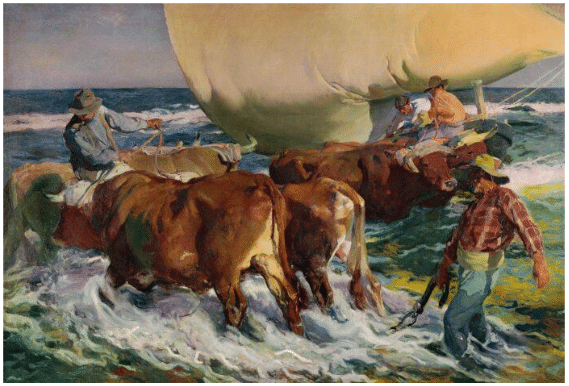
Joaquín Sorolla y Bastida, “Beaching the Boat (Afternoon Light),” 1903, oil on canvas, 117 7/16 x 173 7/16 in., Hispanic Society of America, New York City
Think about how monotonous a series of paintings of the same small stretch of seaside could have been. In defiance, Sorolla’s paintings, generally cheerful, convey a far larger sense of life beyond their limited and humble subject matter, something any open-minded viewer can relate to. As James Joyce once remarked: ‘In the particular is contained the universal.’
Sorolla grew up in the bustling coastal city of Valencia and returned there often from his home in Madrid. There he drew inspiration from the Mediterranean air and light, painting women and children on the beach and fishermen and their families hard at work.

Joaquin Sorolla, Sewing the Sail (1896) (Not part of the Norton exhibition)
Revered for his unique blend of realism and modernism, replete with unmixed colors and vigorous brushwork, Sorolla was hailed by no less a contemporary than Claude Monet as “The Master of Light.” The French critic Henri Rochefort observed: ‘I do not know any brush that contains as much sun.’
Sorolla’s breezy, sunlit paintings of the sea are the subject of an exhibition at the Norton Museum of Art in West Palm Beach, Florida running through March 16, 2025. The Norton Museum is the only U.S. venue of the exhibition “Sorolla and the Sea,” which has been organized for it by the Hispanic Society Museum & Library (New York City). In addition to examples of the full range of Sorolla’s paintings of the sea, the museum will exhibit paintings by Monet and Sargent from its permanent collection.

Sorolla, After the Bath, 1908. On view at the Norton Museum.

Sorolla, Fishing Boats, 1910, oil, 33×21 cm. (Not on view at the Norton)
Look at the huge puffed-up sail in “Beaching the Boat” (top of page) or “Fishing Boats” (directly above) – how all the angles relate to each other and to everything else – how boldly the sail fills the space. In that sail’s powerful burst, all the gusty energy of the ocean itself gathers and billows.

Sorolla, “The White Boat, Java,” 1905 (also not in the Norton exhibition)
All of these “dynamics” we’ve been studying here will work to enliven any painting, and the underlying principles are universal:
- catch the eye from across the room,
- “move the eye through the painting” in a way that discourages the viewer from looking away, and
- maximize variety throughout.
And yet – beyond the technical aspects, the elements of painting, including composition, contribute to meaning as well. Sorolla’s sea paintings express a spontaneous feeling for air and light as well as, at times, a sense of the larger forces at work – the compressed, mighty energies where ocean, sky, and humanity meet. For me, that beautiful insight is makes them great.
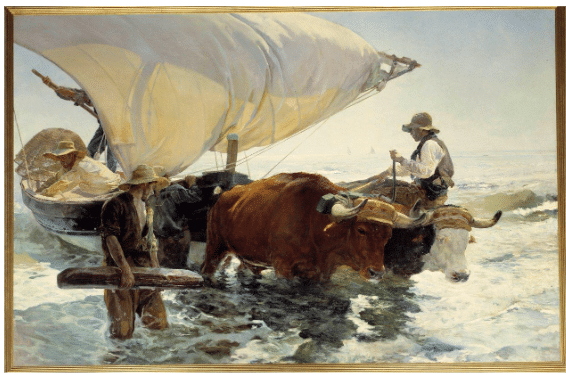
Sorolla, “Returning from Fishing, Towing the Boat” (also not at the Norton)
The way Joaquín Sorolla mastered the color of light is something many artists dream of doing, yet never quite pull off. One person who has mastered it is Thomas Jefferson Kitts — a modern master in the color who teaches how to paint like Sorolla with this art video workshop, “Sorolla: Painting the Color of Light.”
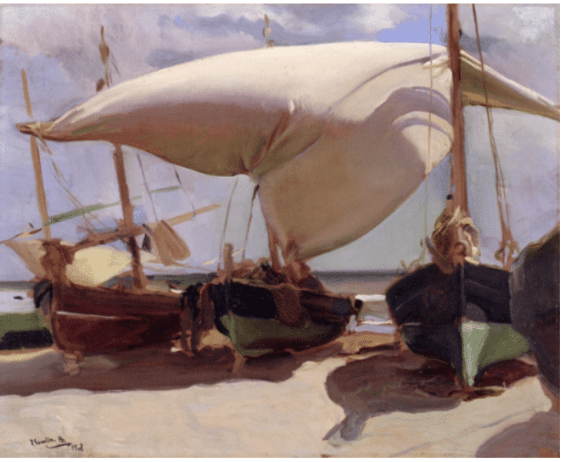
Joaquín Sorolla y Bastida, “Beach of Valencia (Boats) (Barcas, Playa de Valencia),” 1908. Oil on canvas, 18 7/8 x 23 1/4 in. (48 x 59 cm). Collection of Debbie Turner. Photo: Personal Archive, Blanca Pons-Sorolla, Madrid.

Sorolla, The Rocks of Java