Science tells us what’s “objectively real.” However it has little or nothing to say to us about what anything actually feels like or means to us.
“It would be possible to describe everything scientifically, but it would make no sense,” Albert Einstein pointed out. “It would be without meaning, as if you described a Beethoven symphony as a variation of wave pressure.”
Although we think of him as the quintessential scientist, Einstein passionately celebrated imagination and creativity of all kinds. He championed the idea that while things like music or emotions (like love for a spectacular work of art, for example) can be “described” in scientific terms (as wavelengths or as electro-chemical impulses in the brain, for example), to do so misses the point.

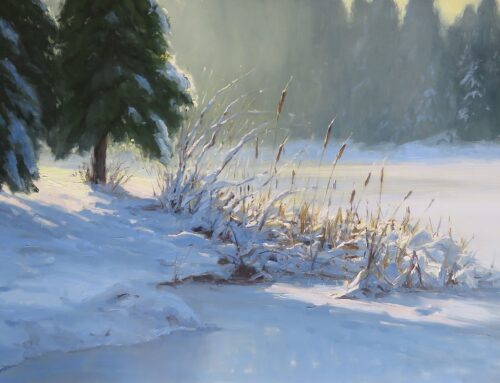
Joseph McGurl, 8×12, oil on panel, plein air sketch painted on Nashawena Island off of Cape Cod.
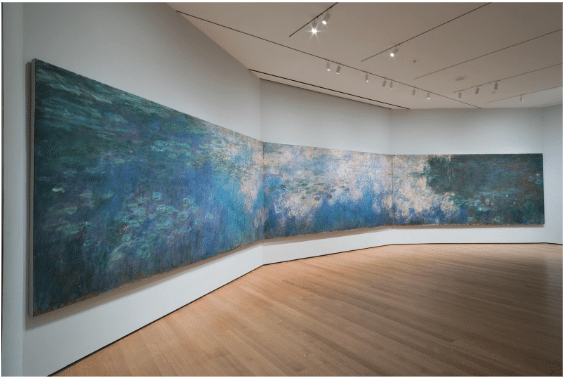
An oil painting is composed of granular chemicals, minerals, and organic compounds suspended in an oily solution more or less systematically arranged on a stabilized fibrous substrate. And that says absolutely nothing about Monet’s Waterlilies (or a Joseph McGurl’s landscapes, or the entire history of art since time began, for that matter).
Through processes even science cannot explain, consciousness assembles the result of their arrangements into a powerful emotional-psychological bio-mental response. And on it goes. “Imagination is more important than knowledge,” Einstein said. “Knowledge is limited. Imagination encircles the world.” And yet, without those chemicals, the pigments and processes available to Monet and the Impressionists wouldn’t have existed, let alone the vast spectrum of hues and mediums available to artists today.

Monet’s “Waterlilies” panels at the Museum of Modern Art, NYC.
Sight perceives Monet’s “Waterlilies” through the arrangement of rods and cones in the eye via electrochemical impulses transferred to the brain by the optic nerve. We know this because scientists have proved it to be true. Doctors use this knowledge to perform eye surgery and other processes that near miraculously treat impaired vision.
However, while science can tell us what’s “objectively real,” it has little or nothing to say to us about why any of it matters – that is, it tells us nothing about what anything, real or otherwise, actually means.
We can disagree about what’s true or not and how relatively important or unimportant art might be, but art doesn’t care. “Everything you can imagine is real,” said Pablo Picasso, real in the moment of experience anyway. Art remains the always open refuge of imagination, insight, and shared experience.
Perhaps philosopher Friedrich Nietzsche was right when he said, “We have art in order not to die of the truth.”
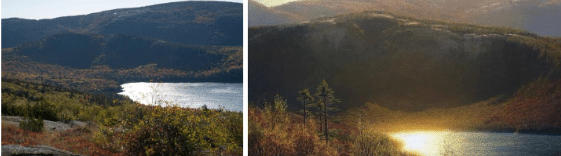
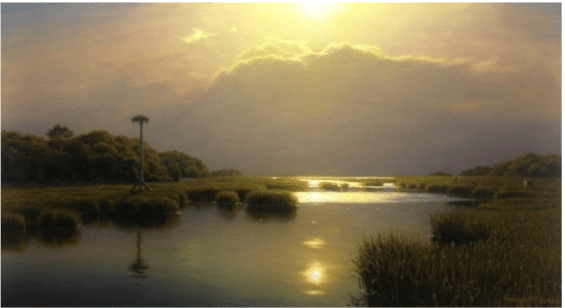
The location “in reality” (left) and Joseph McGurl’s transformation of it on the right.
Joseph McGurl details, step by step, the process of creating the painting above in his video.
A Passing Storm: A Romantic Landscape by Thomas Cole

Thomas Cole, “Landscape with Tree Trunks,” 1828, approx. 26 x 32 in. RISD Museum, Providence RI
Suspended between darkness and light, violence and beauty, what does this wild corner of the primordial North American landscape say to us today?
What can we gather from the dead trees, twisted around each other, and evidently shattered by lightning or wind, crossed like an “X” in the foreground as if a barrier forbidding the viewer from entering further?
In “Landscape with Tree Trunks,” Thomas Cole (1801-1848) depicts a passing storm above a mountaintop half draped in deep shadow and half illuminated by tremulous sunlight. We are poised between the picturesque and the sublime, hopeful calm and dreadful storm.
The blasted tree, “dead from a lightning strike,” confirms RISD the museum that owns this painting, “mediates between heaven and earth and suggests the cycle of life.” At the top of the waterfall a Native American “salutes nature’s magnificence,” RISD says.

Detail: A Native American, crowned with eagle feathers, stands above a waterfall, the sole human presence in Cole’s 1828 “Landscape with Tree Trunks.”
I love Cole’s paintings because they invite us to consider our relationship not just to the American landscape, but to all of Nature, and to contemplate the fate of humanity therein. By the time Cole was tramping through the Catskills making sketches for studio paintings like this one, the wilderness, along with its wild beauty, was fast disappearing, something Cole registered in paint and in essays on art and nature.
Cole was an active and pessimistic witness to the rapid European “development” of the American continent. For him, despite all the “settlement” going on, very little was settled indeed. The same year he painted this, he painted the aftermath of a massive landslide that struck a pioneer family in New Hampshire; freakishly, though the disaster wiped out every living person, it spared the shack they fatally evacuated from in fear, where a rescue party found a Bible still open to the page from which they’d been praying in desperation. To someone with a Romantic imagination like Cole’s, it seemed a rebuke by God. (For more on Cole the ecological artist, revisit this post.)
Cole doesn’t tell us what anything means or which way things are going to go in his landscapes, but he makes us feel the immensity of nature and the intensity and gravity of our human moment as it plays out on the cosmic stage. His paintings accurately depict North American scenery, American flora and fauna, with a naturalist’s eye. Yet his artistic creations transcend observation and analysis, remaining always rich, even epic, storehouses of poetry, thought, and possibility.