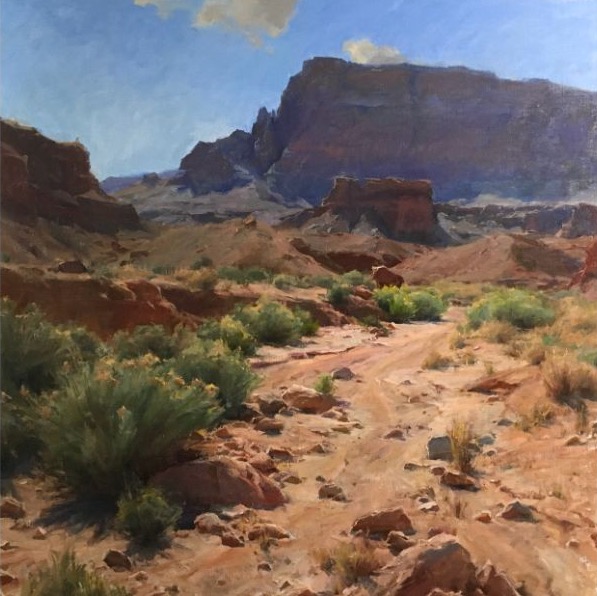
Most painters spend decades chasing what Kyle Ma already has at 25. His plein air work captures the play of light with remarkable accuracy and subtlety, supported by consummate drawing and delivered with brushwork that manages to be both lively and sensitive. His compositions are thoughtful and immensely satisfying to contemplate, his tonal and color relationships so carefully aligned that his paintings feel like complete, coherent worlds. Mountains, rocks, trees, clouds, fields, plains, and figures all work together in seamless harmony — and all of it achieved with a directness and freshness that radiates the sheer joy of looking at, and being in, the world.
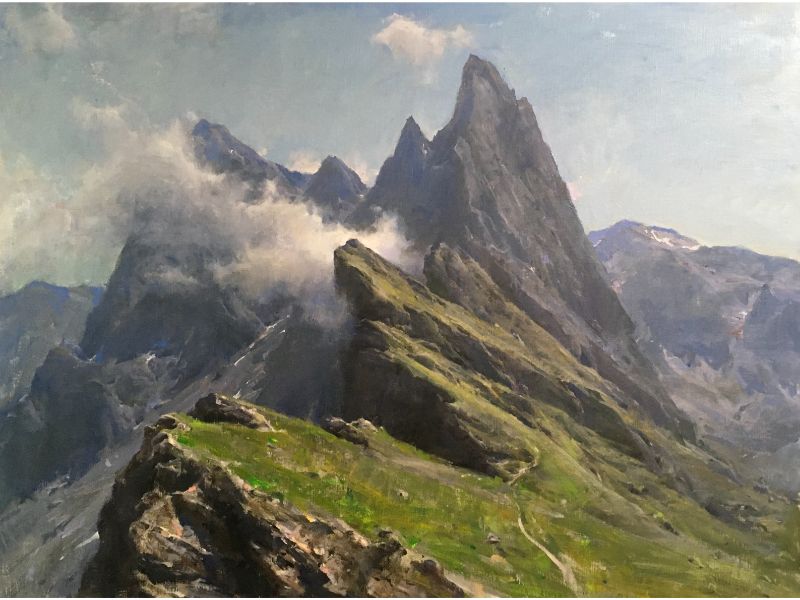
“Seceda” (oil, 30 x 40 in., studio from plein air study)
ON-SITE: PREPARATION AS PRACTICE
That joy of looking shapes everything about how Ma works, beginning long before he picks up a brush. “I spend a lot of time thinking about where I would get good compositions,” he says. “Sometimes I’ll go on Google Earth and fly around, looking at the structures of things. I figure out which way is north, south, east, west, and predict where the light is going to hit at a specific time of year. Then I make that happen.” Armed with this comprehensive understanding of topography and light, Ma arrives on site with a spatial awareness most painters spend years trying to develop.
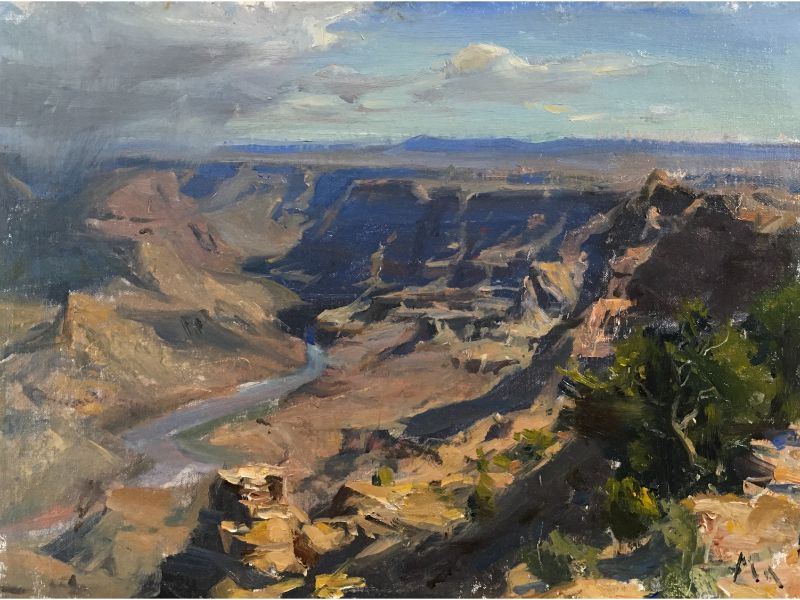
“Desert View” (oil, 9 x 12 in., plein air)
His on-site setup is deliberately simple — a pochade box affixed to a photo tripod, standard oil painting panels, and a palette of titanium white, cadmium lemon, cadmium yellow deep, cadmium red, amethyst, radiant violet, ivory black, transparent oxide red, ultramarine blue, and phthalo green. His approach to palette control is relaxed. “My palette is pretty much a mess,” he admits. “I’ve gotten to the point where I’m really intuitive with mixing. Whenever I see a new color, I can get it pretty quickly — which eliminates the need for pre-mixing.”
Ma begins on a canvas lightly toned with black or raw umber, drawing in his major shapes with a small round brush. “One thing I’ve learned is to use straight lines for the drawing instead of getting right into the curves of forms — it’s simply more precise that way.” Once the basic shapes and proportions are established, he blocks everything in quickly, focused on the distribution of shapes, rhythm, movement, and brushwork. “To create a compelling image there needs to be a hierarchy of interest — areas of solidity versus areas where you’re a bit more loose and atmospheric.” With the block-in and basic design resolved, he works through the painting, selectively refining areas. Within two to three hours, the painting is essentially complete.
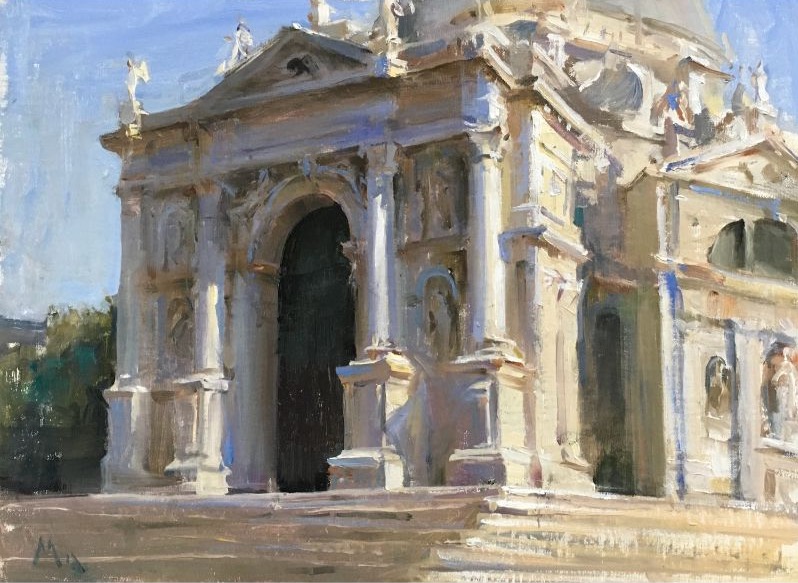
“Afternoon at the Salute” (oil, 9 x 12 in., plein air)
IN THE STUDIO: LAYERS, TRUST, AND RESTRAINT
The artist’s studio practice follows a similar logic but allows for greater depth and nuance. Working from a combination of photographs, sketches, plein air studies, and imagination, Ma is careful about what he trusts. “I trust my own sketches, my own intuition and my own taste, much more than photos,” he says. “The photograph is a tool to get the drawing right — to remind me where that tree was, where that shadow fell. But everything has to go through the filter of my own artistic sensibilities.” In the studio, he builds in layers, allowing the block-in to dry before going in with a second pass — getting more precise, refining the specific character of each area.
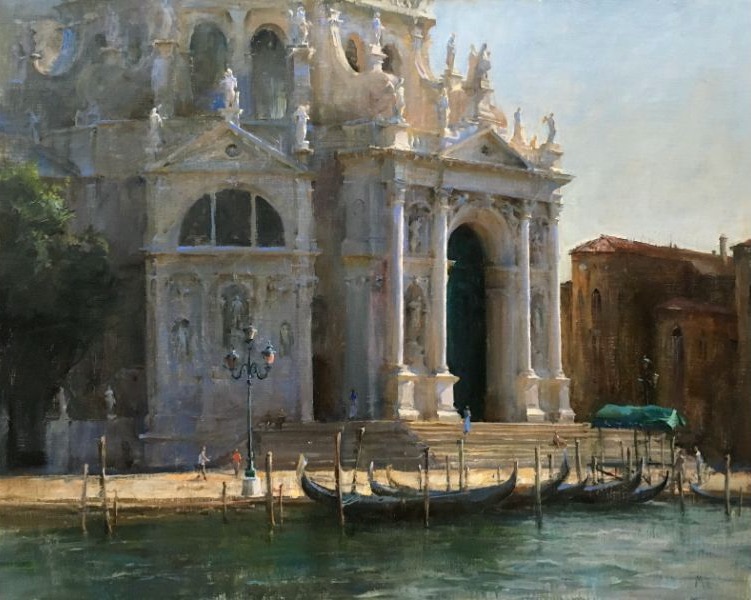
“View of the Salute” (oil, 24 x 30 in., studio from plein air study)
The central question of studio painting, Ma says, is knowing when to stop. “It’s a deliberate choice — selecting which areas to render to a high degree of finish and which areas to leave a little mysterious. With shadows, I keep things simple and let most of the action happen in the lights, where you naturally see things in more definition. And then I linger over what might seem like small decisions — making sure nothing looks out of place and every brushstroke is exactly the level of sharpness or softness I want it to be. I adjust values and colors, if needed, to suit the painting. Although, I’ve spent a lot of time on it by the end, the work looks very painterly and not very detailed.”
The reward is a painting that works at two distances. “From across the room, you get a really striking image,” Ma says. “If your values, shapes, and colors are correct, it’s going to look very realistic. And then when you get up close, you see the brushstrokes and all those little decisions — and that makes it even more interesting and beautiful.”
Kyle Ma’s patience is rare — but it’s exactly the kind of process PleinAir Magazine has been documenting for over a decade. Subscribe today and get the full story behind the work of today’s top artists, delivered six times a year.