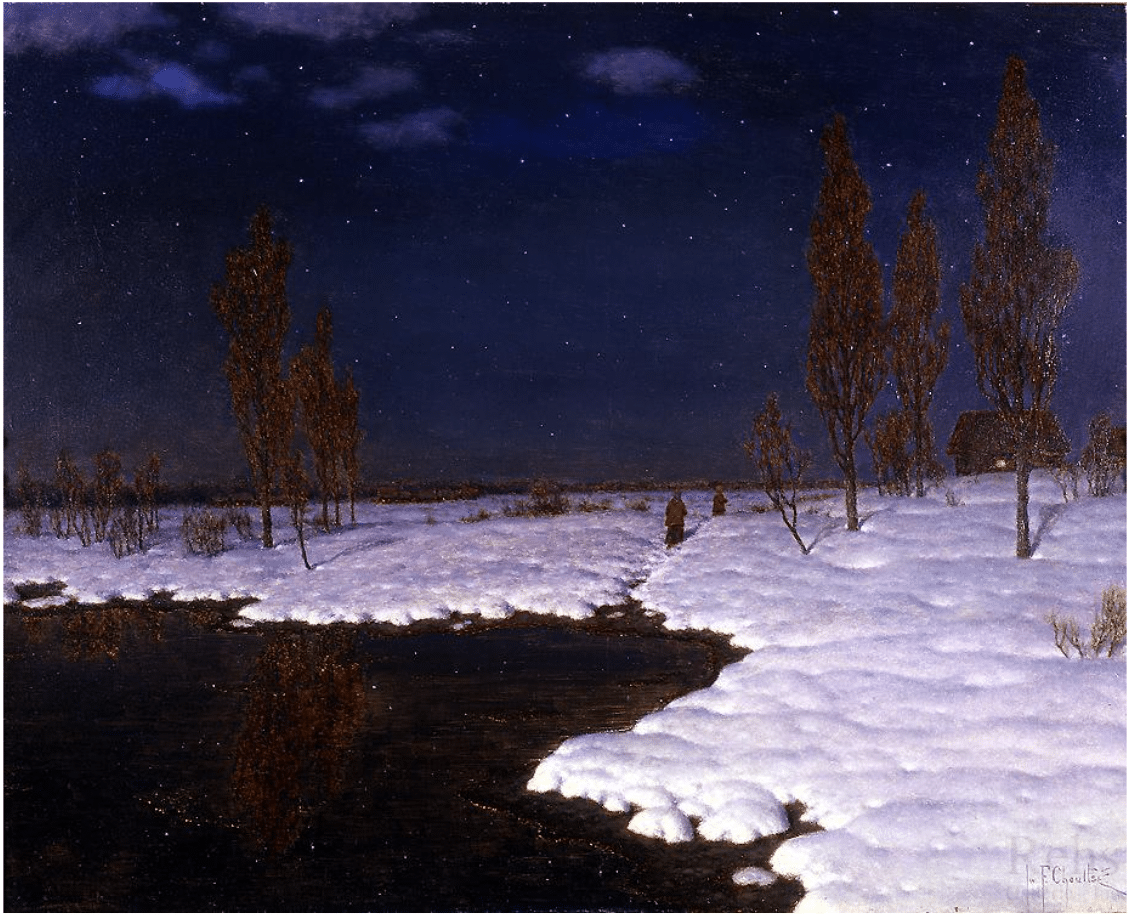
The above painting by Ivan Fedorovich Choulste, Nuit de Mars, Russie, is a reprisal from our previous edition. It’s a remarkable painting that bears a closer look.
The black pond mirrors the night sky, a scattering of pinpoint stars in a field of midnight blue. Two figures, separated from each other by some distance, make their way toward a house on the hill, where a single light glows like a dying ember on the first floor. It is a moonless night; the trees nearly disappear in the dark, save or their trunks which remain starkly visible against the snow, which is muted with violet shadows. Between the night sky and the dark lake or pond, only a spit of snow-laden land remains to anchor the huddled house and figures. Overall it is a hushed and mysterious painting.
Winter nocturnes have a very special quietness about them. They might put one in mind of
Percy Bysshe Shelley’s haunting and melancholy poem, Lines: The Cold Earth Slept Below, published in 1823. The poem is reproduced below with some remarkable snowy night paintings.
The cold earth slept below;
Above the cold sky shone;
And all around,
With a chilling sound,
From caves of ice and fields of snow
The breath of night like death did flow
Beneath the sinking moon.
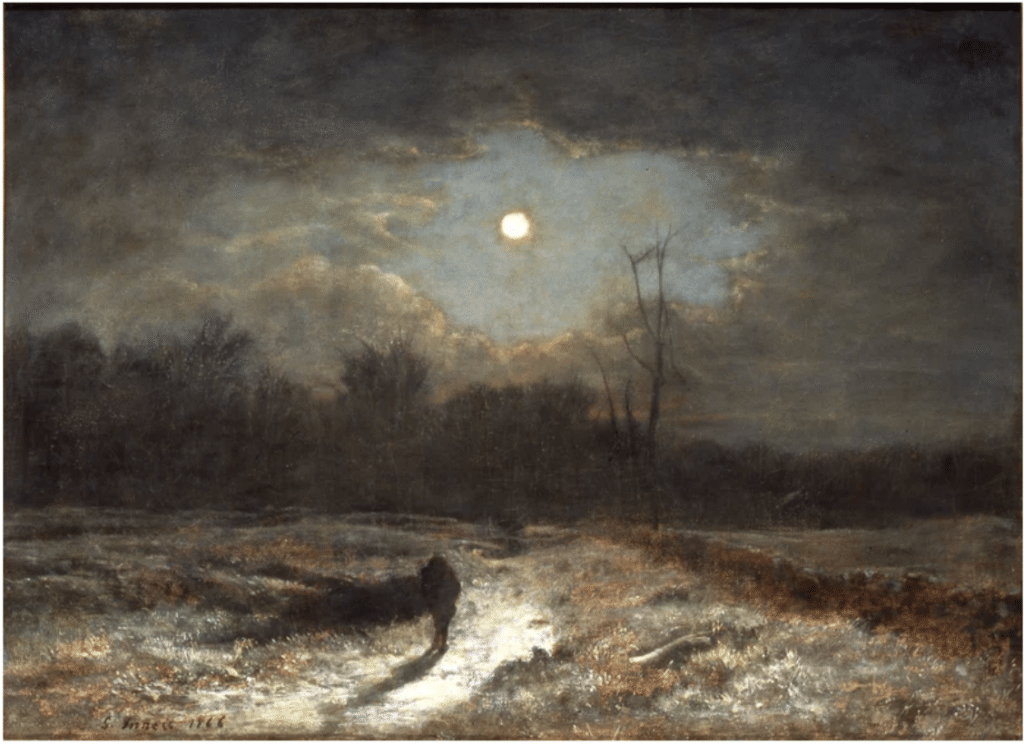
George Inness, Winter Moonlight (Christmas Eve), oil on canvas, 22 × 30 in. (1866) Montclair Art Museum
The wintry hedge was black;
The green grass was not seen;
The birds did rest
On the bare thorn’s breast,
Whose roots, beside the pathway track,
Had bound their folds o’er many a crack
Which the frost had made between.
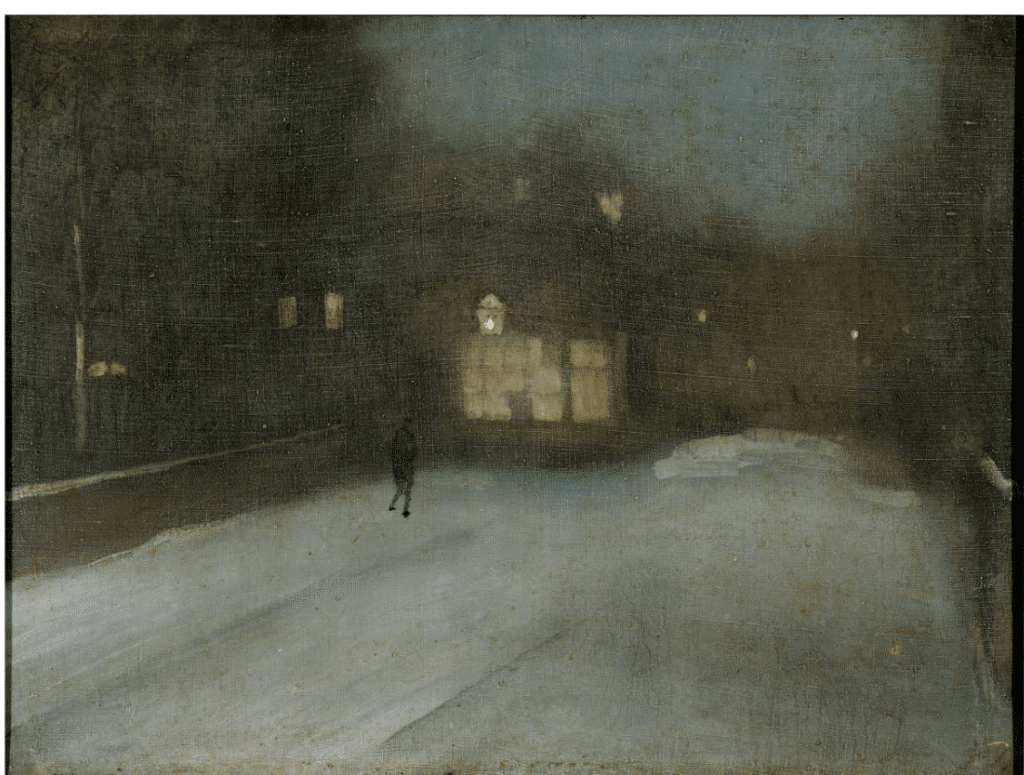
James McNeil Whistler, Nocturne in Grey and Gold: Cheslea Snow, oil, 62x47cm (1876), Harvard Art Museums/Fogg Museum, Bequest of Grenville L. Winthrop
Thine eyes glow’d in the glare
Of the moon’s dying light;
As a fen-fire’s beam
On a sluggish stream
Gleams dimly—so the moon shone there,
And it yellow’d the strings of thy tangled hair,
That shook in the wind of night.
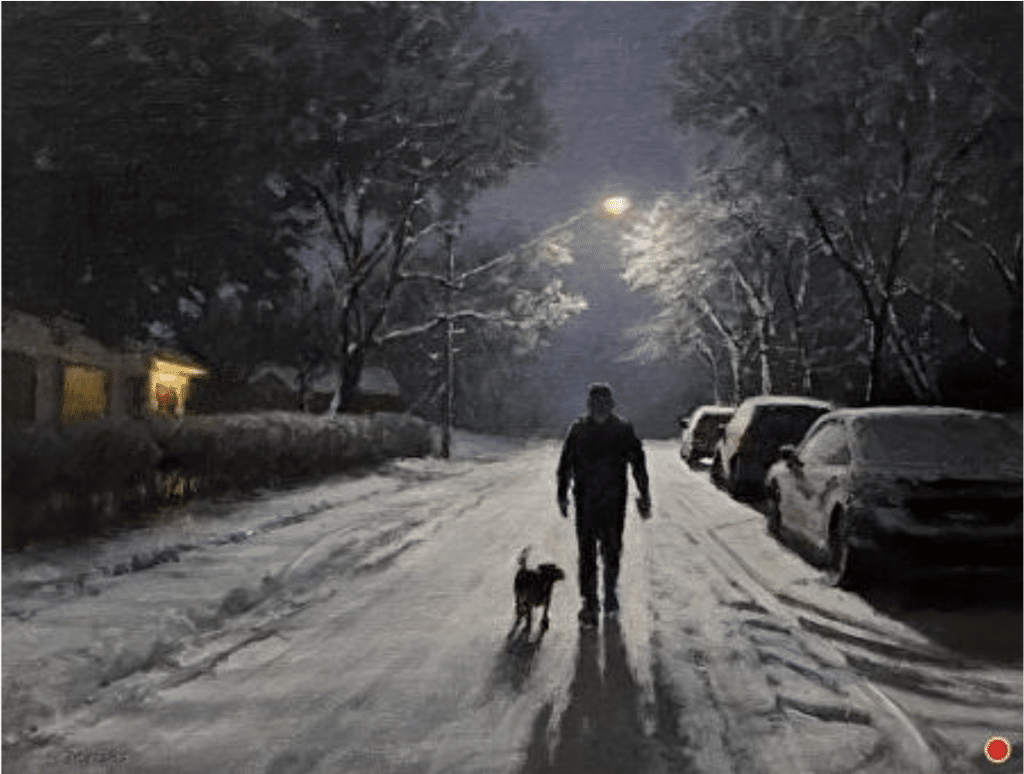
Carl Bretzke, Mark’s Turn to Take the Dog Out, Oil, 11 x 14 inches
The moon made thy lips pale, beloved;
The wind made thy bosom chill;
The night did shed
On thy dear head
Its frozen dew, and thou didst lie
Where the bitter breath of the naked sky
Might visit thee at will.
-P.B. Shelley
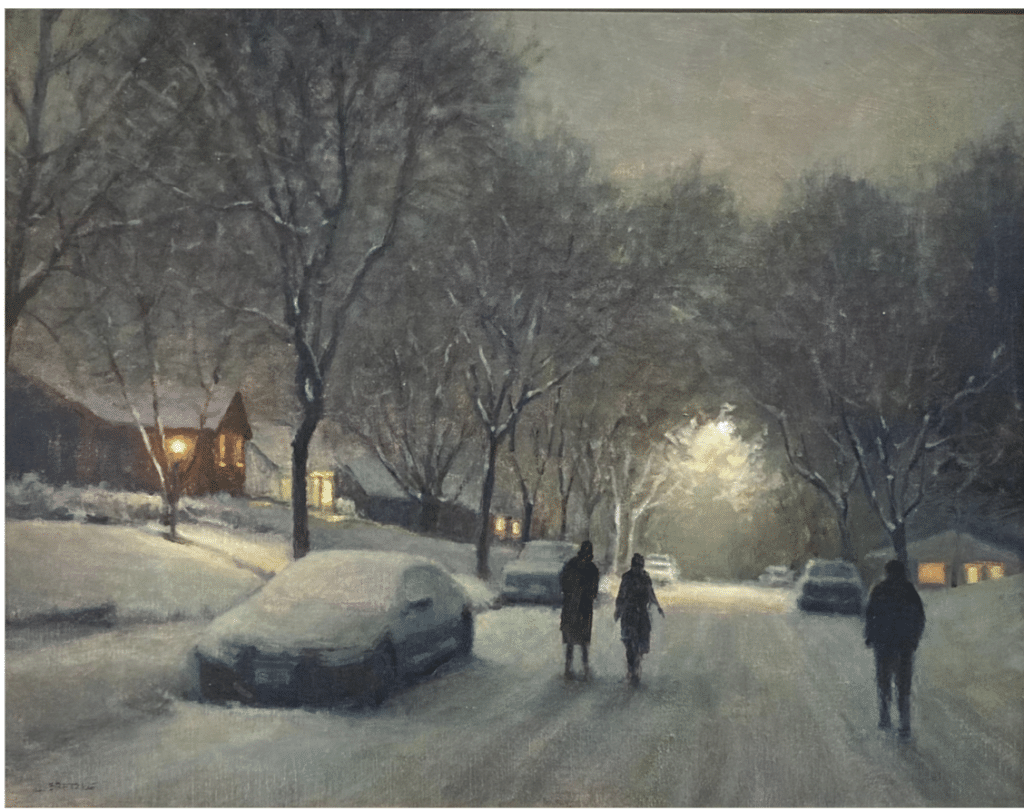
Carl Bretzke, Unshovelled Sidewalks, oil, 16×20 inches
If you’re interested in learning how to paint nocturnes, Carl Bretzke has a video available for download called Nocturnes, Painting the Night.
Of Light in Wintertime: Aaron Schuerr on Painting Snow
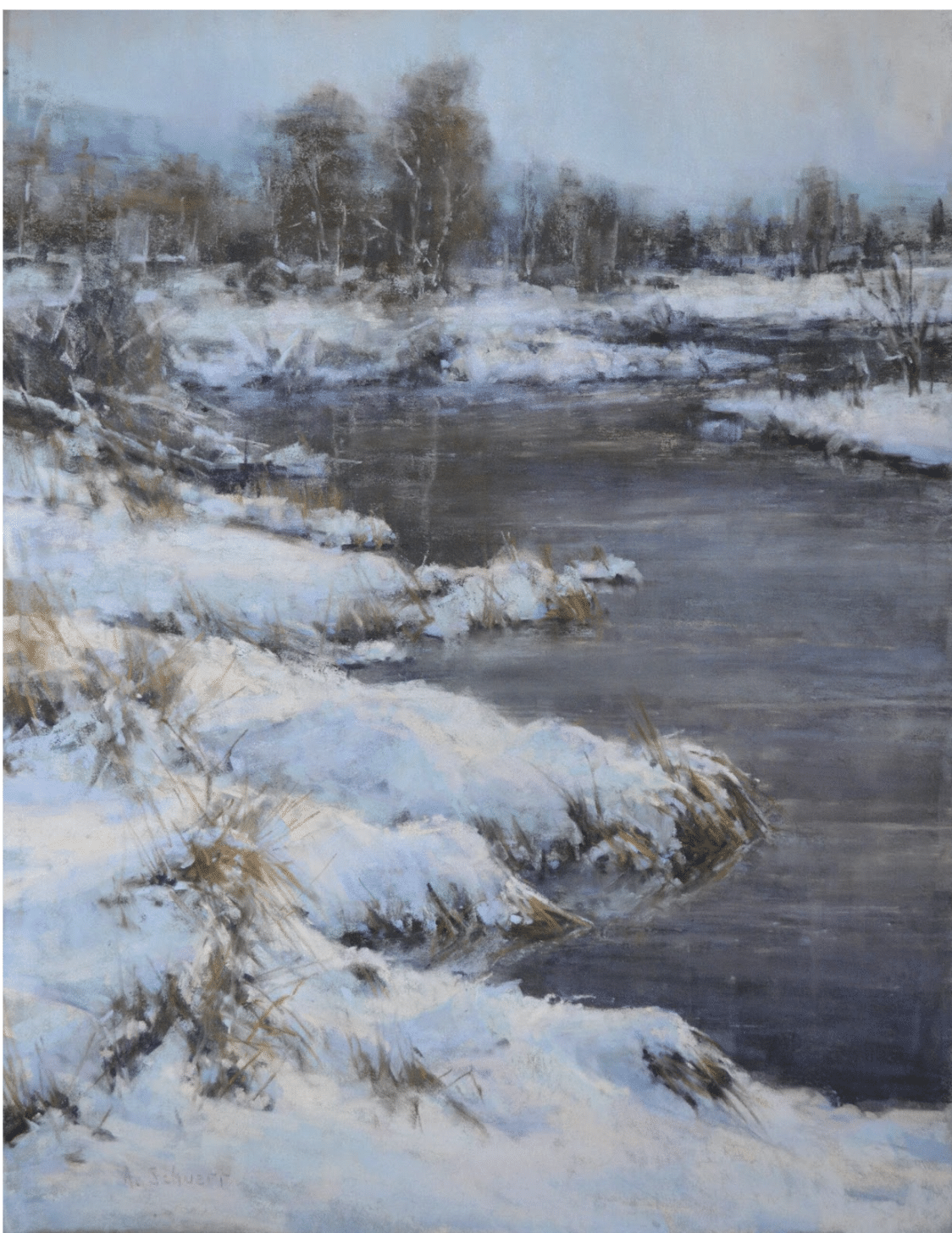
“Winter Waters” (pastel, 18 x 14 in.) by Aaron Schuerr
“The next time the sun comes out after a snowstorm, I suggest you take a stroll in your neighborhood,” says Aaron Schuerr. “Look at the light bouncing from the snow onto a house, and the color of the house back onto the surface of the snow. Make tracks and peer into the holes; the shadow color radiates as though there is a blue light buried down deep.”
“Back alleys can provide a masterclass in light and shadow patterns. Observe the color along tire tracks as they move from light to shadow and back to light again. Note the shift in the color of a long cast shadow from source to terminus,” he says. “In short, look down, look around, and feel a growing sense of wonder at the power of light in wintertime.”
Inside Winter Sunset in Pastel, Aaron Schuerr will show you the deeper and more meaningful side of painting — how to translate the essence of any scene onto your paper and narrate an emotionally resonant story through your art. His brilliant teaching prowess will get you to see — really see — a whole new world that is hidden from the eyes of untrained artists.