George Inness is still considered one of the best landscape painters America has produced. A lot that’s because he believed the role of the artist is to “go big or go home,” which in his case meant to embrace a spiritual aspect of sight.
“Artistic vision,” for this painter, meant the drive to capture a glimpse into the overarching harmony between matter and spirit that he felt ties existence together and, by its very nature, makes us human. It’s no small feat for a landscape painter, but the great ones of the Hudson River School showed the way as well.
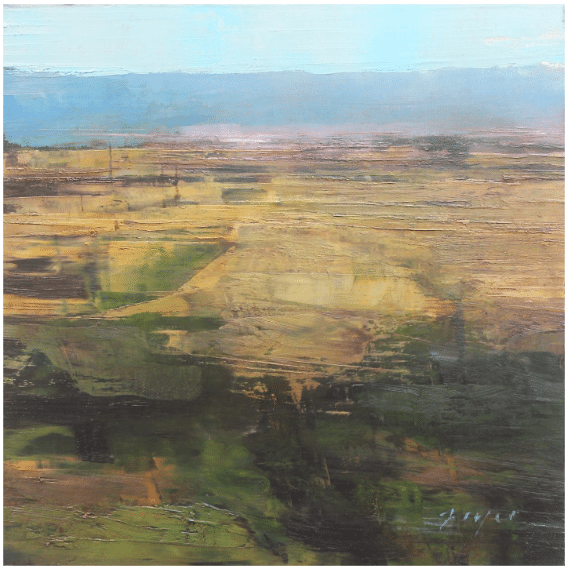
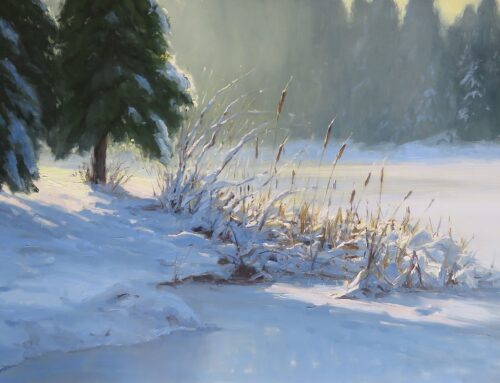
Contemporary expressive landscape in action: Douglas Fryer, August, 10 x 10 in.
Innes’s peers until they went separate ways, the Hudson River School artists drew upon expression as much as they valued accuracy. You can identify individual tree species in Inness, but that’s about it. Painters like Cole made intricate studies of American flora and fauna which they then used in the studio to freely create composite images.
Their expressive, composite creations moved viewers more powerfully than any purely observational painting could have done. What’s meant by “expression,” a word that can be vague and confusing, is often simply this – the attempt to express in paint what made you want to paint a thing in the first place. To get there, you have to know what to let go of and what to play up in subtle ways and develop the technique to do so.
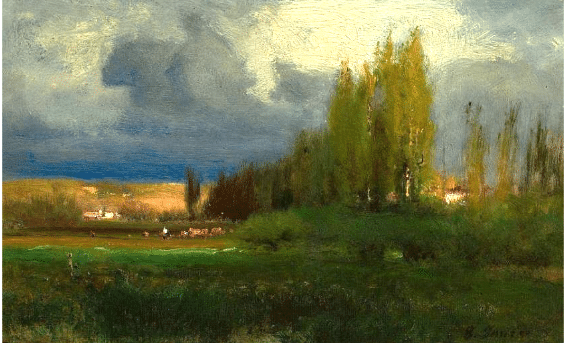
George Inness, Landscape Study, 1882, 15.75 x 21.75 in.
It seems to me that Inness succeeded in doing something like that in the landscape study above. He goes right for the big stuff, the poetic experience. He is less concerned with the specifics of detail and more concerned with the contrasts in the luminosity and energy of a receding storm. He has infused the landscape with mood and feeling; the play of complimentary colors (flecks of warm reds and oranges versus the cooler emerald streak in the middle ground and the foreground greens) and softened edges. He seems to be hinting at larger forces or, as befits the transitional moment between storm and clearing, something waiting, about to be revealed.
To return to that vivid emerald green in the middle ground; it’s got extra energy because of how Inness painted it. Clearly, he just laid it down – it’s really nothing more than a lively streak of bright green paint, energetically applied and containing the energy with which he applied it. He uses this same device again and again in his later paintings, so it seems to be not so much observed as perhaps symbolic or shorthand for something, maybe something to do with liveliness, natural growth and life (which after all is how it feels).
You might wonder, “Did he really see this? Was there for a moment such dramatic movement in the clouds in the wake of a retreating late afternoon storm? Did the light really hit the little white building on the right and the strip of green field we’ve been talking about that way? At what point did the visual recording of his experience end and the lyrical poetry of his describing it begin?
Effectively communicating personal vision – that which, for you, lifts the ordinary to the remarkable: That’s the objective. Many a man or woman in whom the Artist is alive becomes a seeker – a devotee of meaningful emotional, and even spiritual expression. Certainly this was the case for Inness. For such an artist learning technique becomes not a necessary chore but a practice – at times frustrating, at times exhilarating, but always a dedicated pursuit.
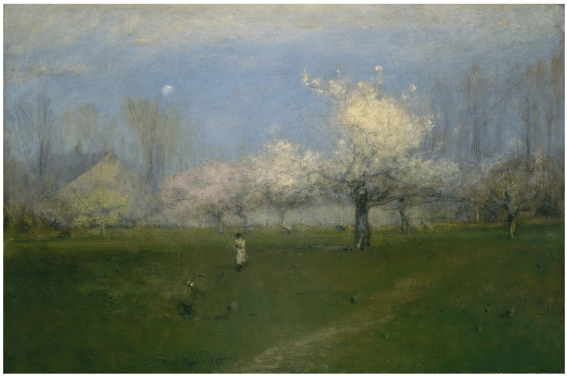
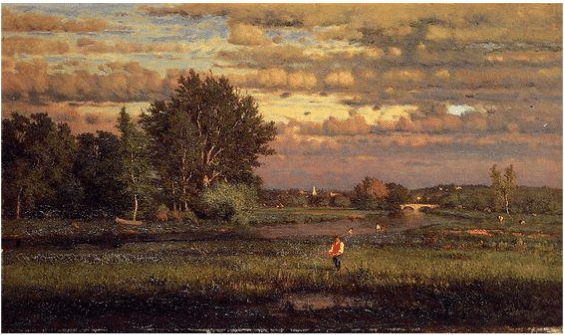
George Inness, Spring Blossoms, Medfield, oil on canvas, 1891
Robert Henri perhaps, author of the very inspiring book The Art Spirit, would say art’s highest goal is really self-development. The process of creating art makes us more sensitive observers of life, Henri said, further leading us to live as often as we can in the state of “elevated consciousness” that “makes creative expression inevitable.” (The Art Spirit)
In this way, technique, self-development, and expression all advance together. When you respond to something “out there” – a face, a landscape, the fall of light on a leaf or a bowl of fruit – you are responding to something “in here,” within your mind and heart as well. Consider if that is what you really want to paint – not just what something looks like, but also something of how it feels to look at it. That makes for great painting.
Can you dedicate yourself to developing specifically the kinds of techniques you need to adequately express – that? As you learn, chances are you’ll find yourself seeing more and more stuff “out there” that you respond to “in here,” and that, according to Henri, is a tremendous achievement in living.
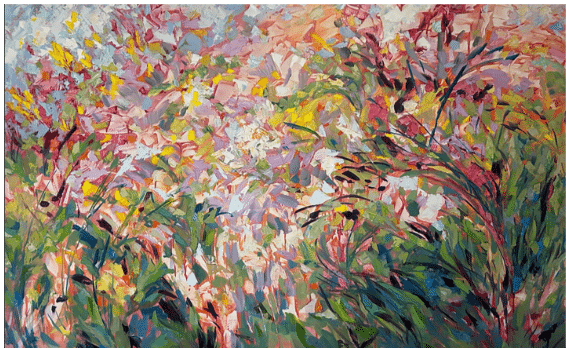
Cynthia Rosen, Rhythm in Giverney, oil on panel, 36 x 58 in.
Not everyone needs or wants to leap into Big Emotionally Creative Impulses, yet creativity’s wellsprings exist for all. Art is no privileged, elitist specialization. The vast majority of artists and writers living in America have full-time day jobs, often exhausting ones. And yet they’re excited about doing something meaningful, maybe even making a positive difference in someone’s life with their own creativity. Being an artist is something available to anyone committed to living an open, freer life with courage, mindfulness, commitment, and an eye for life’s moments of joy.
“The passionate play goes on,” wrote Walt Whitman, “and you may contribute a verse.”
Expression in painting comes in many, many forms. If landscape lures you, you might want to look into Douglas Fryer’s Painting with Intuition or Cynthia Rosen‘s Expressive Landscape Painting.