Can a landscape be epic?
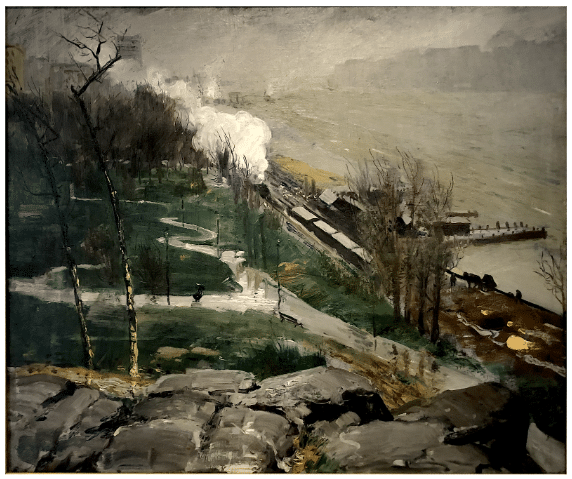
That’s the question RISD professor and artist-printmaker Nancy Friese asks in a brief essay on the painting titled “Rain on the River,” created in 1908 by a young American “Ashcan School” realist named George Bellows (1882–1925).
Some landscapes surely can – Albert Bierstadt < https://en.wikipedia.org/wiki/Albert_Bierstadt#/media/File:Looking_Down_Yosemite-Valley.jpg comes to mind – but can this one by Bellows? His group, the Ashcan School, was an artistic movement in the United States that produced works portraying sharply observed, grittily realistic images of early 20th-century urban life. Inspired by Robert Henri, Bellows and his breakaway peers rendered urban subject matter with a rough-and-ready technique that matched their bold, unflinching desire to paint the truth of their time and place as they truly saw and felt it was.
Obviously painted from observation, Bellows either created “Rain on the River” en plein air or, perhaps (less likely some say, given its intricate realism), from a smaller on-site study. Either way, Bellows was known for working from and observing life with an unvarnished eye.
“Rain on the River” is a striking canvas first of all because it isn’t “pretty” the way we might expect early 20th century landscape paintings to be. Instead of polished and lyrical like a a post-Hudson River School Tonalist painting, it’s strongly angular, alternately saturated and “grayed out,” seemingly almost “messy” with colors that avoid any of the expected harmonies or enhancements and simply, bluntly, tell it like it is.
According to professor Friese, “Bellows answers Yes” to the question whether a landscape can be “epic,” in the sense of taking a strong, unflinching stare into the heart of a moment in history. Few painters before Bellows had dug into the grittier sides of America’s early 20th century industrialization and the experiences of tens of thousands of ordinary people as so much around them changed forever.
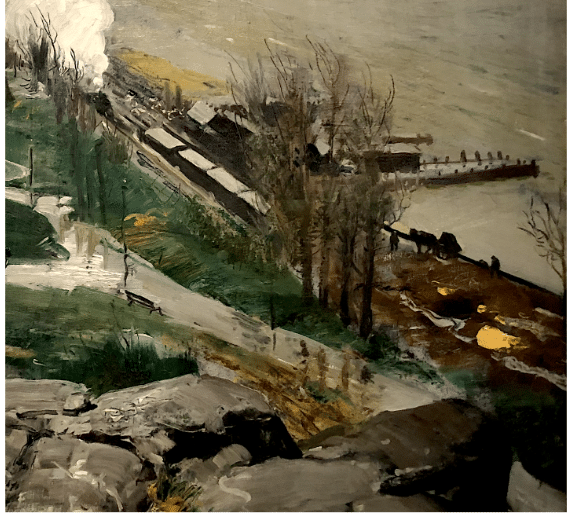
Here’s a closeup of the righthand side. Writers have pointed to the pool of gold paint as the kind of thing one wouldn’t make up – it’s a puddle at an odd angle reflecting the diffuse overhead light. Note the tiny silhouettes of the men loading coal onto a horse-cart off to the right. Another painter might have made THAT potentially picturesque detail the central motif of the whole composition. Nope, not Bellows.
The scene is a view from a rocky ledge above Riverside Park. Bellows’ painting surveys a freight train making its way down New York Central’s Hudson River route. We’re given a juxtaposition of hulking gray bedrock (in the foreground) and a landscape busy with urbanizing itself, all shrouded with a gray, rainy day light as a train cuts in. “The string of cars reinforces a rushing diagonal that skirts the riverbank and culminates in a great puff of steam,” writes Friese. ”Against the fog-shrouded backdrop, a pedestrian scurries across a rain-slicked path and coal scavengers fill a horse-drawn cart.”
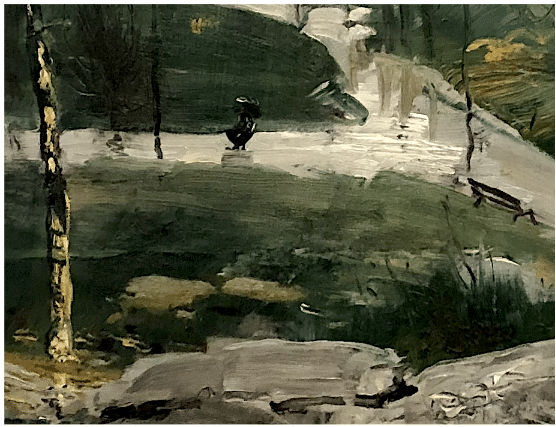
Closeup showing the “scurrying” pedestrian (see below). Check out the empty park bench nearby – it must be roughed in with a total of – what? – five strokes at the most?
Bellows’ aggressive brushstrokes pick out reflective surfaces animated by graphic observations: a lone pedestrian scurries across a rain-slicked path, and a horse-drawn cart awaits a delivery of scavenged coal. This is very much a painting of a moment in time and history, rendered with an originality and authenticity these artsts felt was lacking on the one hand from Modernist posturing and on the other from the “beauty of nature” gospel of the American Impressionists at the time.
Fries notes: You can see Bellows was “approaching the canvas at various speeds: quick abbreviations in the right-hand dock, slower development in the smoke and the important color shapes. Divided into quadrants of rain, river, industry, and park and rimmed with close-cropped rocks, the painting presents balance and dynamic action.”
“A powerful range of tonal progressions is interrupted by linear sequences of trees and soil. Smoke, rain, mist, stone, and trees heighten the sense of touch. Human activity is represented in cool greens, warm grays, and touches of ochre gleaming through. Color reinforces the weather and the particularity of view.”
“The painting evokes cities on rivers and artists who seek the outside [world] as a home to subjective experience.”
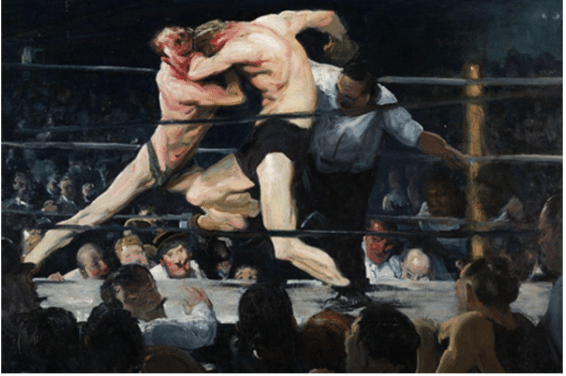
George Bellows, “Stag at Sharkey’s,” 1909, oil on canvas, 92 x 122.6 cm (36 1/4 x 48 1/4 in.)
Bellows is best known for his depictions of boxing matches in illegal downtown clubs in New York City, such as “Stag at Sharkey’s” (above), which gives us both a documentary and an archetypal renderiung of man vs. himself. By the way, there’s an epic write-up on Bellows’ many “Boxing Pictures” from the great John Wilmerding, writing for an exhibition in the National Gallery in Washington D.C., over here.
For Bellows’ many admirers (Bill Gates shelled out $27.5 million for a Bellows painting in 1999, which at the time was the highest price ever paid at auction for a work by an American artist) there absolutely is a sort of “epic” heroism in the artist’s determination to seize upon an entirely new kind of beauty, unfrilly and distinctly American, that didn’t compromise truthfulness and authenticity.
“Bellows was regarded as one of America’s greatest artists when he died, at the age of 42, from a ruptured appendix,” notes the Metropolitan Museum. His work “invites the viewer to experience the dynamic and challenging decades of the early twentieth century through the eyes of a brilliant observer.”
Writing to RISD president Eliza Radeke, Bellows called Rain on the River “one of my most beautiful things.”
Since it’s birth in mid-nineteenth-century France, plein air painting in one form or another has never been out of fashion. It’s likely to stay that way too. If you want to work on your plein air game, check out one of the many pro videos that teach you everything from the basics to the “epic” tools and tricks of the trade right here.
Do Not Pass van Gogh: Jailtime for Just Stop Oil Protestors
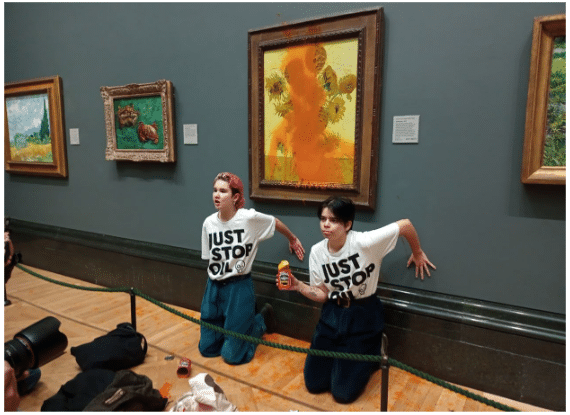
Just Stop Oil protesters with tomato soup in front of Vincent van Gogh’s Sunflowers, 1888, at the National Gallery in London.COURTESY OF JUST STOP OIL
Despite the backing of more than 100 artists, curators, art historians, academics and other art professionals, Britain’s “van Gogh soup” environmental protestors were sentenced to jail time at the end of last month.
Two years ago now, in October 2022, Phoebe Plummer and Anna Holland splashed tomato soup onto the glass behind which London’s National Gallery displays Vincent van Gogh‘s painting titled “Sunflowers.” They also glued their hands to the wall while speaking out about Britain’s issuance of new oil drilling licenses.
The action initially raised a furor (and a flurry of interest in global warming) because early reports didn’t realize that, as the demonstrators well knew, the painting is behind protective glass, so the van Gogh wasn’t damaged nor was it intended to be. The gesture was symbolic – the painting served as both a symbol of human potential and what we stand to loss as well as an image of spirituality embodied in natural beauty.
The protestors successfully drew attention to the fact that Britain’s National Gallery, as an extension of the country itself, profits from the continued extraction and sale of oil, the burning of which is damaging the planet’s ecosystem. If people won’t care about nature, the logic goes, perhaps they will pay attention when it’s realized that culture and the social fabric itself are also at risk.
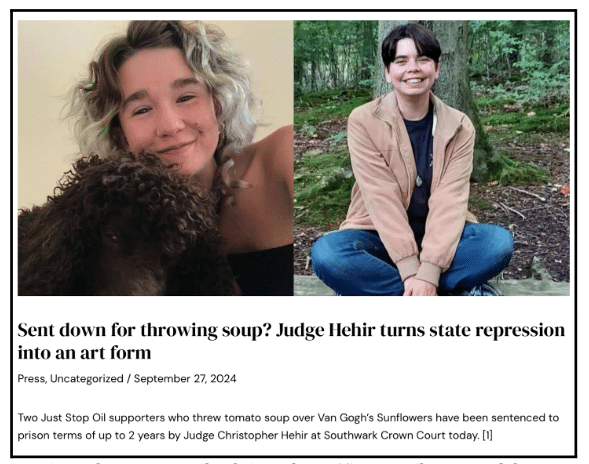
The Just Stop Oil website posted the announcement immediately following the news.
Artists and academics had pleaded with the judge prior to the sentencing on the grounds that “iconoclasm has been a vital aspect of art throughout history.” The protestors, their open letter, sponsored by Greenpeace said, were actually “upholding a centuries-old tradition of calling on our social conscience through art.”
Phoebe Plummer was jailed for 2 years for the soup throwing plus 3 months for a second offence, while Anna Holland received a prison sentence of 20 months. They are also subject to 3-year “Criminal Behaviour Orders” and are expected to serve at least half of their sentences in custody.
The museum claims the soup damaged the painting’s frame. Expressing zero sympathy with the group’s political views, the judge delivered his verdict refusing to hear any arguments or to examine any evidence, according to Just Stop Oil.
The protestors defended their actions in a statement that read, in part:
“In Parliament Square, the beating heart of democracy in the UK, there are statues of Pankhurst, Gandhi and Mandela…why? Because these people fought for our democracy. They battled to bring about the rights we see today. And how did they do that? They broke the law to bring about justice when the society in which they were in was unjust.”
“If we meet current commitments only, net zero by 2050, perhaps some form of humanity will survive. This isn’t ideology, this is the science of the IPCC, and the UN, the UK Committee on Climate Change… were calling for no more fossil fuel licences to be issued at the time these actions took place and yet the Conservative government was still storming ahead with over 100 new (drilling) licences. That refusal to listen to science, reason or morality is what appears to be a dangerous and extreme ideology to me.”
Separately, noted Just Stop Oil, over 63,000 people, including 10 UK Members of Parliament, have signed a petition demanding an end to the imprisonment and silencing of protesters advocating for urgent (environmental) action.