For anyone building an art career, individual successes and failures often feel like “live or die” moments. Setbacks, defeatist self-criticism, toxic comparisons with others? All part of the job description. So how to deal?
It might help to understand that no one way is the “right” way to do any of this. There are as many paths to “success” (both careerwise and artwise) as there are artists who paint and “art worlds” that support them. There are as many ways to paint trees (and forests, for that matter) as there are artists who paint them.
Take note: there is no one art world; there are many art worlds. Even within them, what looks like a “path” to a successful career turns out to be way more random, personal, and varied than it seems from afar.
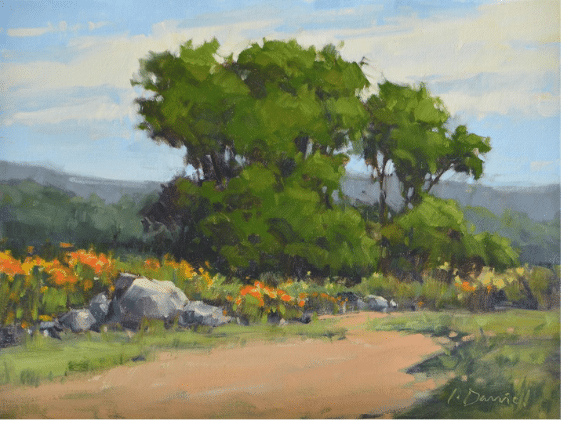
Laurel Daniel, “Flowers of the Field,” oil, 12 x 16 in. Laurel Daniel teaches her tree technique in a video titled Outdoor Painting Basics
Is your goal to sell your work in a gallery? Fine, as long as you understand that selling in a gallery, or even multiple galleries, no matter how glamorous, is not enough to make a living. Or is it selling at art fairs (traveling or staying local? Those booths cost money, so does travel, you need your own tent, no guarantees, etc., etc.). Is your brass ring to have thousands of followers online like more “famous” (Internet famous is a thing!) artist X? Or instead should it be maintaining a small but loyal following on Facebook or via something like Patreon?
Look past the surface of “success” and you find nothing but choices and chances, this ways and that ways, could-be’s and maybes. Maybe you should be selling prints from an online portal (or is your website? Good prints cost money to produce so are you able to sell lots? But are you also building an email list (and are they buyers or lurkers)?
Maybe your goal is one day publishing a book (things have changed and most are self-published these days, and there are many models to consider, all with significant up-front costs). Or is it doing the convention “circuit”? Winning art competitions? Leading your own workshops (at home or abroad? Any idea how much work and planning go into those, btw?). Every one of these things is different for each artist.
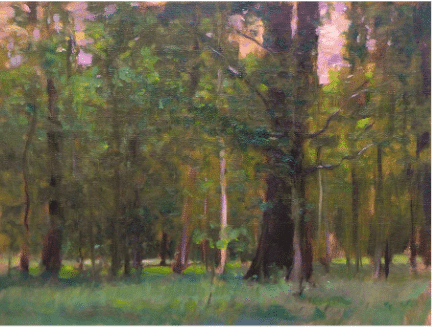
John MacDonald, “Field, Farm, and Woods,” oil, 9 x 12 in. John MacDonald has own way of painting trees, which he demonstrates in his video
Most professional artists combine several of these things plus other sources of income to make it work. And it is absolutely doable! It’s just that under the hood, no two art careers are really alike. Everyone does it differently, things are rarely what they seem, and how you build a career will be unique to you. The shiny goals and dreams we chase are usually mirages. Once you realize this, you don’t beat yourself up as much when you see others succeeding where you are not, or when your trees don’t look enough like artist X’s trees.
Bottom line? Don’t worry so much about the trees or even the forest. It turns out there are many forests and each is composed of many different trees. Most artists who make it through the long haul end up believing and doing just this:
Do the best work you can and get it seen by as many people as possible.
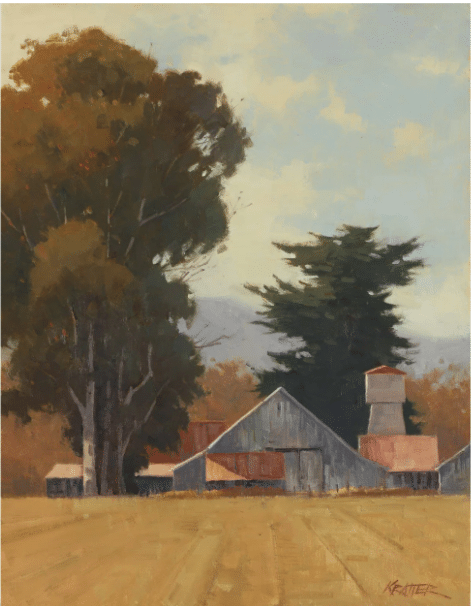
Paul Kratter, oil Paul Kratter teaches the art of painting trees in depth in his video, “Mastering Trees.”
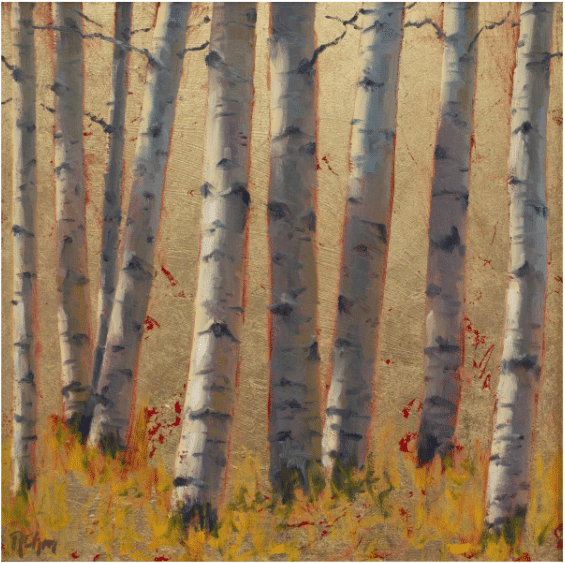
In addition to Paul Kratter’s video focusing on painting trees, the other artists featured in this post all cover their own techniques for painting trees: Rohm teaches painting trees in his video, Laurel Daniel teaches her tree technique in a video titled Outdoor Painting Basics, John MacDonald has own way of painting trees, which he demonstrates in his video.