Above image licensed under CC BY-NC-ND.
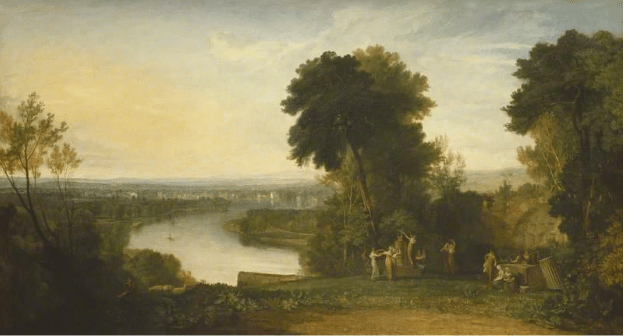
An endless dream of timeless summer days hums in the warm greens and hazy distances that we inhabit as we gaze at the painting by JMW Turner above. It’s a pastoral landscape, then a popular genre, which Turner painted early in his career. It’s just too inviting not to lean into and luxuriate in for a while.
The term “pastoral” refers to an old tradition in European “history” painting: imaginary utopias lush with tall, vaguely Mediterranean trees, atmospheric backgrounds, and a soft honeyed light. Pastoral paintings usually contain a few picturesque ruins here and there. They’re peopled with figures from classical literature, such as nymphs, satyrs, bacchantes, nature gods and goddesses, and above all rustic shepherds clothed in animal skins loitering in quiet pastures (the word “pastoral” is a form of the word “pasture”).
There’s something very specific going on here though, which we need the title to understand. “Thomson’s Aeolian Harp” refers to a lyric poem by English poet James Thomson (1700-1748), titled ”An Ode to Aeolus’s Harp.” The Aeolus in the title refers to the Greek god of the winds. Turner’s image celebrates the poetic motif of classical figures who, as Thomson writes, “hymn their God (Aeolus) amid the secret grove.”
Thomson’s poem begins with an ecstatic chant to the sons and daughter of Aeolus: “Aetherial race, inhabitants of air!” and continues to entreat the race of the winds to come and play the aeolian harp, an unearthly musical instrument that can’t be played by human hands.
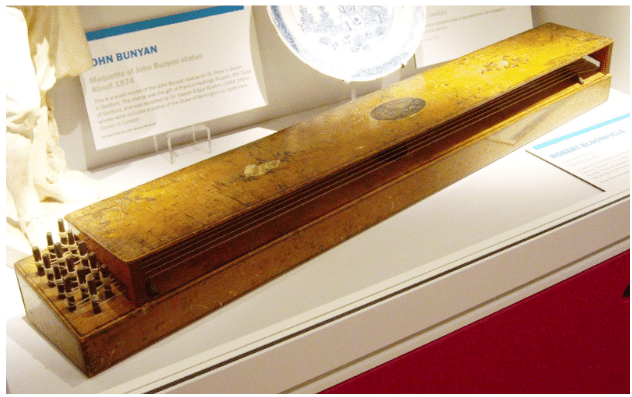
An aeolian harp dating to the 18th century.
Once a popular invention, the aeolian harp whether brought into gardens or placed on a windowsill, is “played” by the breezy currents of air that vibrate the strings as they pass.
The Romantic poets of Turner’s time (early 1800s) seized on the image of the aeolian harp as a symbol of the active imagination of the sensitive soul; the artist or poet aspires to create by allowing nature itself to resonate within him or her, to play “across the instrumental strings” of the soul (Shelley). The Romantic poets loved the “witchery” of music for its ability to move the soul:
A “voice is hovering o’er my soul—it lingers
O’ershadowing it with soft and lulling wings,
The blood and life within those snowy (invisible?) fingers
Teach witchcraft to the instrumental strings.
My brain is wild, my breath comes quick—
The blood is listening in my frame,
And thronging shadows, fast and thick,
Fall on my overflowing eyes;
My heart is quivering like a flame;
As morning dew, that in the sunbeam dies,
I am dissolved in these consuming ecstasies.”
-Shelley
A close look at the “main action” (what there is of it) in Turner’s painting reveals the “secret grove” of Thomson’s poem, in which mythological figures dance around and adorn a golden harp with midsummer garlands. According to the British Museum, Turner set the scene in an actual location outside London, “a view overlooking the River Thames from Richmond Hill,” where “the River bends in a backwards ‘S’ shape, and various buildings “line the far bank.”
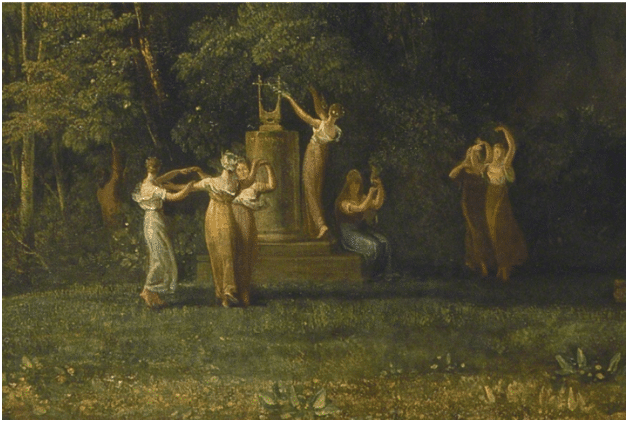
Detiail of “Thomson’s Aeolian Harp”
‘There are three loose groupings of figures in the foreground to the right, some near a golden harp mounted on a pedestal, others sitting around a stone plinth amongst classical ruins. The group of three barefoot female dancers holding hands in a ring are the Three Graces, and the four females who are decorating the harp are the Four Seasons. They all wear eighteenth-century classical dress.”
Lest such a far too literal British critic break the spell, let’s end with more poetry, this time with Samuel Taylor Coleridge’s famous poem on the theme. Coleridge compares his beloved Sarah to the aeolian harp, “that simplest Lute,”
Placed length-ways in the clasping casement, hark!
How by the desultory (i.e. aimless) breeze caressed,
Like some coy maid half yielding to her lover,
It pours such sweet upbraiding (i.e. protestations), as must needs
Tempt to repeat the (ardent lover’s) “wrong”! And now, its strings
Boldlier swept, the long sequacious (i.e. dependent) notes
Over delicious surges (of wind) sink and rise,
Such a soft floating witchery of sound
As twilight Elfins make, when they at eve
Voyage on gentle gales from Fairy-Land,
Where Melodies round honey-dropping flowers,
Footless and wild, like birds of Paradise,
Nor pause, nor perch, hovering on untamed wing!
And let us leave our poets and our painters then to dream amid the dancers in the sacred groves of summer days long lost to antique time – where gentler stirrings of the winds than we know in our own day moved the heart, and the soul and Nature still could sing in rhyme.