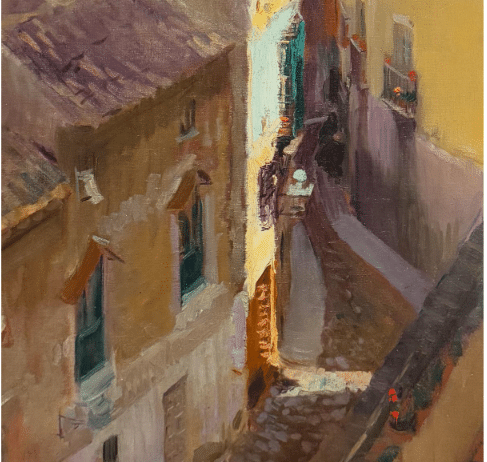
Most recently we basked in Joaquin Sorolla’s celebrated mastery of light (see Sunshine on a Brush). In this post we go deeper – by staying on the surface. This painting, “A Street in Toledo (Una Calle de Toledo),” we again find a virtuoso performance – the light strikes the side of this one building on a twisting street in Toledo so hotly and directly that the isolated wall becomes a glowing bar of molten yellow-gold.
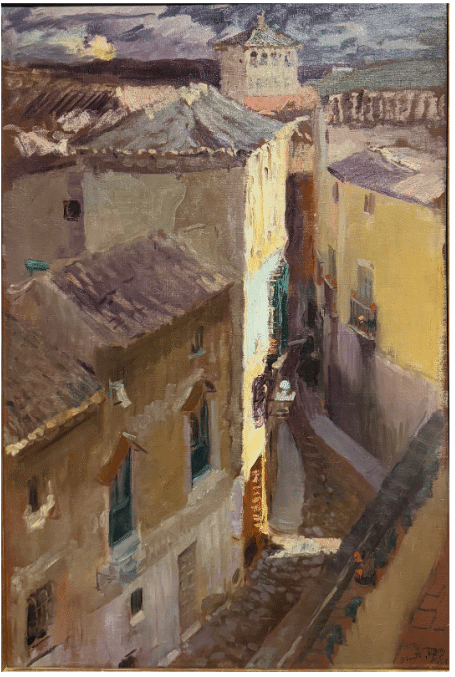
Joaquin Sorolla y Bastida, “A Street in Toledo (Una Calle de Toledo)” (1906), oil on canvas, 37 7/16 x 24 3/16 in. Worcester Art Museum
Much like his contemporary John Singer Sargent (with whom American readers may be more familiar) Sorolla (1863-1923) drew inspiration from his own open and alive response to the observable world around him. Color, light, shape, and movement fill his freshly composed canvases.
Sorolla created the painting titled “A Street in Toledo” during his first trip to the Spanish city in 1906. He was so taken by the beauty of the area, that Sorolla completed twenty paintings in only ten days.
He described this work as a “touch of fantasy, pure middle ages, which holds you spellbound.” The compelling perspective and color palette—different tones of purples, browns, and reds, with hints of green throughout— all draw viewers’ eyes to the striking strip of light in the middle of the composition.
However, of especial interest to artists, and it’s something you couldn’t know without seeing this work in person, is that as much as this canvas exemplifies consummate realism, it’s also a jubilant tour-de-force of expressive paint handling and ultimately a celebration of painting itself. Sorolla is “a painter’s painter,” and this is why.
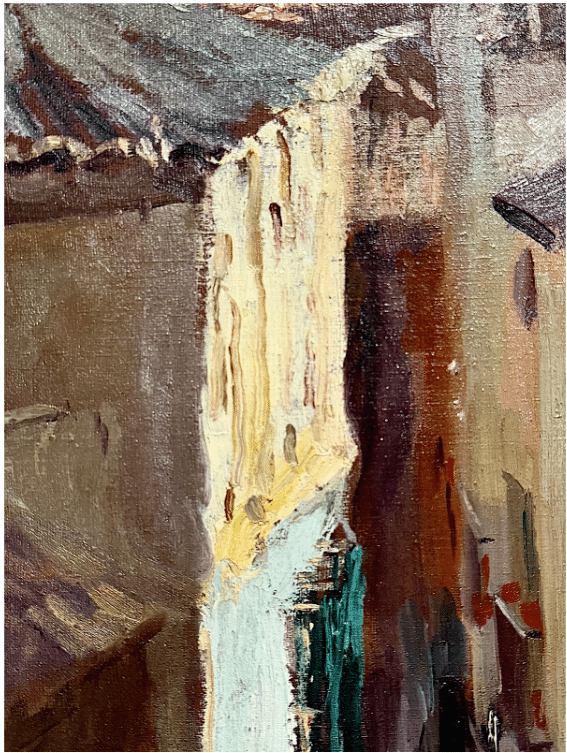
What you miss in online images and even pictures in books is the paint. Sorolla’s paint handling involves much more than preserving visible brushstrokes for their own sake. And Sorolla’s canvases are not just realist representations! They’re, hugely, wonderfully, surfaces – under Sorolla’s brush, a painting is a charged, electro-magnetic field, something that can only be fully experienced in person. “Painting is an unspoken dialogue, where paint speaks silently in masses and colors,” says James Elkins. “Paint is water and stone, and it is also liquid thought. That is an essential fact that art history misses.” Handled as such, paint “sings and celebrates itself.” (c.f. Walt Whitman)
Such a painting is partly “about” the link between the act of painting and the artist’s way of seeing (or as in this case re-imagining) the world with fresh eyes. A vision of the world is met by the materiality of oil paint – a Protean substance that coats, drifts, heaps, runs, flows, drips, and twists under the brush, first in the moment of creation (in the spontaneous “unspoken dialogue” between painter and canvas) and forever on the walls of museums.
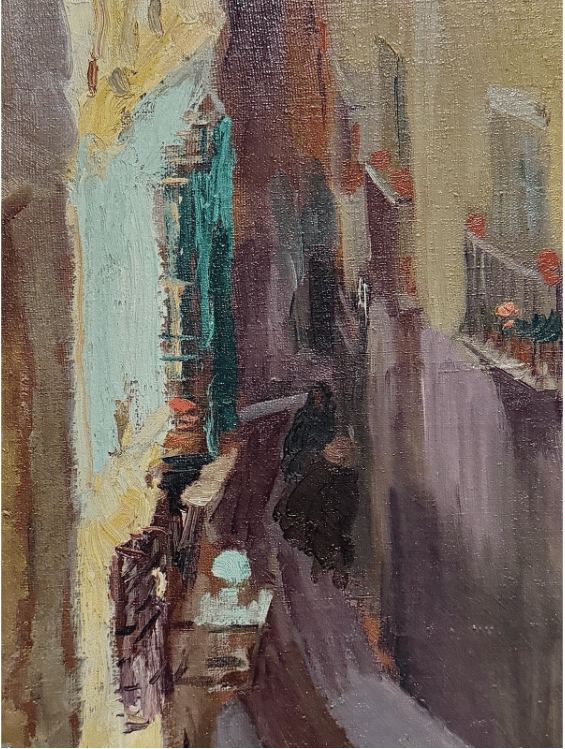
As artists, we can borrow from the dynamics of brushwork and composition in Sorolla’s work to enliven any painting; the underlying principles are universal:
- catch the eye from across the room, and dazzle it at short range by using small soft brushes for atmosphere and detail and switching toward the ed to large, bristly brushes loaded with fluid paint for bold expressive brushwork and “painterly” dynamics (marrying surface handling with equally bold and expressive color and value choices).
- enhance design with curves and diagonals and, as always, “move the eye through the painting” in a way that discourages the viewer from looking away, and
- maximize variety throughout when it comes to design by keeping the following in mind:
- push value contrasts
- create big asymmetrical shapes,
- fight the underlying right-angled grid with bold curves (parabolas) and strong diagonals
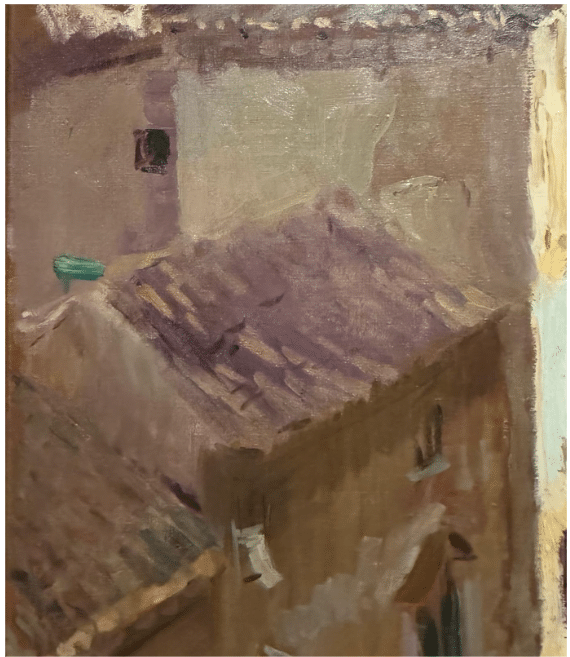
And yet – beyond the technical aspects, all the elements of painting, including brushwork, composition and design – should contribute to meaningful expression as well. Sorolla’s landscapes and seascapes use them to express a spontaneous feeling for air and light as well as, at times, a sense of the larger forces at work – the convergence of mighty energies in nature and humanity and even in the PAINT and the exciting ACT of PAINTING itself.
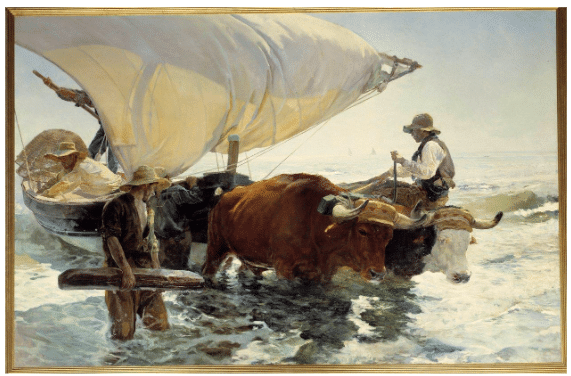
Sorolla, “Returning from Fishing, Towing the Boat” (also not at the Norton)
The way Joaquín Sorolla mastered the color of light is something many artists dream of doing, yet never quite pull off. One person who has mastered it is Thomas Jefferson Kitts — a modern master who teaches how to paint like Sorolla with this art video workshop, “Sorolla: Painting the Color of Light.”
Join the Gold Rush in Plein Air Painting at Lake Tahoe, Nevada
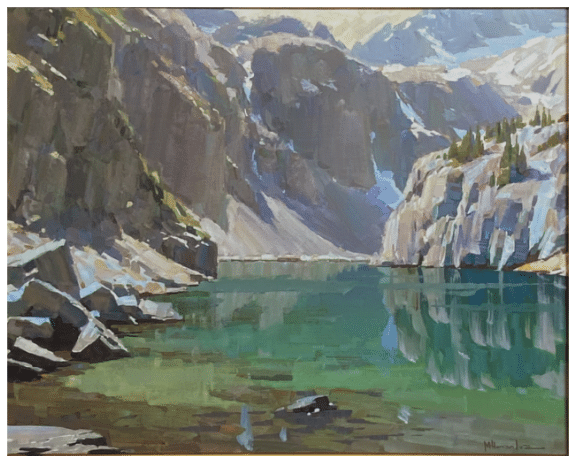
Mike Hernandez, Alpine Blue, gouache, 16 x 20 in.
If painting outdoors from life like Sorolla did is your jam, why not look into the annual Plein Air Convention and Expo (PACE) being held in Tahoe this May 19- 25, 2025. It’s five days of immersion in the knowledge and experience of 75 of the nation’s top plein air professionals.
Training sessions will be indoors at the Nugget Casino Resort in Reno, NV., projected on giant high-definition screens and outdoors in the afternoons. Every year, the Plein Air Convention brings the foremost artists in their fields to share their best practices and techniques with you for five days of high-impact art instruction. It’s your chance to be part of a family of artists and to learn from the very top painters in the world.
Don’t miss it!