Anyone driving north from New York City or south toward New Jersey has passed the famous “Palisades” (or at least a sign for the Palisades Parkway 😉 They’re a line of 300-foot-high gray basalt cliffs lining 20 miles of the Hudson River between East New York and Jersey City.
The Palisades were a well-known landmark in the 19th century, the site of countless events and excursions, picnics, parties, and at least nearly 20 documented duels, including the famous one that took place between Alexander Hamilton and Aaron Burr on an outcropping of its cliffs. In the 1820s it was described in a tour guide as an unparallelled site for beautiful scenery, a “little Eden” reachable by “six cents you pay at the ferry.”
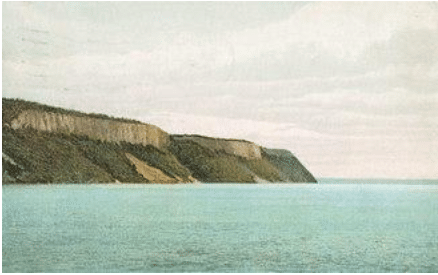
1898 hand-colored postcard of the Palisades.
Such an accessible and well-known landmark was sure to find its way into many American landscape paintings over the years. What follows is a mini-history of 19th century American landscape painting taking the Palisades as a common theme. Artists in America painted some excellent portraiture and still life works during the 19th century, but most were firmly anchored in European tradition. Landscape was the first genre in which American artists added a new chapter to the history of the art.
Not all landscape artists were on board though. The Palisades appear blue, hazy, and distant, yet still unmistakable, in an 1870 landscape by John William Hill (below). Hill was a British transplant whose main ambition seems to have been to match the classical stylings of his motherland’s Royal Academy. His style and approach to painting this landscape places him firmly in the school of English pastoral painters like Constable (at his mildest) and Thomas Gainsborough.
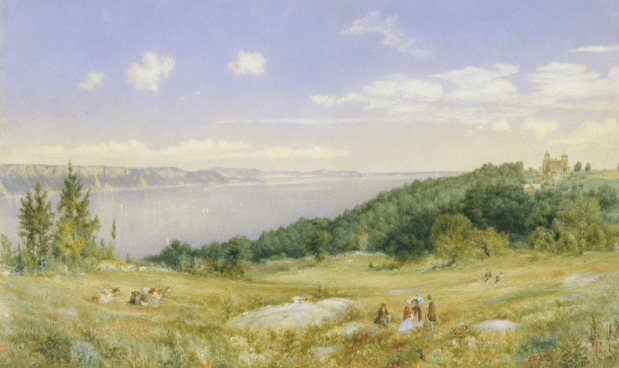
John William Hill ,The Palisades, ca. 1870, watercolor
For Hill, the North American spectacle of the Palisades is merely a backdrop for an essentially European pastoral landscape. If we crop the left side of the painting (see below), we’re left with a tame version of North American scenery. In resemblance to paintings of English country manors, it’s complete with aristocrats wandering around some grounds that, were they not so hilly and pine-topped, would be right at home in any Regency drawing room.
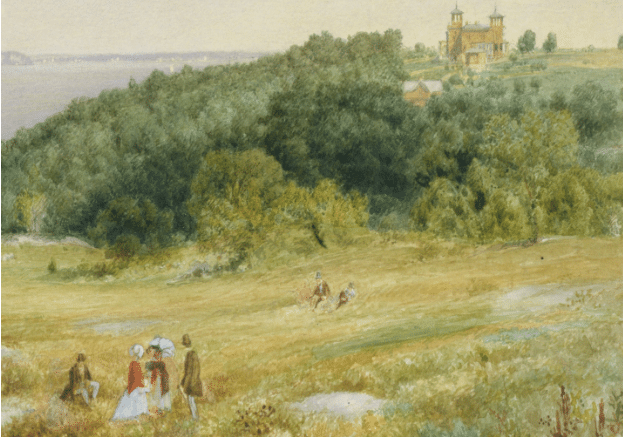
DETIL of John William Hill ,The Palisades, ca. 1870, watercolor
This is the received baseline of tradition that the Hudson River School painters were reacting and innovating against. True to form, Hill’s painting was likely a commission showcasing the holdings of a wealthy landowner. The viewpoint is said to be the estate of Christian H. Lilienthal of Yonkers, looking north to the house and property of William S. Cochran at right, with the Palisades, almost an afterthought, across the Hudson at left.
The Hudson River School treated landscape differently. For them, the landscape was no longer thought of as a prim backdrop for human activities. In their work it became the main actor in a visual drama full of philosophical and spiritual significance.
Consequently, there’s more imagination and feeling than in the Hill watercolor in George Inness’ first painting of the site (below). Inness probably completed this one in 1866. He was still working in an earlier, derivative manner designed to fit in with the prevailing Hudson River School Style. We’re on the Palisades side now, looking across to the other side of the river.
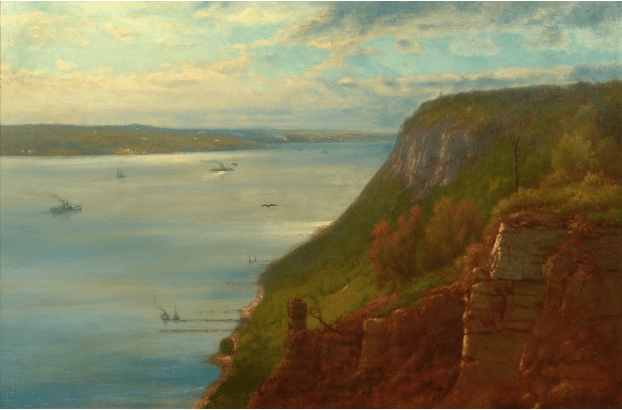
George Inness, “The Palisades,” oil, 1866.
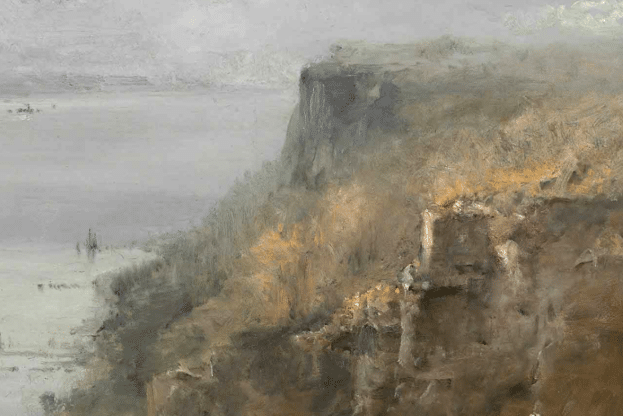
Inness treated the identical view in a far more mystical version of this painting (below), which he revisited probably around 10 years later. Inness came into his own as a painter around 1880. By then he’d fused the lessons of French Barbizon painting with his own Americanized version of 18th century mysticism. Consequently, there’s a massive distance between his c. 1866 depiction and the one from 1878 below.
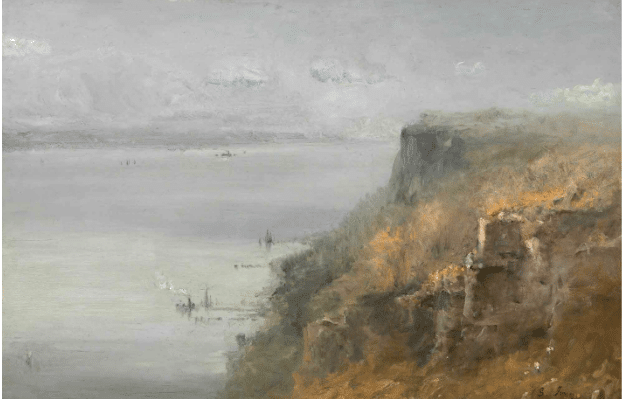
George Inness, “Palisades on the Hudson,” 1878, oil on canvas,
20 x 30 in. (50.8 x 76.2 cm.)
The scene in Inness’ 1878 painting of the same view might well be, except for the steamship, something from a fantasy novel or a poem like Keats’ “Ode to a Nightengale” (with its “Charm’d magic casements, opening on the foam / Of perilous seas, in faery lands forlorn”). It’s an altogether different beast. A gray fog mantles the distance and mist softens the edges of things, washing out the ordinary colors leaving just a pearly gray and a warm, autumnal foreground. In his later paintings, Inness endeavored to paint the interpenetration of the visible, material world with the invisible, immaterial world. What he gives us here suggests an image drawn from memory, something remembered from a dream.
In our very short review of the genre’s trajectory, the American landscape has gone from
- a prosaic, formulaic setting for pseudo-aristocratic leisure, to
- a picturesque landscape beautiful in its own right, to
- A poetic and imaginative creation, as much an unearthly vision as a depiction of a particular place.
With the Hudson River School, painting in America went from imitations of European models to engagement with the visual beauties and intriguing implications of the land. With Inness and the Tonalists who followed, painting crossed over from descriptive to expressive, becoming less about a “sense of place” than a state of being. In comparison to Inness, many of the paintings of the Hudson River artists such as Thomas Cole and Frederic Church seem little more than theater sets where nothing happens. Inness embeds his vision into his work, transforming what he experienced into something we can feel and experience in paint.

Drone footage of Palisades in summer.
To begin to sense how these artists put themselves into their paintings, compare their work with the drone photo above. Unlike any of the paintings, the photo, a digital capture unframed by the human eye, has little inherent beauty as such. Yes, the place that it’s a picture of looks like it would be beautiful if you could be there to see it, but the picture of it is just a picture, something transparent that points to something in the world.
The John W. Hill painting (top of page) synthesizes fact, imagination and a conservative aesthetics, and the result is pleasant enough to look at. The early George Inness presents the place as beautiful, with the comfortable appeal of a postcard. The later Inness involves the viewer more intimately– one must approach it interpretively, imaginatively entering into a transcendent image that evokes more than it shows.
The story this littler survey tells is that it’s through landscape painting, and a focus on the experience of the “new” world itself, that American art first got its balance.
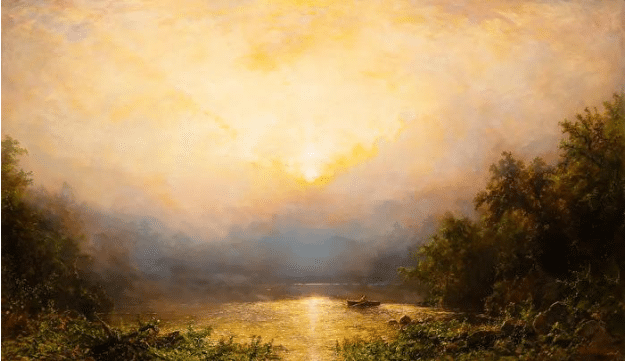
Erik Koeppel, “Morning Sun Burning Throuh,” Oil on panel, 18 x 30.5 in.
Interested in the Hudson River School and how they painted? Try your hand with Eric Koeppell’s videos on learning the techniques of the “Hudson River School Masters.”