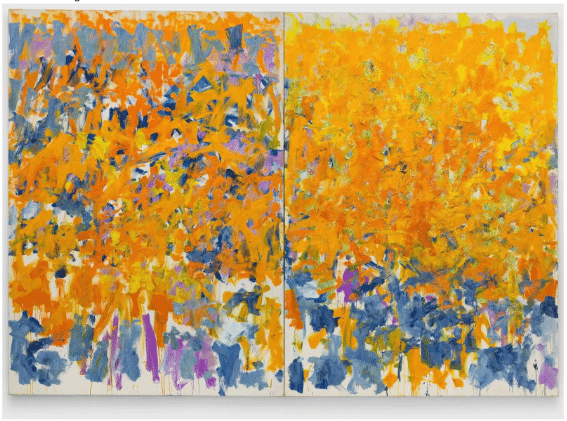
It’s easy to mistake the intensions of numerous “challenging” or “edgy” artists for obnoxiousness or obscurity. But keep looking and thinking, and what at first seems like a childish flip-off to aesthetic conventions may gradually reveal itself as deeper than that – deep enough to require that we look at art anew, in ways we didn’t know possible. Taken on their own terms, such paintings can speak to universal truths deeper than any style or artistic convention.
Take Joan Mitchell’s painting, “Wood, Wind, No Tuba,” (above), an appropriate abstraction for the leaf-season. Colors in dense layers swarm with exuberance across its two large panels. The title hints at a double meaning: the oranges and yellows suggest a riot of autumn leaves atop a stand of trees (woods) in the wind. The playful pun (“woodwind”) flips the script from representational landscape to music – woodwinds and brass are the elements of symphonic orchestras. By steering just shy of representation, the artist ensure her depiction of the “wood” and “wind” of the shaking autumn leaves glittering in the sun is the pure play of hue and rhythm across canvas – a symphony of color, feeling, and imagination in motion.
To the casual eye much modern and contemporary work looks like a cheap shot – apparently unskilled, unnecessarily cryptic, or smugly inexpressive. Naturally, some of it is (every genre has its greater and lesser lights). However, many of the Modern 20th century artists whose work looks willfully crude were sincerely trying to get behind the conventional to something prior to the sophistication of realist art.
What they were after was the bedrock of human experience, embodied in a spontaneous formal expression that matched its ancient, universal character. Their works dispense with “polite” representation in search of something raw, authentic, and pared down: The “shocking” and ungainly modes of expression that arose with 20th century modernists like Picasso were and continue to be about the search for authenticity.
I’m not sure it matters at all whether a work is hyper-photorealistic or abstract. I’d rather ask, what does that particular artwork convey and how does it convey it? Most abstract artists aren’t flouting convention just to be shocking or different – they are loading their paintings with meaning through their paint. A painting from Pablo Picasso’s blue period, for example connects with the earliest paleolithic sculpture and cave paintings for the hand-hewn sense of something real, carved from the foundations of human experience.

Pablo Picasso, Blue Nude, 1902
Picasso painted “Blue Nude” in 1902 after his best friend and roommate’s suicide. The psychological repercussions of that tragedy hit hard (they were two young aspiring artists/poets freshly arrived in Paris from the sticks), and the event touched off what’s known as Picasso’s “blue period.” Mortality literally colored all of Picasso’s painting at the time; his blue period paintings view a basic, common humanity through an essentialist lens of deepest emotion expressed through rough gestures and grave moods, an emphatic and pointedly bare and unpretentious line, and of course that stony, cool, melancholy and nearly monochrome color. Although these are among his most popular works today, at the time nobody wanted to buy the pictures, and Picasso became as nearly poor as the “street people” he was painting.
In “Blue Nude” (above) everything is stripped to essentials – the isolated figure as well as the distance from conventional Western representation (modeling, realistic color, and figure and ground). This masterpiece is splendidly rude, in the word’s original sense of uncultivated or undeveloped – in Anglo-Saxon, rudus literally meant “broken stone.” “Blue Nude” has the timeless. elemental character of a universal summary of humanness scratched into a rock wall with a charred stone tool. What could be more “real?”
A Young Abstractionist Getting Major Notice
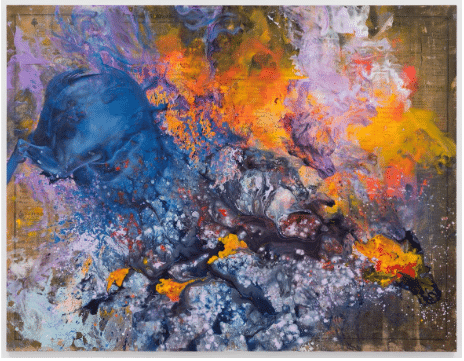
Firelei Baez “Untitled (Les tables de geographie reduites en un jeu de cartes),” 2022. Oil and acrylic on archival printed canvas. 82 3/8 x 105 3/4 in. 209.2 x 268.4 cm.
Firelei Baez creates abstract paintings that, far from meaningless, function as fictional worlds in which the artist explores the legacies of colonialism on a pan-geographic, cosmic level.
With a commitment to embedded storytelling, Baez’s large and exuberant, colorful artworks contain complex and layered uses of pattern, decoration, and gestures. To fully take them in, you must spend time with her paintings and absorb their exuberance and symbolism, reading for the underlying maps, texts, and images as well.
“Les tables de geographie reduites en un jeu de cartes” (a quote that forms part of the title of the painting above) translates to “Tables of Geography, Reduced to a Game of Cards.” It is the name of a set of geographical playing cards created in 1669 which, arranged in the traditional four suits, each suit represents a different continent: Hearts: Europe, Diamonds: Asia, Spades: Africa, Clubs: North and South America. (Picture seventeenth-century colonials literally playing games with the “underdeveloped” homelands of indigenous peoples.)
Close looking will reveal multiple horses, realist horses, spirit horses and ghost horses, galloping Pegasus-like at varied scale across a painterly galaxy of exploding, celestial color and motion. Underlying it all, the canvas is printed with the blow-up of a French newspaper bringing European colonists news of the (since 1664) Spanish/French colony of the modern Dominican Republic, which is where Baez was born. The Smithsonian Museum of American Art acquired one of Baez’s canvases from this series for its permanent collection in 2023.
For the Joy of It
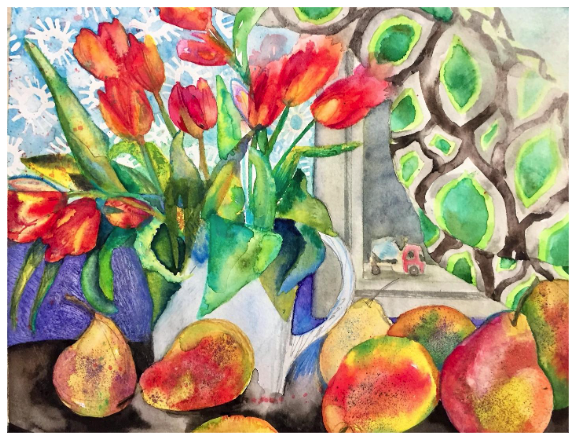
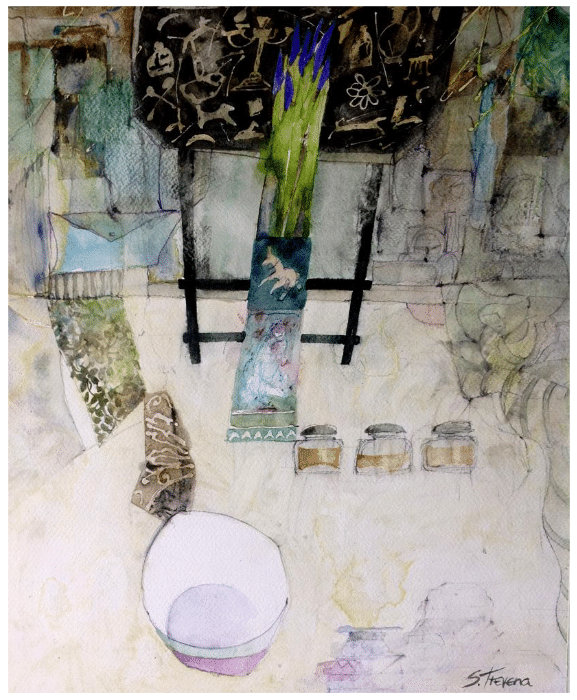
Shirley Trevena, still life, a semi-abstract watercolor painting she often uses in her demo classes.
Shirley Trevena blends representation and abstraction in colorful still lifes with a joyous creative spirit. Born in 1940, she is a well-known watercolorist with an international reputation and is regarded as one of Britain’s most innovative artists in the medium. She is a Member of the Royal Institute of Painters in Watercolour and is author of three best-selling books and DVDs.
Trevena’s videos, which you can stream right to your computer or purchase on DVD, are titled Taking Risks with Watercolour, Breaking the Rules of Watercolour, and My World of Watercolor.
Happy world-building, as the kids these days say.