Alongside his revolutionary North American landscapes, Thomas Cole issued a prophetic warning of cosmic proportions to the so-called civilized world.
The five paintings (or volumes – together they read like an epic poem) in Thomas Coles’ “The Course of Empire” cycle comprise one of the greatest legacies in all of nineteenth century American painting. It’s a monumental work on permanent display at The New York Historical, American history museum and library on the Upper West Side of Manhattan in New York City. Sadly, it is a masterpiece that not enough artists – or for that matter Americans – even know exists.
“The Course of Empire” charts the rise and fall of an imaginary Empire, from pre-civilization hunter-gatherer tribes to utopian vision to desolate ruins.
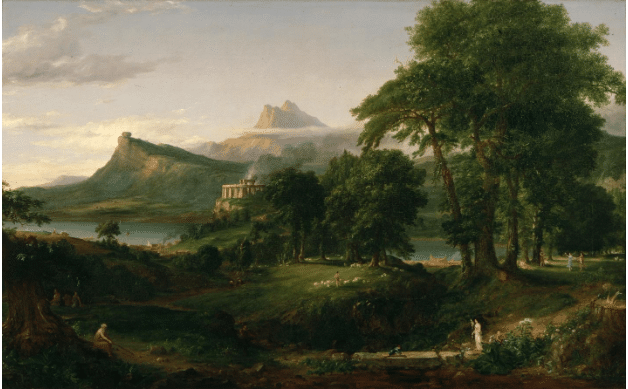
Detail of Cole’s “The Course of Empire 2: The Pastoral State,” 1834, 39.5 inches by 63.5 inches (100 cm by 161 cm).
In advertising the paintings, Cole quoted lines from Lord Byron
There is the moral of all human tales;
‘Tis but the same rehearsal of the past.
First freedom and then Glory – when that fails,
Wealth, vice, corruption – barbarism at last.
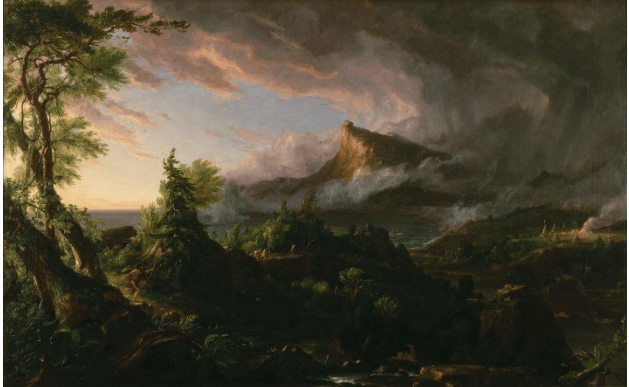
In “The Course of Empire 1: The Savage State,” (top of page) humanity is still in hunter-gatherer mode. The elements of nature run riot, unchecked by agriculture or permanent structures. Storm clouds roiling and primordial mists just beginning to mingle with smoke from a ceremonial bonfire ringed with tiny teepee-like huts. It’s as if we’re witnessing the formation of the habitable world from its original primeval chaos.
Here, as in all five of the paintings, Nature symbolizes the epoch depicted (but in every one of the paintings nature’s power and immensity dwarfs humanity – a hint about who’s really in charge here and how this is all going to end?). In the foreground an archer has grips his bow and runs toward the deer he’s hit mid-stride while leaping over a stream, the arrow plainly visible in the animal’s back.
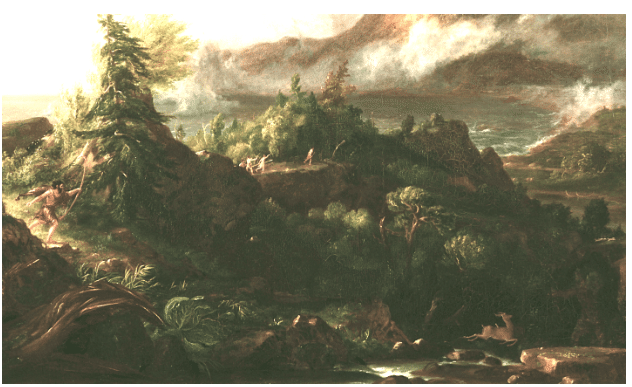
Detail of Cole’s “The Savage State.” Note the hunter chasing after his prey, a buck leaping over a stream, in the foreground.
Cole made several epic allegorical works on a variety of themes common to classical European art and literature. Perhaps the most poignant of these themes, the one to which he most often returned, is the passage of time. Here in “The Course of Empire,” he is describing the arc of human culture from “savage wilderness” through high civilization, to its inevitable destruction and decay as nature reclaims the land’s natural state.
Started as a commission in 1833, the series took three years to complete. All the paintings are oil on canvas, and all are 39.5 inches by 63.5 inches (100 cm by 161 cm) except The Consummation of Empire which is 51″ by 76″ (130 cm by 193 cm).
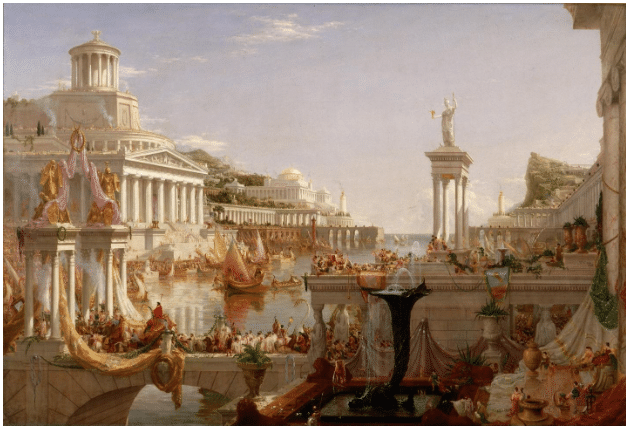
Thomas Cole, “The Course of Empire 3: The Consummation of Empire,” 1835-1836, oil on canvas, 51″ by 76″ (130 cm by 193 cm).
The setting for all five scenes is the same – in all each we can see, from somewhat different angles, the same distinctive mountaintop with a giant boulder on top of it.
If you’ve never seen them, that may be partly because they’re so different from the artist’s pioneering “Hudson River School” paintings. Among art historians though, “The Course of Empire,” is by far Cole’s most famous work, and it very clearly rises above mere scenery. “The Course of Empire” rewards close “reading” (by which is meant a combination of looking and thinking) with vivid and instantly graspable meaning. You don’t have to “look for” the meaning in it because it’s obvious. In fact, it’s right in the title.
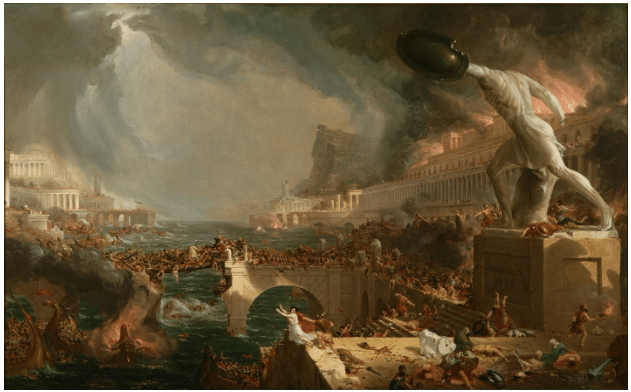
Thomas Cole, “The Course of Empire 4: Destruction,” 1836, oil on canvas, 39.5 inches by 63.5 inches (100 cm by 161 cm).
Thomas Cole’s “The Course of Empire” has been called “one of the most potent works ever painted.” In part two – The Vision – we’re going to continue exploring and enjoying each painting in detail. See you then.
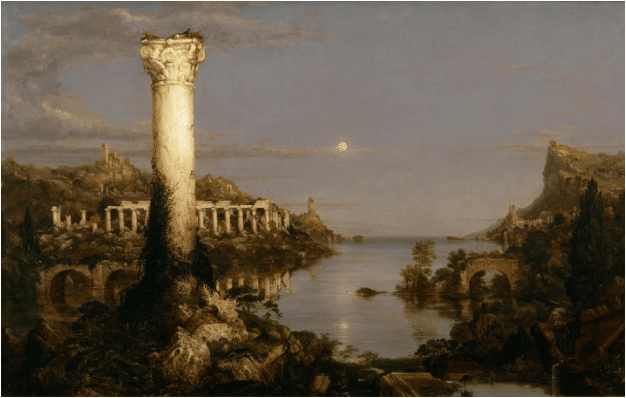
Thomas Cole, “The Course of Empire 5: Desolation,” 1835-1836, 39.5 inches by 63.5 inches (100 cm by 161 cm).
Love the Hudson River School? Contemporary artist Erik Koeppel has reverse engineered everything from the colors they used to the way they depicted rocks, trees, clouds, and skies. His works have been avidly collected over the years, during which Erik has carved out the time to make two professional quality videos teaching what he knows. Check out his video Techniques of the Hudson River School Masters Volume 1 and Volume 2
Until Next Time …
Walt Whitman has a short poem about the kind of primordial landscape that Cole imagined in “The Course of Empire – the Savage State.” He wrote his poem about Colorado, so it’s rockier than Cole’s lush, mist-wreathed greens and mountains, but it makes a nice companion to the painting nonetheless.
Spirit That Form’d This Scene
Spirit that form’d this scene,
These jumbled rock-piles grim and red,
These reckless heaven-ambitious peaks,
These gorges, turbulent-clear streams, this naked freshness,
These formless, wild arrays, for reasons of their own,
I know thee, savage spirit – we have communed together,
Mine too such wild arrays, for reasons of their own;
Was’t charged against my chants (my poems) that they had forgotten art?
To fuse within themselves its rules precise and delicatesse?
The lyrics’s measur’d beat, the wrought-out temple’s grace – column and polish’d arch forgot?
But thou that revelest here – spirit that form’d this scene,
They have remember’d thee.