The Fenimore Art Museum in Cooperstown, NY has acquired an impressive trove of 27 oil paintings by a stellar collection of well-known classic American artists: Albert Bierstadt, Theodore Earl Butler, Mary Cassatt, William Merritt Chase, Frederic Edwin Church, Samual Colman, Frederick Carl Frieseke, William Glackens, Childe Hassam, Martin Johnson Heade, Robert Henri, George Inness, David Johnson, Eastman Johnson, Joshua Johnson, Ernest Lawson, Thomas Moran, Georgia O’Keeffe, Maurice Prendergast, John Singer Sargent, Joan Sloan, Max Weber, and James McNeill Whistler.
The Fenimore is named for the property on which it stands, land once owned by the novelist James Fenimore Cooper. The Museum occupies a 1933 mansion built by Edward Severin Clark, an heir to the Singer Manufacturing Company fortune.
The acquisitions highlight the museum’s effort to expand its already significant collection of American art. This group broadens the scope to include major works created from the 1850s to about 1930, allowing the museum to tell the story of American art and culture as it evolved after the Civil War. Moving forward, Fenimore’s goal is to create a renowned collection of American art that builds upon the early and mid-nineteenth-century works by American artists.
Among the newly added works are these (offered to you, dear reader, as a feast for the eyes):
Martin Johnson Heade (1819-1904)
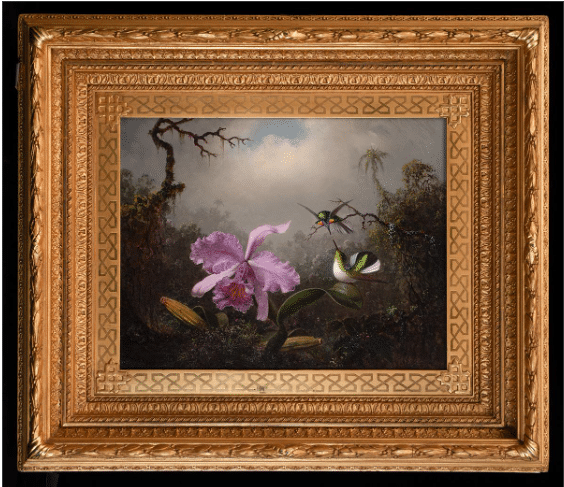
Martin Johnson Heade, Cattleya Orchid with Two Brazilian Hummingbirds, 1871, Oil on panel. Collection of Fenimore Art Museum, Cooperstown, New York. Gift of the Eugene V. and Clare E. Thaw Charitable Trust, N0007.2024(01). Photograph by Richard Walker
In 1863, Martin Johnson Heade traveled to South America, following in the footsteps of fellow painter Frederic Edwin Church, and inspired by the successful publications of artist-ornithologists John James Audubon and John Gould. At the time, an article in the Boston Transcript declared, “It is his intention in Brazil to depict the richest and most brilliant of the hummingbird family—about which he is so great an enthusiast…He is only fulfilling the dream of his boyhood in doing so.”
Heade was fascinated with tropical flora and fauna—studying and painting hummingbirds in Brazil between 1863 and 1865 and making subsequent trips to Nicaragua in 1866 and Colombia, Panama, and Jamaica in 1870. It was not until 1870 Heade considered also focusing on the flowers that he witnessed on these travels. The present work is one of the first instances where the artist painted the two elements of orchids and hummingbirds together—a compositional pairing today considered both the highpoint of Heade’s artistic achievements and an icon of American Art history.
Heade’s early attraction to the mystical hummingbird had huge ramifications for his artistic career, and he diligently studied the various species to perfectly capture their miniature magnificence. In the present composition, the artist painstakingly represents the unique coloring and features of a pair of birds native to Brazil: a horned sungem (Heliactin cornuta), above, and a black-eared fairy (Heliothryx aurita), below. However, unlike his more scientifically oriented predecessors Audubon and Gould, Heade combined a Darwinian attention to accurately cataloguing the natural world with a Victorian emphasis on evoking the latent, transcendent power of nature.
George Inness (1825-1894)
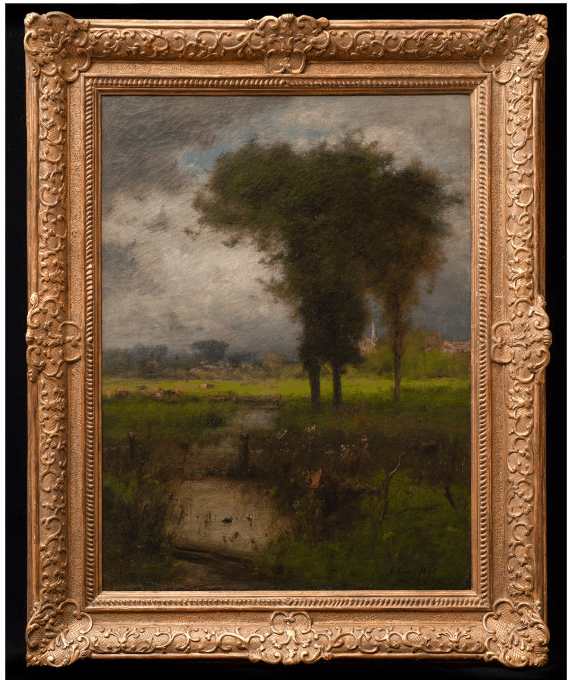
George Inness, “Summer, Montclair,” 1887, Oil on canvas. Collection of Fenimore Art Museum, Cooperstown, New York. Gift of the Eugene V. and Clare E. Thaw Charitable Trust, N0005.2024(01). Photograph by Richard Walker
George Inness’ first international trip, in 1851, took him to Rome and Florence. In Florence, he met the portraitist William Page who introduced him to the writings of the Swedish scientist-turned-mystic Emanuel Swedenborg, which increasingly shaped his personal and aesthetic philosophy. During a stopover in Paris on his way back to New York, Inness was introduced to the Barbizon school. They offered an alternative to the more meticulous work of most of Inness’ Hudson River School contemporaries. While Inness was equally inspired by the idea of divine significance in nature, he was drawn to the fresh, loose brushwork and overt emotional tone of Barbizon paintings.
Although clearly a studio painting, this work contains the grayed color Inness sought in his plein-air landscapes done while the artist was in Milton, Massachusetts and Montclair, New Jersey in the 1880s. The forms are created by numerous layers of thin color applied with a variety of touch, seen clearly in the large elm trees. Due to its remarkable state of preservation, the painting has retained the extremely subtle adjustments of light, color and texture that capture the effect of a landscape recently drenched by a thunderstorm, now clearing off. Despite the presence of ‘Montclair’ in the title of this and many other works from the period, the locations depicted are generally unknown. Instead, they offer spaces for contemplation and reflection, an idea captured in one of his key remarks from the 1880s:
“You must suggest to me reality, you can never show me reality.”
Robert Henri (1865-1929)
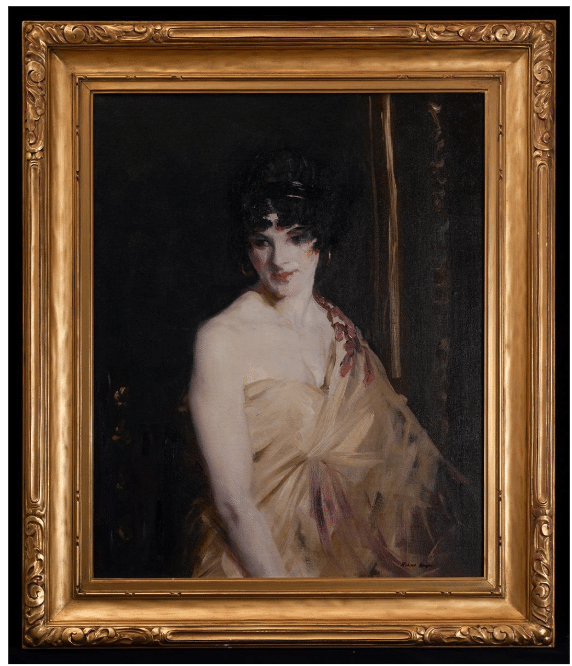
Robert Henri, “Betalo, The Dancer,” c. 1909-1910, Oil on canvas. Collection of Fenimore Art Museum, Cooperstown, New York. Gift of the Eugene V. and Clare E. Thaw Charitable Trust, N0006.2024. Photograph by Richard Walker
Robert Henri (as he pronounced it, HEN–rye) is best known for his unconventional urban realist subjects executed in a bold, painterly style. Although Henri was an important portraitist and figure painter who was admired for his straightforward, vital likenesses of unusual sitters, he is best remembered today as the influential, progressive, and charismatic founder of the so-called Ashcan school of urban realism. A champion of “art for life’s sake,” he was noted for his democratic approach to portraiture and chose sitters from diverse racial groups and walks of life.
Betalo Rubino, a dancer noted for her striking features and unusual dramatic costumes, became an important model for Henri. During 1909 and 1910, he painted a series of portraits of her. In this work, Henri focuses the viewer’s attention on the demure appearance of the model. Each of the works from this group feature the dancer in costume, a yellow satin gown, matching shawl, and gold jewelry. Here, the sweeping brushstrokes visible in the fabric of her garments express tones of yellow and purple and a bold floral pattern liven the monotone palette. She glances away from the viewer, disengaged, in a moment of reflection. The background is further decorated in splashes of yellow and gold which construct the room around her.
Georgia O’Keeffe (1887-1986)
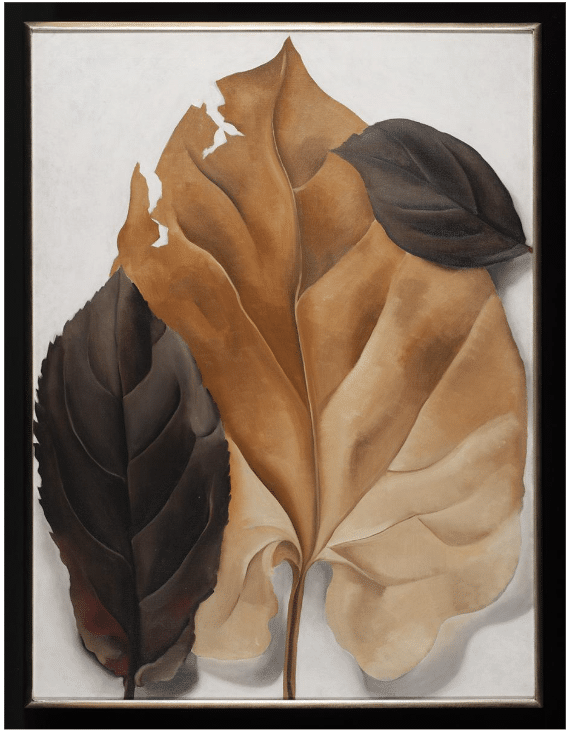
Georgia O’Keeffe, “Brown and Tan Leaves,” 1928, Oil on canvas. Collection of Fenimore Art Museum, Cooperstown, New York, Gift of Eugene V. and Clare E. Thaw Charitable Trust N0014.2023. Photograph by Richard Walker.
Between the years 1918-1934, Georgia O’Keeffe spent extended summers at Alfred Stieglitz’s family estate, located just north of Lake George Village, New York. She found herself inspired by the area, creating over 200 works representing an abstract and modernist take on panoramic views of the lake, mountains, close ups of trees, flowers, and barns as well as intimate, yet monumental studies of leaves. O’Keeffe often collected leaves that appealed to her for their striking diversity of shape and color. She created twenty-nine leaf paintings between 1922 and 1931, all based on leaves she’d found and collected while at Lake George.
The works are on display at the Fenimore until December 29, 2024. You can see and read all about the rest of the newly acquired American masterworks on the museum’s web page.
Okay, But Where are the Wild Things?
(Well, the Wild Things are in Denver!)
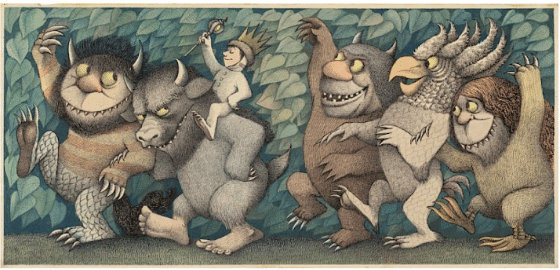
Maurice Sendak, “Where the Wild Things Are,” 1963, watercolor and ink on paper, 9 ¾ x 22 in.
Outside Over There and Nutshell Library. He also designed theater sets and collaborated on films. Wild Things opened at the DAM on Oct. 13, 2024 and will be on view through Feb. 17, 2025, in the museum’s Hamilton Building.
The show includes a wide array of objects, drawings, paintings, and mockups. It also includes sketches for the set designs of the Where the Wild Things Are opera and costumes for the live-action, feature-length film.
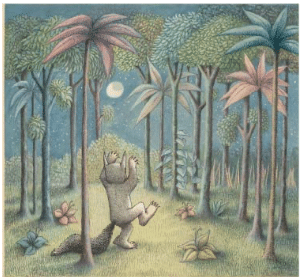
Wild Things is titled after Sendak’s Where the Wild Things Are, the beloved children’s book he authored in 1963 that became a cultural touchstone, signaling to all the beauty, whimsy, and mischief that his inspired his pens and brushes over a 65-year career. Among many other highlights, the exhibition will feature the first presentation of all the original paintings for Where the Wild Things Are and significant additional loans from The Morgan Library & Museum in New York and Warner Bros. Entertainment, Inc.
“Maurice Sendak’s art tells stories of courage, adventure, resilience, curiosity and a deep understanding of the human desire for connection and discovery,” says Christoph Heinrich, Frederick and Jan Mayer Director of the Denver Art Museum and co-curator of this exhibition. “Sendak’s identity and experiences as a first-generation American, combined with the legacy and heritage of his Polish Jewish family, especially through WWII and the Holocaust, make his personal perspective and artistic insight immensely valuable, powerful and timeless.”
Following the success of Where the Wild Things Are, Sendak embarked on a second career as a stage designer and producer for theater productions including The Magic Flute and The Nutcracker throughout the 1980s. He collaborated with many of the greatest writers, directors and composers of his time and received numerous awards throughout his career, including the Caldecott Medal, the Hans Christian Andersen Award and the National Medal of Arts, making him the most celebrated picture book artist in history.
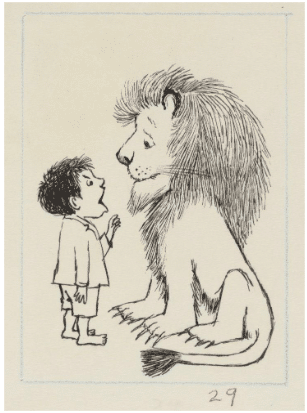
Maurice Sendak, “Pierre,” 1961-2, ink on paper, 4 ¾ x 3 ½ in.
Wild Things Are Happening: The Art of Maurice Sendak has been co-organized by the Denver Art Museum and the Columbus Museum of Art in partnership with The Maurice Sendak Foundation. It is curated by Jonathan Weinberg, Ph.D., Curator and Director of Research at The Maurice Sendak Foundation and Christoph Heinrich, Frederick and Jan Mayer Director of the Denver Art Museum.
Generous support is provided by Bank of America, Kent Thiry & Denise O’Leary, the donors to the Annual Fund Leadership Campaign, and the residents who support the Scientific and Cultural Facilities District (SCFD). Promotional support is provided by 5280 Magazine and CBS Colorado.
Planning Your Visit
The most up-to-date information on planning a visit to the Denver Art Museum can be found online under the Plan Your Visit tab. Use this page to find details on ticket pricing, public transit options and access information. General admission for museum members is free every day. Youth aged 18 and under receive free general admission everyday thanks to the museum’s Free for Kids program. Free for Kids also underwrites free admission for school and youth group visits.
About the Denver Art Museum
The Denver Art Museum is an educational, nonprofit resource that sparks creative thinking and expression through transformative experiences with art. Its holdings reflect the city and region—and provide invaluable ways for the community to learn about cultures from around the world. Metro residents support the Scientific and Cultural Facilities District (SCFD), a unique funding source serving hundreds of metro Denver arts, culture and scientific organizations.
For museum information, visit www.denverartmuseum.org or call 720-865-5000.