At this time of year, as the Winter Solstice approaches and night comes sooner for us than before, we in North America are obliged to “grow accustomed to the Dark” in the words of Emily Dickinson, perhaps in more ways than one:
We grow accustomed to the Dark—
When Light is put away—
As when the Neighbor holds the Lamp
To witness her Goodbye—
A Moment—We uncertain step
For newness of the night—
Then—fit our Vision to the Dark—
And meet the Road—erect—
And so of larger—Darknesses—
Those Evenings of the Brain—
When not a Moon disclose a sign—
Or Star—come out—within—
The Bravest—grope a little—
And sometimes hit a Tree
Directly in the Forehead—
But as they learn to see—
Either the Darkness alters—
Or something in the sight
Adjusts itself to Midnight—
And Life steps almost straight.
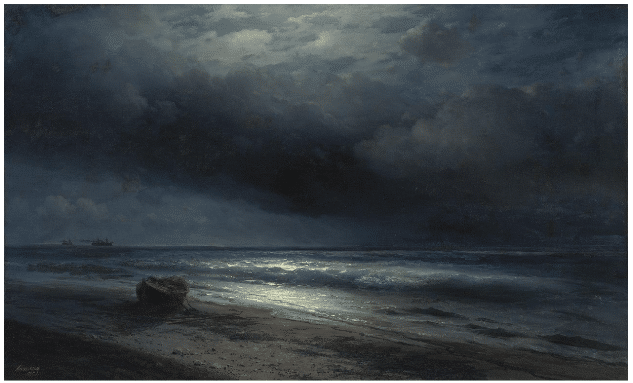
Emily Dickinson’s poem gives us an internal, psychological version of the visceral, dramatic mood that we see in paintings like Ivan Aivasovsky’s painting above, where the moon illuminates a deserted beach to reveal a small boat washed ashore with two steamships in the background. A similar feeling broods behind Winslow Homer’s Wood Island Light and Rufin Gavriilovich Sudkovsky’s lofty clifftop moonrise of 1880 (both below).
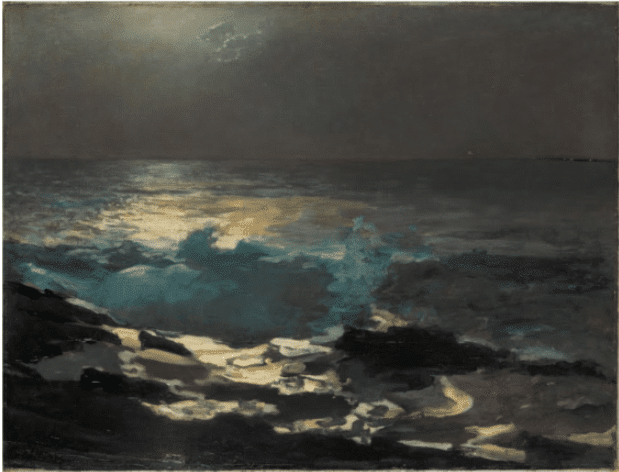
Winslow Homer, Wood Island Light, oil, 30 3/4 x 40 1/4 in. (1894)
In Winslow Homer’s “Wood Island Light,” one of the many Homer painted near his home in Prout’s Neck, Maine, the moonlight adds an intense amount of drama. The moon itself is veiled by clouds and outside the frame, but its light alternately bleaches and gilds the surf. The lights on the ocean and wet rocks amps up the drama as it contrasts with the deep-shadowed blacks of the shoreline.
We get a variation on the theme in the works of Ukrainian artist Rufin Gavriilovich Sudkovsky. A 19th century Imperial painter, Sudkovsky specialized in monumental seascape and maritime scenes. Few landscapist have captured so well the almost sacred hush that settles on the ocean in moonlight viewed from atop a high rough outcropping of headland or a calm, mountain-girded shore.
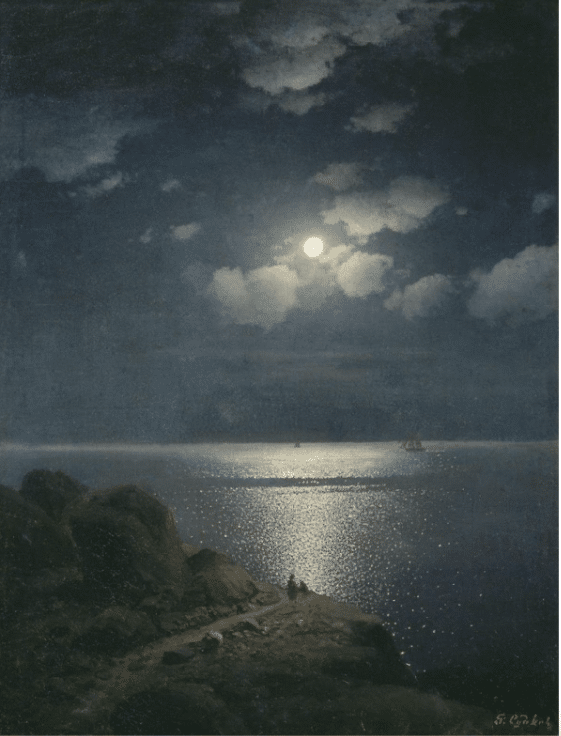
Rufin Gavriilovich Sudkovsky, Moonrise over the Ocean, 1880
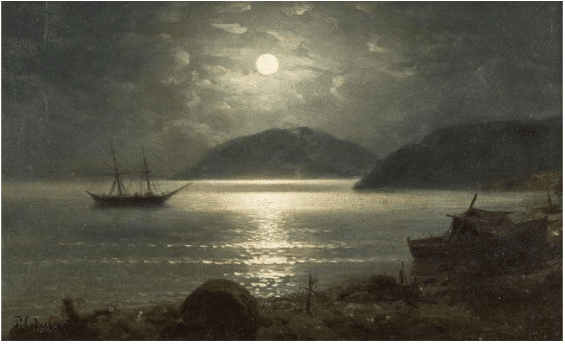
Rufin Gavriilovich Sudkovsky, “Ship on a moonlit bay”, 1881, 8.9 x 13.9 in.
This poem by unjustly neglected 18th century poet Charlotte Smith captures the mood as well:
Huge vapours brood above the clifted shore,
Night o’er the ocean settles, dark and mute,
Save where is heard the repercussive roar
Of drowsy billows, on the rugged foot
Of rocks remote; or still more distant tone
Of seamen, in the anchored bark, that tell
The watch relieved; or one deep voice alone,
Singing the hour, and bidding “strike the bell.”
All is black shadow, but the lucid line
Marked by the light surf on the level sand,
Or where afar, the ship-lights faintly shine
Like wandering fairy fires, that oft on land
Mislead the pilgrim; such the dubious ray
That wavering reason lends, in life’s long darkling way.
In contrast, American artist Charles Woodbury’s Mid-Ocean (below) takes a different approach to the moonlit ocean. In Woodbury’s chilly “Mid-Ocean,” we’re at sea completely, no land visible. Dark swells eclipse the horizon, foreshadowing the arrival of the storm we see in the top right corner.
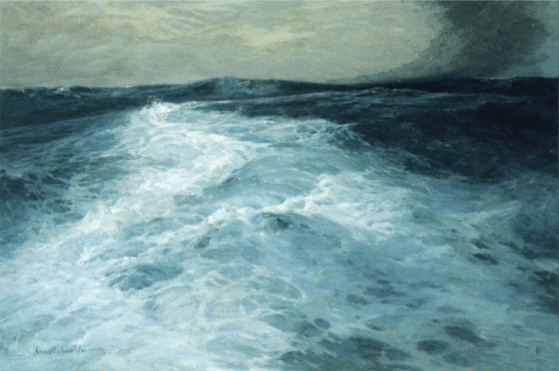
Charles Woodbury, Mid-Ocean, 0il, 1894, 124.5 x 182.9 cm | 49 x 72 in.
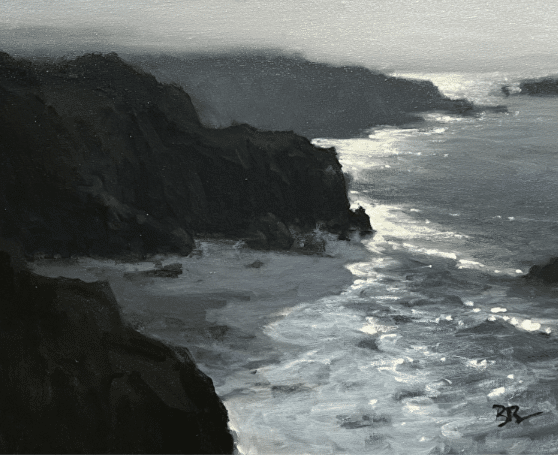
Brian Blood, “Coastal Surf,” oil, 16 x 20 in.
Brian Blood is known for paintings of the California coast such as the moonlit nocturne “Coastal Surf” above. Blood’s painting, “The Setting Sun” (below) was picked among the 100 finalists for the October 2025 PleinAir Salon.
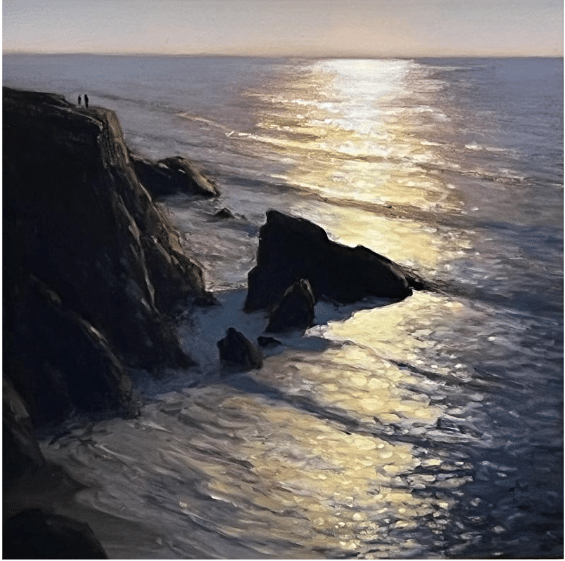
Brian Blood, “The Setting Sun,” oil, 22 x 22 in.
He teaches his techniques and approach to the landscape in his video “Plein Air By the Sea.”
Kathleen Hudson’s Rolling Surf (below) pairs a bright surf-tossed shoreline with a sky on the dark side for atmosphere and drama. By tilting the rocks and sand on a diagonal, Hudson conveys the sense of movement as water at the tideline washes back into the sea while the incoming wave crests and crashes.
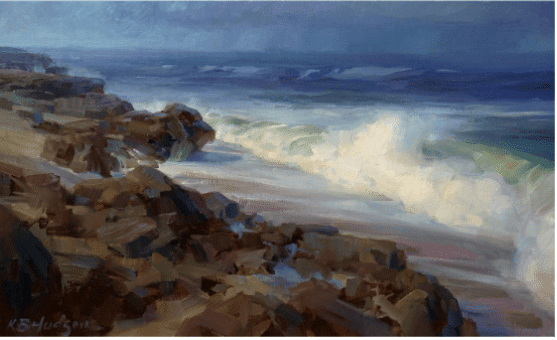
Kathleen Hudson, Rolling Surf, Oil on linen panel, 13 x 21 in.
Kathleen Hudson shares her oil painting technique in the video Creating Dramatic Atmosphere in Landscapes. Or, you can browse multiple approaches to painting the ocean here.