Andrew Wyeth (1917-2009) is often celebrated for his realism and his technique, particularly his meticulous details such as blades of grass, tiny crevices, subtle wear, or grains of sand. What’s not as often discussed is how he created meaning in his work.
Wyeth created lasting work because he drew inspiration from deep wells of emotion and a sense of the pregnant image; he understood how the expressive (or what some would call the archetypal) quality of certain images ensures they lodge in our psyches where they touch off a myriad of thoughts and sensations – something only very good art can do.
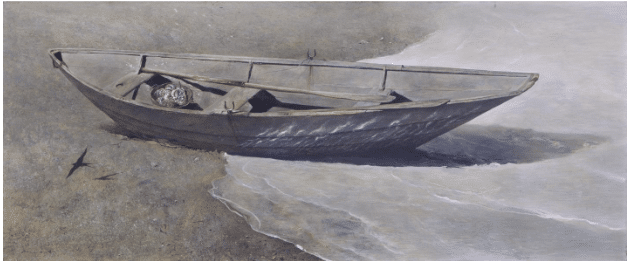
Wyeth called Spindrift (1950 – above) a “portrait” of one of his Maine acquaintances. It’s a fairly large painting (three feet across) done in tempera on panel. The colors are opaque and muted, and the surface is matte.
Half in and half out of the water, housing a bucket of freshly harvested bait fish, the boat has the feeling of being left momentarily. Hard use has battered the oars, the sea and weather have worn the boat’s paint off, and years of oarlock rust have stained the boards.
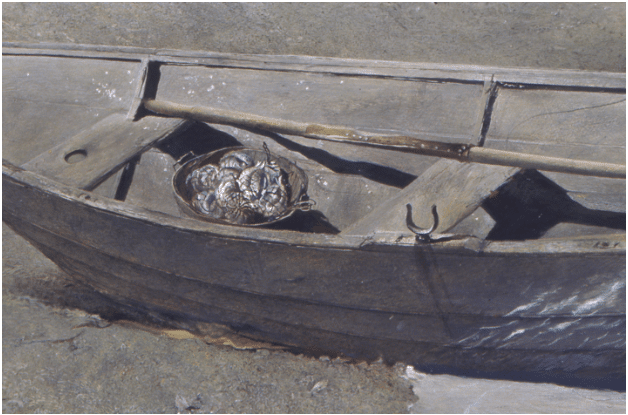
Detail of “Spindrift” showing the wear on the oars, the bucket of bait fish, and a prominent oarlock (it’s the closest part of the boat to the viewer), half in light and half in shadow, and very much empty, standing almost as if bereft.
Wyeth began to infuse his work with this sort of somber and enigmatic quality that persisted throughout his career following the untimely death of his father at a railroad crossing in 1945. It’s that quality which transforms a seemingly “simple” painting of a boat into a feast for heart and mind.
Because Wyeth painted it horizontally, without much in the way of the linear interest a more dynamic perspective would have provided, the boat seems at once stately and somehow naked – laid bare. If you see it in person, the painting can really make you feel like you’re sneaking a look at somebody’s stuff when they aren’t there.
To the left of the hull we glimpse the silhouette of a swallow in flight, providing a counterpoint of motion to the stationery dory. It seems a minor detail, but in fact the whole painting presents a balance between motion and stillness. The stationary/in motion dichotomy is apropos of a temporarily abandoned object whose owner is absent yet present in the object itself, and soon to return at that. Wyeth makes sure we see the bird’s shadow as it skims across the minutely textured sand.
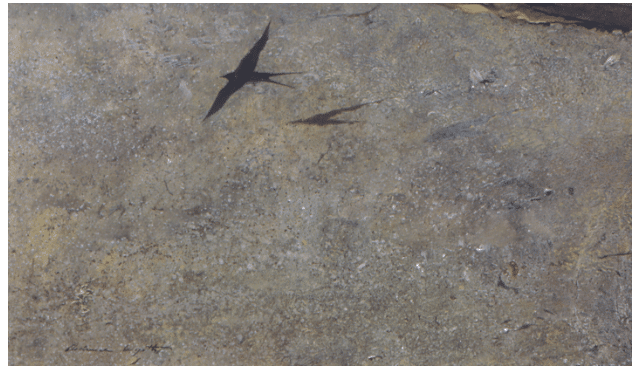
Detail of Wyeth’s “Spindrift” showing the sand texture and the silhouette of the bird and its shadow.
The overall lack of bright color or dramatic contrast in favor of a somber tonality create a mood, one that supports a symbolic role for the open boat: poised between motion and immobility, the cold grays of the ocean and the warmer grays in the sand, life (the quick-passing swallow) and death (the shadow, the dour wash of grays, the absence, the wear) cross paths.
Wyeth wrote of it: “Henry Teel would come in from hauling lobster pots about 10:30 in the morning, pull his dory up on the beach, stow his oars and tackle neatly, and go indoors to cook himself a meal. This is a portrait of Henry without showing the man himself: these are all the things he used, shaped by his life and by the sea.”
Wyeth loved objects whose glory lay in the past, things that told him about time, and surviving loss, and about the people whose lives came close to his. He was more emotional than Hopper, investing rural American objects and architecture with the adagio of a minor-key sonata.
He’s a bit like Robert Frost, in that many people find him approachable because he’s a straight-up realist in style and clearly steeped in unpretentious rural American iconography. Yet like Frost’s poems, Wyeth’s paintings are more complex and often, perhaps, darker than many realize.
The Currier Museum in Manchester, New Hampshire, which owns this work, has this to add:
“Painted only a few years after the death of the artist’s father, Wyeth’s image of an empty boat may serve on some level as a memorial to a beloved parent. “Spindrift” is a nautical term describing spray blown from the sea by ocean winds. As a title, its meaning may embody any number of associations. Given the context of his father’s death, it is perhaps evocative of dissolution and the evanescence of life.” All things must pass.
“Spindrift” recalls a memorable line from American poet Hart Crane’s cryptic poem “Voyages II,” which ends:
Bind us in time, O Seasons clear, and awe.
….
Bequeath us to no earthly shore until
Is answered in the vortex of our grave
The seal’s wide spindrift gaze toward paradise.
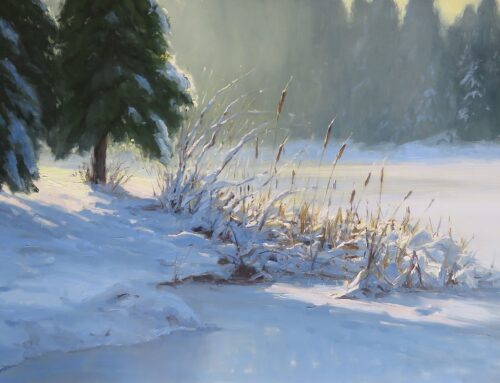
Tempera is made of colored pigments combined with egg yolk as a binder. Gouache, though very similar in appearance, is a watercolor medium consisting of a natural color pigment, water and a binding agent.
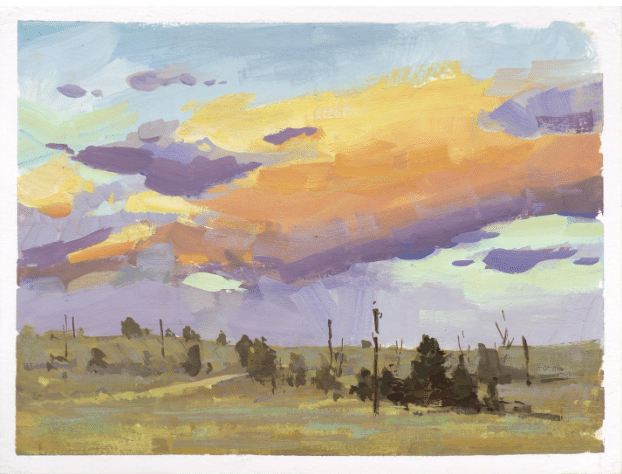
Judd Mercer, “Chatfield Farms, CO,” gouache, 6×8 in.
If gouache appeals to you and you’d like to learn more, look into the one-day online event Gouache Live!, coming on August 23, 2025.
Art Snippet: Know Your Shadow Types
By Contributing Author Brenda Swenson
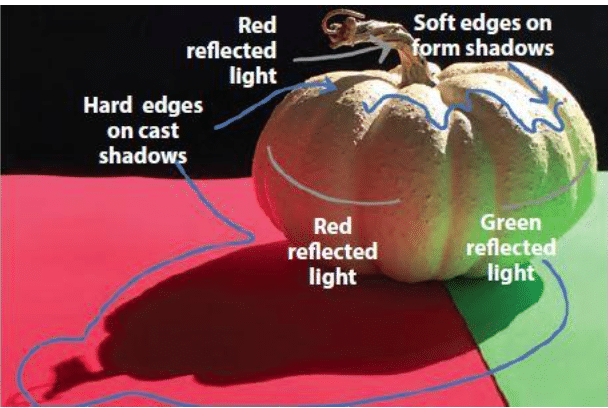
Types of Shadows
Cast shadows suggest the shapes of the objects that cast them and have distinct edges. The further a cast shadow is from the source, the more it is infiltrated by light; as a result,
it becomes warmer, softer, and paler. Cast shadows are darker in value than the objects on which they’re cast.
Form shadows are delicate in appearance and play an important role in making a subject appear three-dimensional. Form shadows are lighter in value than cast shadows. Because form shadows aren’t created by a blocked light source, but by turning from the light source, they also have softer or less-defined edges.
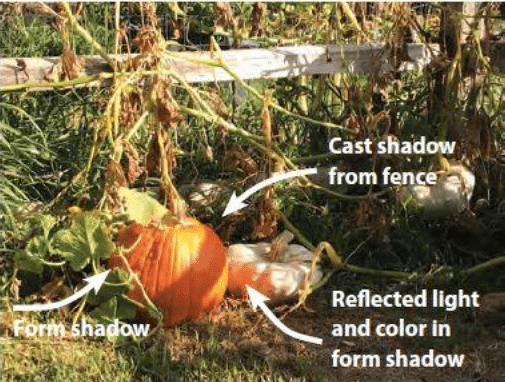
The illuminated area near an object reflects, or bounces, light into the shadows and carries color with it — this is called “reflected light.” The orange pumpkin on the left has form and cast shadows. In case you missed it, see Brenda’s free lesson on negative painting, in which she uses this reference photo.
In this art video workshop with Brenda Swenson, you’ll learn that paintings benefit from a variety of positive and negative painting. Brenda outlines the tools and materials needed for this approach before entering into a step-by-step demonstration of this process. [Learn more about negative painting with watercolor here!]