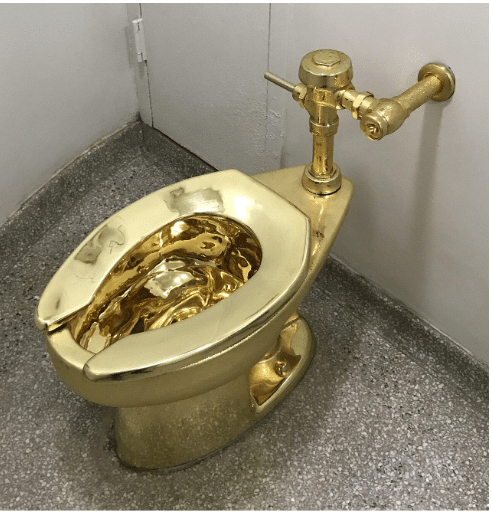
Outbid at auction for Maurizio Cattelan’s $6.2 million 2019 work, titled “Comedian,” which consisted of a banana duct-taped to a wall? Then can I interest you in a $12 million work by the same artist, this time consisting of a (working!) solid 18K gold toilet?
That’s how much the gold commode pictured above fetched at auction at Sotheby’s last week.
“Oh, come ON! That’s not art!” I hear the voices rise in outrage, disgust and disbelief.
Actually, it is art – just not the kind of art most of us think of when we think about art we love.
This is art that’s made specifically to hold a mirror to what’s wrong with how we, as a culture, treat art. It’s supposed to make us mad but not at artists for getting rich from crap art (they aren’t, as I’ll address shortly). It’s intended to out the market for valuing crap art to begin with. It’s literally a joke – (which is why the banana was titled “Comedian”) – but it’s a joke that makes a serious point.
This art (a kind of performance piece if you include the ludicrous sale) criticizes how capitalist culture places seemingly arbitrary (and obscenely high) value on certain works of art and neglects others. It’s almost like the system we have in place for valuing art is all about money! And that is precisely the point – it’s supposed to tick you off. Again, not at art and artists – but at how the contemporary art world as a whole often makes itself rich by mistreating art and artists and distorting our very definition(s) of art.
Contrary to what most assume, contemporary American artists in general aren’t selling works for millions of dollars – the auction houses are. The artists themselves whose works are fetching big auction prices are often left high and dry, desperate to scrape up enough dough to keep going (don’t believe me? Go here. Works like Cattalen’s bring attention to this and force us to question the culture’s shaky definition of art and how/why it’s “valued.”
Actually, I think Cattelan’s work is intended to do three related things: one is to make us smile.
Another is to roast the whole art world establishment. The artist made a “sculpture,” an 18K toilet, to make the ridiculously capitalistic art world look stupid for being willing to pay millions of dollars for literally, a toilet.
The third thing this kind of conceptual art is intended to do is goad us into thinking about what we truly “value” – to question how we, as a society, value art and why. How far do we really want to bring together art and life?
Conceptual art like this is an attempt on the part of artists to fight against the elitism and overpricing of the art market. This has been a side quest of art ever since the commercial art world became a thing in the 20th century. Cattelan’s work in fact pays homage to the originator of this anarchistic vein of creativity, namely, the French provocateur Marcel Duchamp.
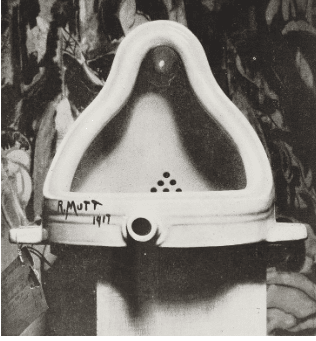
Marcel Duchamp, “Fountain,” sculpture, 1917
It all goes back to Duchamp. Forever blurring the lines between art and life, this absurdist artist famously ridiculed the art establishment by successfully passing off a urinal as a work of art at a New York art fair in 1917. The serious point it made is that we don’t really have a solid definition of what counts as art. Cattelan’s work does the same thing. However, by titling his work “America,” Cattelan adds a political dimension to the gesture: To some, he implies, America is known for producing gobs of mass-produced merchandise, the primary purpose of which is to make as much money as possible for those who produce it. Give it a minute of thought and serious questions arise: What kind of culture do we want to have? What is art supposed to do? What do we believe in and value?
Like Duchamp’s “Fountain,” Cattelan’s “America” is art that disappears behind the mirror it holds up to society. Thereby it doesn’t do what we think of as truly great or moving art as doing. Instead, it does something perhaps equally important: it invites to us ask questions about our world, about what art is, and about what role we want are to play in our lives.
People love to hate this kind of work for its absurdity, but the absurdity is the point. Whatever other roles it plays, it reminds us that we the people should define what counts as art and demonstrates how grotesque, in the eyes of many, an overpriced, elitist, speculative art market we’ve trusted with that job has become.