“I prefer winter and fall, when you feel the bone structure of the landscape – the loneliness of it, the dead feeling of winter. Something waits beneath it, the whole story doesn’t show.”
-Andrew Wyeth
What hidden “stories” wait beneath the winter and fall landscapes Andrew Wyeth loved to paint?
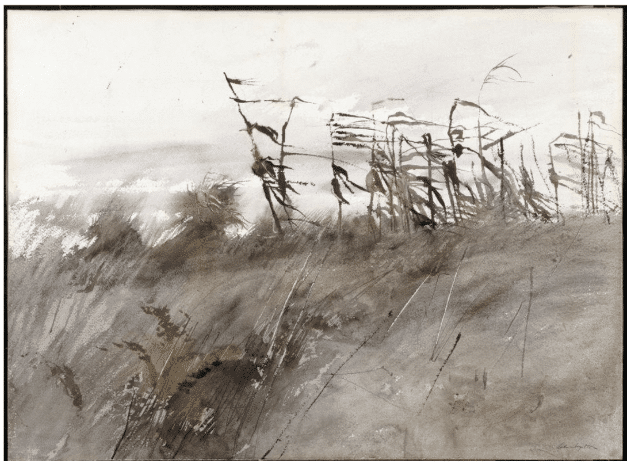
Wyeth’s watercolor November First takes tattered cornstalks swaying in the wind and raises them to the level of visual poetry. A close reading of November First yields clues to how that happens and reveals something about the “story,” albeit untold, that make it a great painting.
It’s not the subject but the subject combined with the way Wyeth paints it, that makes this painting more interesting and engaging than a merely descriptive landscape.
Wyeth positions the viewer at an unusually low level beneath the subject. This diminishes the human element from the start. However, it’s interesting that if we cut off the lower portion of the painting, it still works. But it’s a different painting, and it feels different.
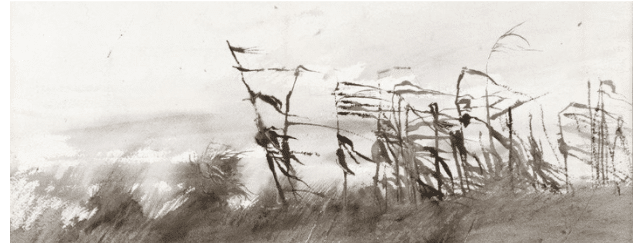
As Wyeth composed it, the hill’s rise and tilt to one side positions us staring up at the sharp-edged barbs and spears of the stalks dominating a bright patch of sky drained of color. Here is where we find the painting’s darkest darks and the starkest contrasts. There’s nothing much else to hold onto – the scene is devoid of any hint of shelter or other manmade elements. The foreground is complicated by a number of lines that, more than representing dead grasses, insist on being read as needle-like slashes of paint.
“November First” is nearly monochromatic. With only grays and the grayest of earthtones, the lack of color helps convey that life itself has seemingly drained away from this barren little part of the world.
Wyeth left quite a bit of raw, rough-edged patches and lines throughout his brushwork. Of course, he was capable of the most photo-like realism, but here the color and paint-handling evoke much more than they depict.
The Smithsonian Museum of American Art, which owns the painting, notes this cornfield was located near Wyeth’s studio in Chadds Ford, PA, behind the house of Dr. Margaret Handy, the pediatrician who cared for Wyeth’s two children. It may helps us feel what’s in this painting if we imagine Wyeth, worried about the kids, side-eyeing the withered stalks scratching against each other in the wind.
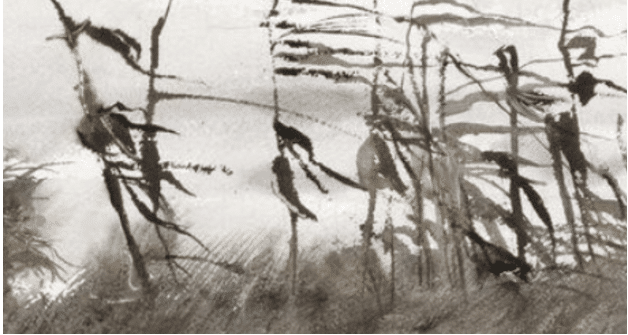
It doesn’t take much imagination to anthropomorphize and translate those cornstalks into figures. If those were people coming over the crest of that hill, what kind of people and what shape do you suppose they’d be in? I think they’d be desperate, lost maybe, clothed in rags, struggling to survive some brutal winter storm, soldiers perhaps, or refugees.
They lean into the punishing wind, which resists them and whips back their withered leaves. There’s a division, on either side of the exact middle of the canvas, of the larger group on the right and the two stalks separated out on the left. That separation reinforces the sense of isolation the arrangement conveys.
Every aspect – the subject, the composition, the contrasts, and the constricted palette, contribute to that “whole story” Wyeth says he sensed – something to do with the inevitable cycles of decay and renewal. It’s a story that’s never fully told but it’s one we all know well, that feeling of time passing, mortality and hope for new life, something a parent might feel for a second or two walking a sick child to the family doctor’s door.
If you’re interested in painting winter landscapes in watercolor, you might want to follow along with master painter Sterling Edwards in his video Brushwork Techniques for Expressive Watercolor, in which Sterling focuses on improving your brushwork and getting feeling into a snowy landscape. Watch a four-minute preview here.
And now for something completely different…
Art that Asks the Big Questions – and also says Hug Me!
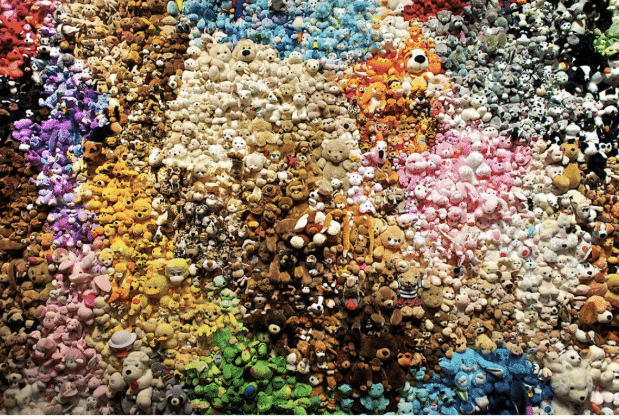
Claude Cormier, Stuffed Animals, 2012, 3,000 stuffed animals, wood
Canadian artist Claude Cormier makes “paintings” with stuffed animals. From across the room, Cormier’s work Stuffed Animals at the Montreal Museum of Fine Art reads like a colorful abstraction. Get closer and you realize it’s plushies – 3,000 of them to be precise.
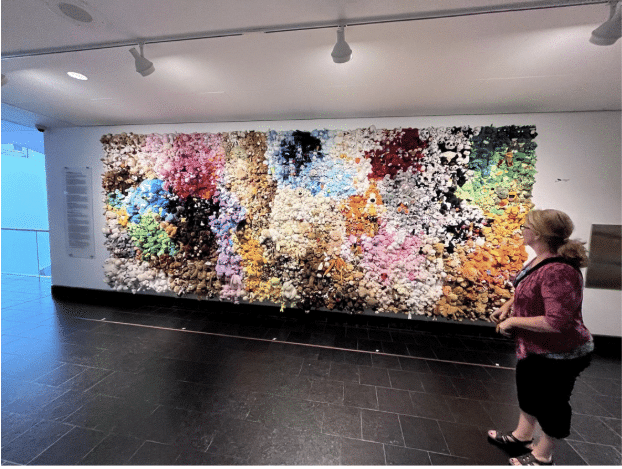
As the artist points out: “Hundreds of stuffed animals lovingly stare out at us. In the incredible hustle and bustle that colors our all-too-brief lives, we crazy little creatures all ask ourselves the same eternal questions, the one so dear to Gaugin: ‘Where do we come from? Who are we? Where are we going?’
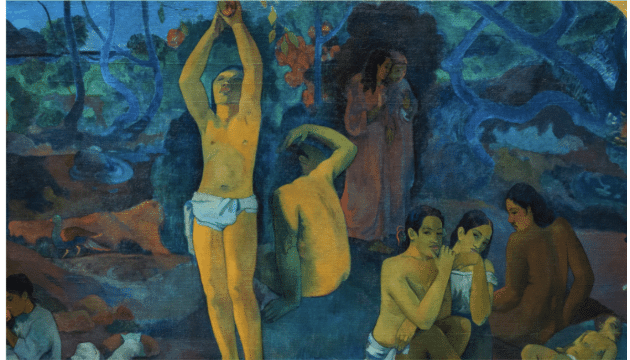
Detail, Paul Gauguin, “Where do we come from? What are we? Where are we going?,” 1897–98, oil on canvas, 139.1 x 374.6 cm (Museum of Fine Arts, Boston