One of the great things about art is that it brings people together.
Imagine our distant, hunter-gatherer ancestors, how they crowded into a low-ceilinged cave by candlelight to watch, as the flickering light made images of animals painted in ochre seem to gallop and graze right before their eyes – a kind of magic. If not a serious spiritual ritual (which it might have been), it was surely a way of bonding and being close to one another. Perhaps it was even something not completely unlike what we do when we go to see a movie with family or friends.
Art that rises above the common denominator, immune to the contentious politics of the day, can offer community, wholeness, and connection above and beyond THE NOISE. Painting is mental engagement and emotional energy. Art slows us down, asks that we learn its secrets and apply them to our understanding of ourselves and others. Life lived passionately inspires art, and art in turn inspires passion for a life well-lived!
Art nourishes self-reflection and passion for life. It grounds us, and it exalts us at the same time. It gets behind the habitual and the predictable and shows us things we otherwise couldn’t see. “This insight,” to quote Ralph Waldo Emerson, “which expresses itself by what is called Imagination, is a very high sort of seeing.”
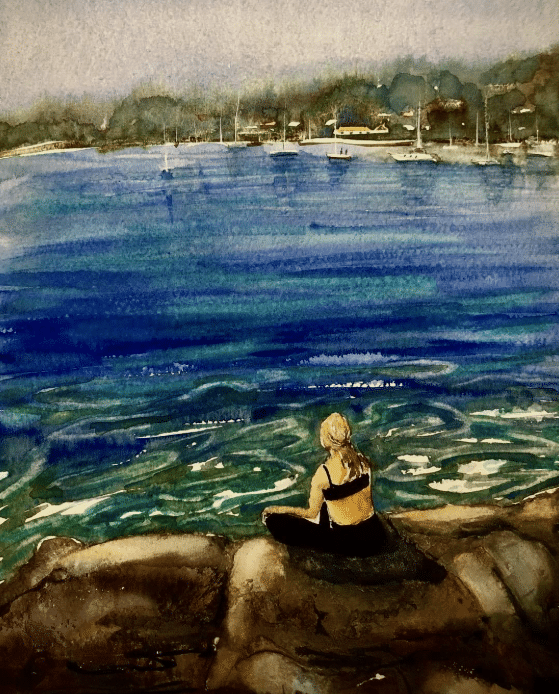
Georgia Mansur, “Peace.”
You’ve probably have heard the phrase “seeing like an artist.” It can mean lots of things, but connecting imagination with a “very high sort of seeing” points to a way of sharing and responding to a heightened experience of the world that many, many of us aspire to. Is it too absurd to believe that a way of seeing and living life has the potential to unite people, like those gatherers in the cave, with a common aspiration to be better human beings for ourselves and others?
The kind of “seeing” Emerson means comes from cultivating a relationship between what German poet Frederic Holderlin called our “feeling hearts” and the “gods.” It is with a sort of spiritual vision, which philosopher Becka Tarnas calls “the eye of soul,” that we locate “the opening of a realm in which the true beauty of the anima mundi (James Hillman’s term for the world soul) can be revealed.”
For representational artists, this often involves moments of insight into what strikes one as the truth and beauty of things, as Matisse laid out: “The essential thing is to spring forth, to express the bolt of lightning one senses upon contact with a thing. The function of the artist is … to express the shock of an object on his nature; the shock, with the original reaction.”
In cultivating cultural bonds, sharpening perception, and expanding consciousness, art fosters a heightened awareness that inspires deeper, more intentional living with fresh eyes and an open mind and heart.
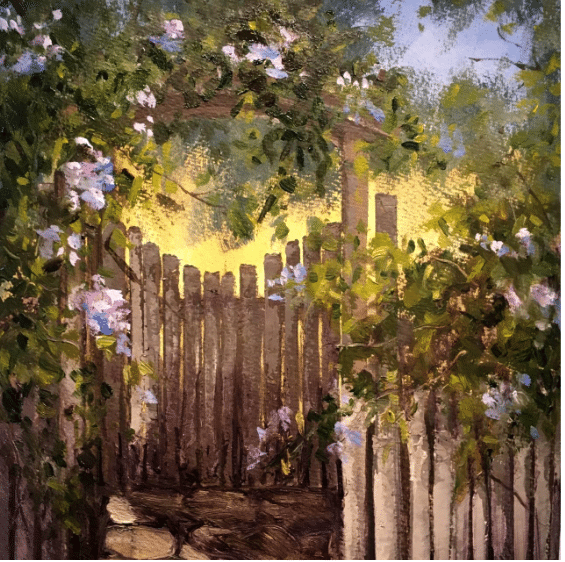
Georgia Mansur, “Garden Gate.”
“Art is not an outside and extra thing; it is a natural outcome of a state of being… the object is intense living, fulfillment; the great happiness in creation.” – Robert Henri
A painting is not just an accurate drawing or a collection of well-executed rules, tips, and tricks we collectively agree make a “good” painting. “All paintings are human creations that are, in effect, self-portraits, either for the individual or as a species,” in the words of writer and artist Lincoln Perry.
The more you study and learn to appreciate art – what it is, where it comes from, how and why – the many purposes for which it’s made – the richer your inner life and the more passionate about making art – and living life – you may become.
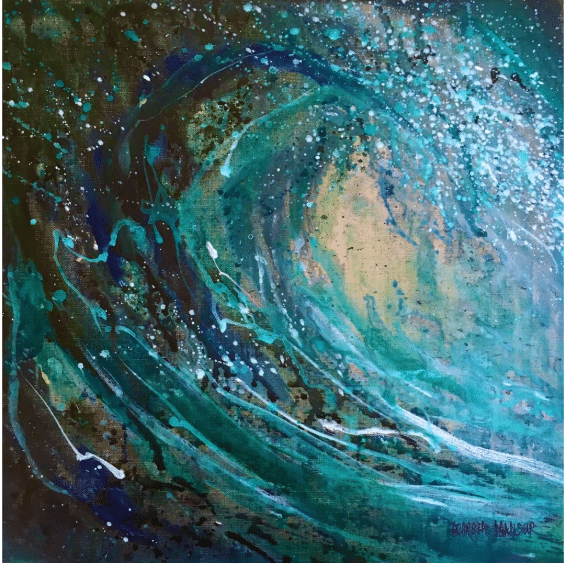
Georgia Mansur, “Splash”
Check out Georgia Mansur’s two teaching videos, one on vibrant watercolor and the other on simplified seascapes in acrylic, here.