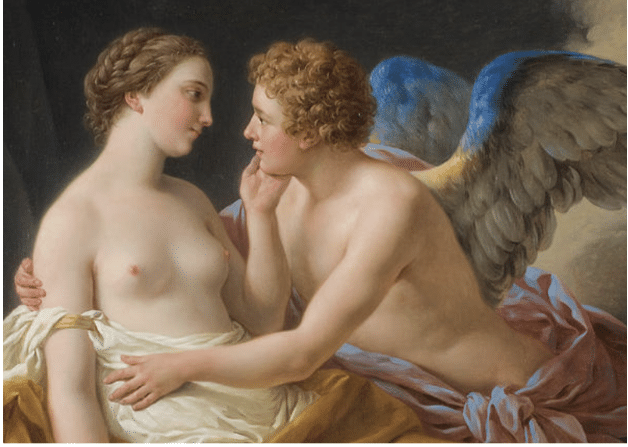
“It is a difficult matter to keep love imprisoned.”
-Apuleius, The Tale of Cupid and Psyche
“Apuleius reminds us that love—like art—cannot be confined.” So writes author Brainard Carey commenting on the above quote by the classical Roman author Apuleius. Brainard continues with the following:
“Both (love and art) are born of the spirit and thrive beyond the limits of reason, structure, or expectation. Love, much like a painting or a poem, defies rigid boundaries; it flows freely, often irrationally, guided by emotion and imagination rather than logic. Art, too, is an expression of the ineffable, capturing the unseen, the deeply felt, and the mysterious. In this way, love and art mirror each other. They are passions of the soul, transcending the ordinary to reach something eternal, something beautiful that cannot be easily explained or restrained.”
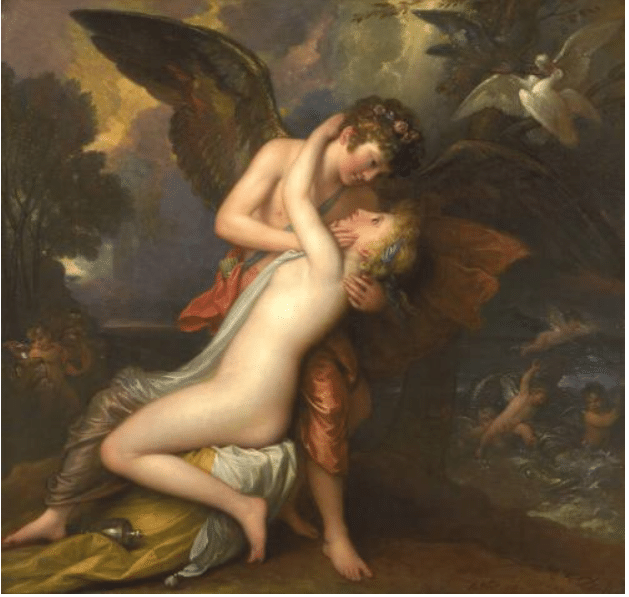
Benjamin West, Cupid and Psyche, Oil, 54 x 56 in.
“Love is an art, just as living is an art,” said the human potential psychologist Erich Fromm. Both art and love involve a deep connection with the world, a creative expression of emotions, and a desire to connect with others. They both require effort, dedication, and a willingness to be vulnerable, too. Making art, like falling in love, involves mystery, chance, instinct, and trust. Both demand a willingness to take chances, to risk feeling awkward, being misunderstood, to appear foolish, childish, inexperienced, clumsy, and even, in the unlikely event of being successful, to come off as self-congratulatory and self-important!
And art, like love, can come in the most unlikely forms. Just as we tend to carry a lot of preconceived notions about the kind of person we are supposed to love, we can have baggage around what kind of art we’re “supposed” to like or make and how it’s supposed to make us (or our viewers) feel. But just as no one should feel ashamed for loving what they love or not loving what they don’t, the majority of potential art lovers who wish to simply look and think and react shouldn’t feel inadequate, dumb, or unworthy if they don’t love a particular work of art, at first sight or otherwise.
Sometimes, however, we can make snap judgments about people. We can do the same thing about paintings too. If we were to take the time to get to know them better, we might well end up liking then and – who knows? – maybe quite a bit more. It’s fine to say, “I know what I like.” Just be sure you’re giving it a chance, that you’re not just liking what you like because that’s all you know. Or do that, and be willing to accept that the reason may be that you don’t care to learn more.
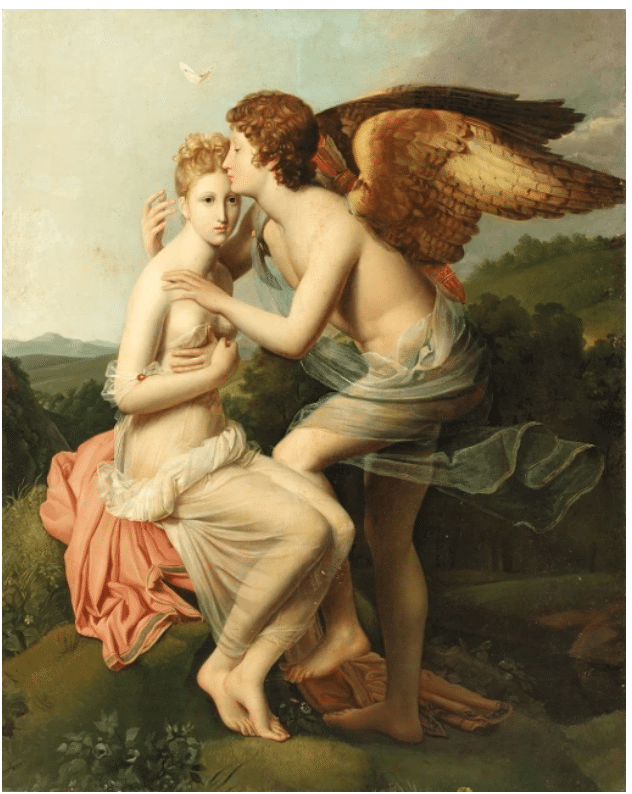
François Pascal Simon Gérard, “Cupid and Psyche,” Oil, 69¾ x 56 in. (177.1 x 142.2 cm.)
There’s another similarity between modern painting and modern dating: Seeing art only on a screen, as so many of us do, can be just as deceiving and half-informed as choosing a partner on an online dating app. It’s not an accurate indicator of quality, connection, or staying power.
“For a work of art to be truly lovable,” says Cara Ober, who’s written insightfully on just this subject “you have to get close enough to smell it, for it to fill your entire field of vision so that your retinas absorb it all. It is only at this intimate physical level, essentially the same proximity of the artist to the art when they made the piece, where the work can sweep you off your feet. The element of surprise and magic, of defying expectations, is essential.”

Adolphe Bouguereau, Amor and Psyche (detail)
Artists, like lovers, share their souls with another. Both are reaching out, touching someone’s heart, and in return finding joy and fulfillment.
“Art must be an expression of love or it is nothing,” said the painter Marc Chagall. For Chagall, art was not just a means of expression, but a total embrace of life and its many forms of love. Chagall believed that art is most genuine when it’s an outpouring of love driven by a deep passion and connection to the subject. For Chagall the very act of painting, of mixing color, applying the strokes, adjusting values, edges, and details – all of it is an act of love.
Can’t get enough images of the Cupid and Psyche motif? Go here. You’ll find 60 examples from across the history of Western painting.
“What though the rose have prickles, yet ’tis pluck’d.”
― William Shakespeare, Venus and Adonis