“A happy life is not a life without struggle – it’s a life with meaningful struggle.” That’s the opinion of author Mark Manson. “Doing hard things,” he says, “is a habit that must be practiced … or like any habit, it will be lost.”
Art is a hard thing, a gloriously toilsome, exciting, direful challenge, as stimulating as any expedition into terra incognita. Artists grapple with the unknown. You’d think just copying something would be easy (with enough patience and practice anyway), but it isn’t. Besides, art is much more than copying things. It’s creative. Art challenges us to draw upon our own feelings and ideas about this strange ordeal we call life on planet Earth.
Not only is art hard to do, it’s even hard to describe in its totality. It’s so hard to talk about that we have never even been able to agree on a definition of it. What is art? remains a perpetual question. Why? Because it’s as just as hard to figure out what it even is as it is to understand what humanity is and why we’re here. Art, in fact, plays a huge part in that quest for answers to the most basic of questions. Art is one of the most sensitive instruments we have in the search for meaning.
Sometimes after hours of standing at an easel trying to make paint do what you want it to, you can feel like you’ve been wrestling with an angel. Or a ghost.
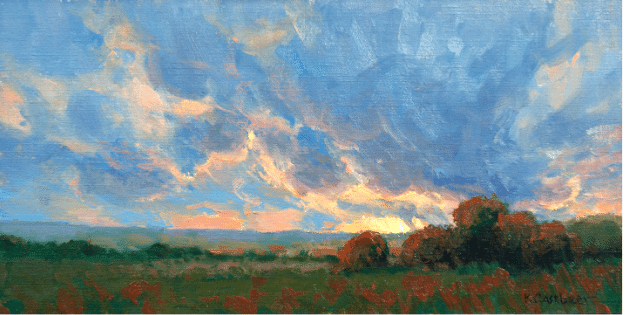
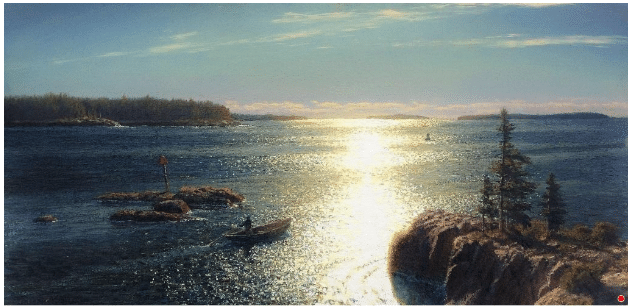
Kim Casebeer, “Filtered Light in the Flint Hills,” oil, 8 x 16 in. Casebeer teaches the art of dramatic light in her teaching video, “Dramatic Light”
But if art wasn’t so challenging, I don’t think we’d keep doing it. It is, in fact, struggle that gives our lives meaning. Life becomes boring, slack, and empty without something to engage us, something we can try for, believe in, something to live , fight, and to put life on the line for.
That’s one of the reasons so many people say they wish they could make art. A lot of people think longingly of the creative life; they admire and respect artists to the point where they almost seem to dismiss art as some odd, anomalous phenomena outside everyday life. They (wrongly of course) consider artists to be people so unlike them that we may as well be some strange and alien species on some parallel track of our own. They simply assume they have no “artistic talent” and stop trying.
Who can blame them though, when art is, in fact, so hard? Art, even copying, requires varying degrees of courage, self-sacrifice, knowledge, discipline, the ability to stay with discomfort, the readiness to be pushed to one’s limits, and the willingness to be thought of as “different.” These are not easy things!
Art is a struggle, thank goodness. It’s one of the many we can choose to give our life meaning.
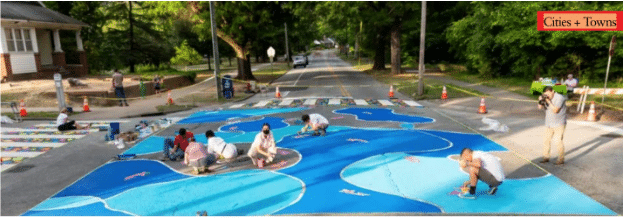
Art Snippet: Know Your Shadow Types
By Contributing Author Brenda Swenson
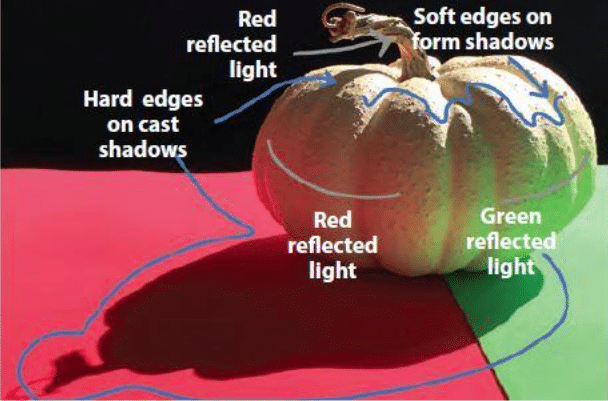
Types of Shadows
Cast shadows suggest the shapes of the objects that cast them and have distinct edges. The further a cast shadow is from the source, the more it is infiltrated by light; as a result,
it becomes warmer, softer, and paler. Cast shadows are darker in value than the objects on which they’re cast.
Form shadows are delicate in appearance and play an important role in making a subject appear three-dimensional. Form shadows are lighter in value than cast shadows. Because form shadows aren’t created by a blocked light source, but by turning from the light source, they also have softer or less-defined edges.
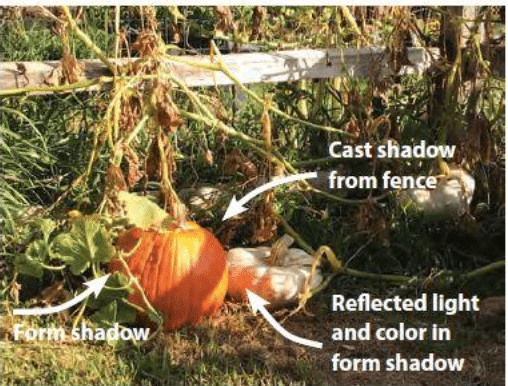
The illuminated area near an object reflects, or bounces, light into the shadows and carries color with it — this is called “reflected light.” The orange pumpkin on the left has form and cast shadows. In case you missed it, see Brenda’s free lesson on negative painting, in which she uses this reference photo.
In this art video workshop with Brenda Swenson, you’ll learn that paintings benefit from a variety of positive and negative painting. Brenda outlines the tools and materials needed for this approach before entering into a step-by-step demonstration of this process. [Learn more about negative painting with watercolor here!]