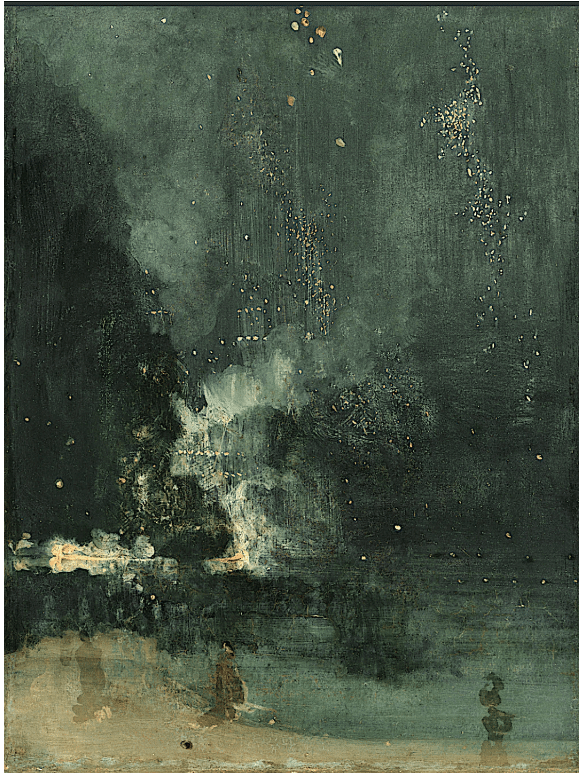
It was, as art historian Linda Merrill writes in her book, A Pot of Paint: Aesthetics on Trial in Whistler v. Ruskin, “the most celebrated lawsuit in the history of art.”
As we suggested in part 1 of this two-part essay, Victorian ex-pat James MacNeill Whistler was the kind of celebrity that you either loved or loved to hate: showy, vain, defiant, and blithely different.
So, when in 1879 the leading art critic of the day, John Ruskin, took him down in a crushing review that everybody remotely connected to the art world read, Whistler gleefully waxed his outrageous mustache, polished and popped in his monocle, donned his kid gloves, and sued the man for libel.

>JMW Turner, Norham Castle, Sunrise, c. 1845, oil on canvas.
Turner, who was also painting in England and at the exact same time, can look pretty abstract; you’d think it wouldn’t be that big a leap to understand what Whistler was up to. But for whatever reason, Ruskin wasn’t having it.
Ruskin’s opinion was gold. He practically forged the legacy of JMW Turner. But of Whistler’s “Nocturne in Black and Gold – the Falling Rocket” (the striking and beautiful rendering of fireworks lighting up smoke in a night sky at the top of this page) he said the artist had childishly “flung a pot of paint in the public’s face.”
The media of the day ate it up. On its surface, the debate was a welcome distraction during a dull London November: at stake was the extraordinary sum of one thousand pounds and the reputation of a rockstar artist vs. that of the most renowned writer of the day. In retrospect, the foundations of modernism and indeed nothing less than how we understand the nature of art was at stake.
Victorian realists, Whistler complained, refused to “consider a picture as a picture apart from any story it may be supposed to tell.” Ruskin used the “Falling Rocket” painting to call Whistler an ill-educated imposter: “I have seen, and heard, much of Cockney impudence before now, but never expected to hear a coxcomb ask two hundred guineas for flinging a pot of paint in the public’s face.” The critique stung, but the canny, self-promoting Whistler realized it was a tailor-made chance to capitalize on the vicious attack
The larger issue was this: Whistler (and the Aesthetic Movement he inspired) championed the radical idea that art doesn’t have to be religious or morally uplifting, or even strongly representational, so long as it has its own internal drive toward beauty and meaning. In 1872 Whistler had defined painting as “the exact correlative of music, as vague, as purely emotional, as released from all functions of representation.”
The Aesthetic movement, sometimes called “Art-for-Art’s-Sake,” said that art could convey meaning purely through aesthetic experience rather than representational content. That’s Modernism 101.
During the trial, Whistler was pressed to define his use of musical terms, including “nocturne” and “arrangement” (one of Whistler’s most famous portraits, that of his mother, was titled Arrangement in Grey and Black No. 1). His paintings were used as evidence for the defense, with the judge demanding explanations about their composition and what the artist was trying to do. The judge even suggested that of Nocturne: Blue and Gold—Old Battersea Bridge (below) it was impossible to tell right side up from upside down.
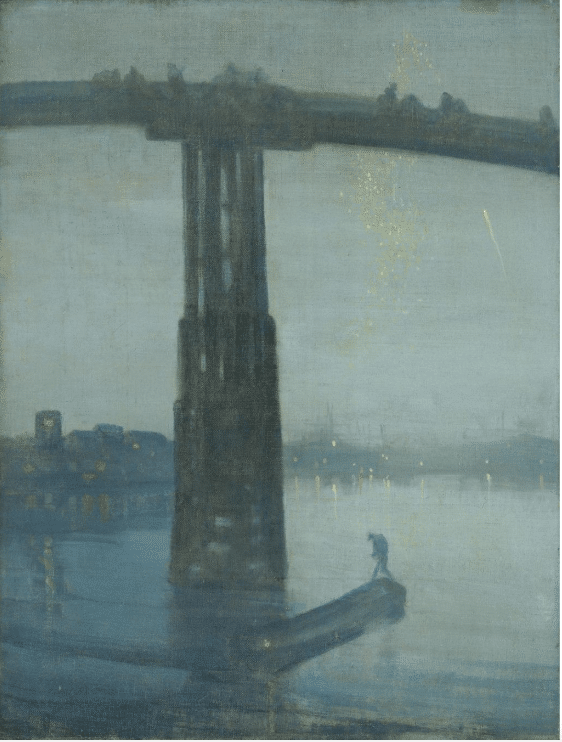
James MacNeill Whistler, “Nocturne: Blue and Gold – Old Battersea Bridge,” c. 1872–1875, oil on canvas, 68.3 cm × 51.2 cm (26+7⁄8 in × 20+1⁄8 in)
This trial is where that famous, often misattributed idea comes from, where someone asks “How long did it take you paint this?” and the answer is “a lifetime.” The judge asked Whistler: “How long do you take to knock off one of your pictures?” Whistler replied: “Oh, I ‘knock one off’ possibly in a couple of days—one day to do the work and another to finish it,” prompting the magistrate to ask: “The labor of two days is that for which you ask two hundred guineas?”
“No,” said Whistler, “I ask it for the knowledge I have gained in the work of a lifetime.”
In the end, Whistler won the verdict, but the court awarded him just the British equivalent of a penny. The cost of the trial forced the artist into bankruptcy. Whistler lost his home and everything in it. He moved to Venice to restart his career by returning to his first art, etchings. And although he lived for another 23 years, he never returned to painting nocturnes.
Now, of course, the nocturne is an established genre, and the subsequent course of modern and contemporary art has proved that painting can be and do many things other than mirror what we see.
If you are a fan of the nocturne, the genre that Whistler inspired, consider checking out a couple relevant teaching videos, including Carl Bretzke’s “Painting the Night.”
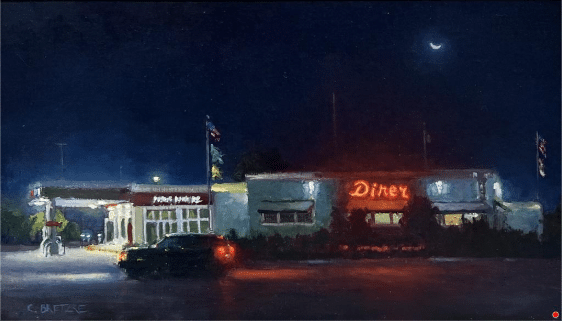
Carl Bretzke, “Diner after Dark (Lighthouse Plein Air 2025,” Oil, 12 x 20 in.