“October is the month for painted leaves. Their rich glow now flashes round the world. As fruits and leaves and the day itself acquire a bright tint just before they fall, so the year near its ending. October is its sunset sky; November the later twilight.” – Henry David Thoreau
Henry David Thoreau, the author of the profoundly influential Walden, or Life in the Woods, isn’t known for writing explicitly about art (that was more his friend Ralph Waldo Emerson’s department). Nonetheless, anyone reading him quickly learns he had the heart and soul of an artist and channeled tremendous creativity into surprising and enduring prose. An artist can learn much by walking beside him.
Maybe you feel your life is too busy, too basic, too full, or too broken to listen to some nature-loving mama’s boy* from 1854. Thoreau’s answer would be you’ve got it backwards – it isn’t that fate has handed you a less-than spectacular life; on the contrary, “you conquer fate by thought.” It’s on you to seek the truth and beauty of life. If he’d been imprisoned in a corner in an attic all his days, like a spider, he wrote, “the world would be just as large to me while I had my thoughts…. However mean your life is, meet it and live,” he advised. “Do not shun it and call it hard names. Love your life, poor as it is. You may perchance have some pleasant, thrilling, glorious hours, even in a poorhouse.”
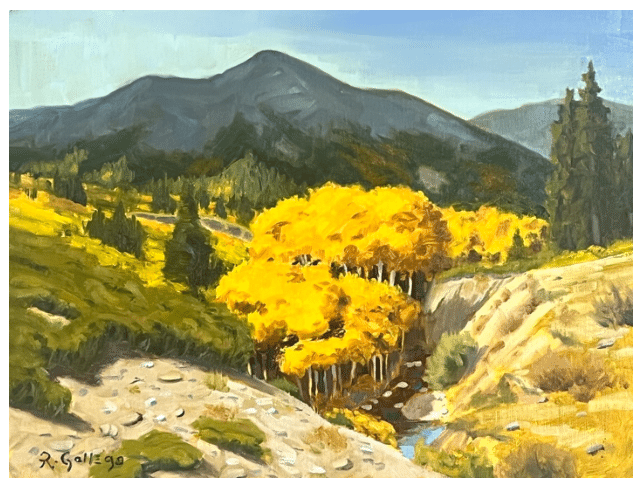
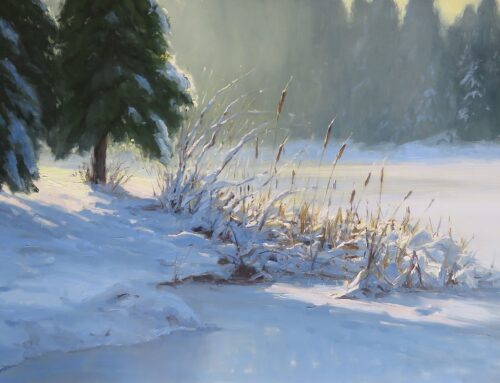
Rich Gellego, “Tioga Pass Gold,” Oil, 12 x 16 in.
Indeed, art distils such “pleasant, thrilling, glorious hours” precisely so that we may taste them again and again. (“We write to taste life twice,” said Thoreau’s New England contemporary, Emily Dickinson. And Thoreau can use words to paint gorgeous images of the natural world he loved. He doesn’t mind letting his rough, hard-headed pragmatic philosophy make space for exactly the joy and delight in beauty to which artists aspire.
Thoreau finished an extraordinary ode to autumn shortly before his death. He titled it “Autumnal Tints,” and you can find the entire essay here. Here, however, are a few choice passages in which Thoreau’s thoughts dwell on creativity, self-knowledge, and of course, the beauty to be found in woods and meadows. You can tell he’s “seeing like an artist:”
“I would fain improve every opportunity to wonder and worship, as a sunflower welcomes the light. The more thrilling, divine objects I behold in a day, the more expanded and immortal I become. If a stone appeals to me and elevates me, tells me how many miles I have come, how many remain to travel – and the more, the better – reveals the future to me in some measure, it is a matter of private rejoicing.”
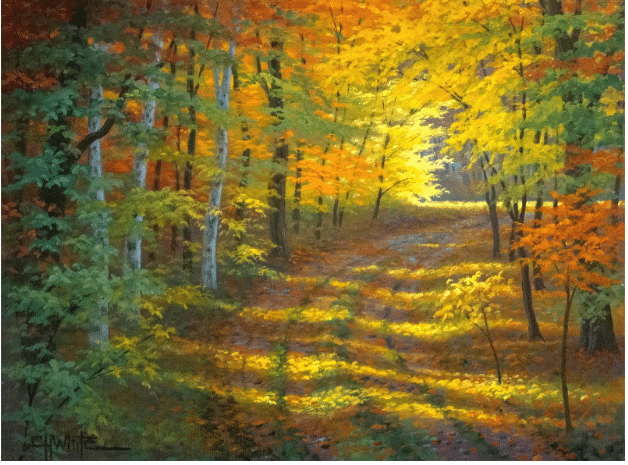
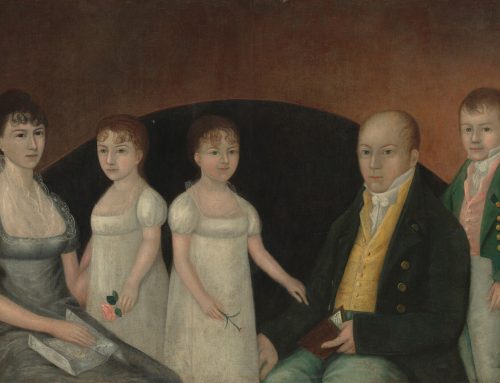
Charles White, “October in Ontario,” Oil, 12 x 16 in.
Or this:
“If, about the last of October, you ascend any hill in the outskirts of our town, and probably of yours, and look over the forest, you may see well, what I have endeavored to describe. All this you surely will see, and much more, if you are prepared to see it,—if you look for it…. Objects are concealed from our view, not so much because they are out of the course of our visual ray as because we do not bring our minds and eyes to bear on them; for there is no power to see in the eye itself, any more than in any other jelly.”
What’s needed is honest expression and trust in one’s genuine vision. “Not how the idea is expressed in stone or on canvas is the question,” wrote the New England philosopher, “but how far it has obtained form and expression in the life of the artist.”
Truly seeing like an artist means seeing with your whole being, not just your eyes. “We do not realize how far and widely, or how near and narrowly, we are to look. The greater part of the phenomena of Nature are for this reason concealed from us all our lives. The gardener sees only the gardener’s garden… There is just as much beauty visible to us in the landscape as we are prepared to appreciate — not a grain more.”
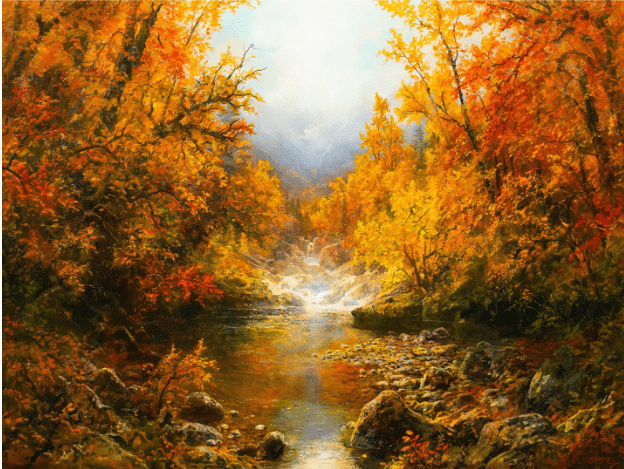
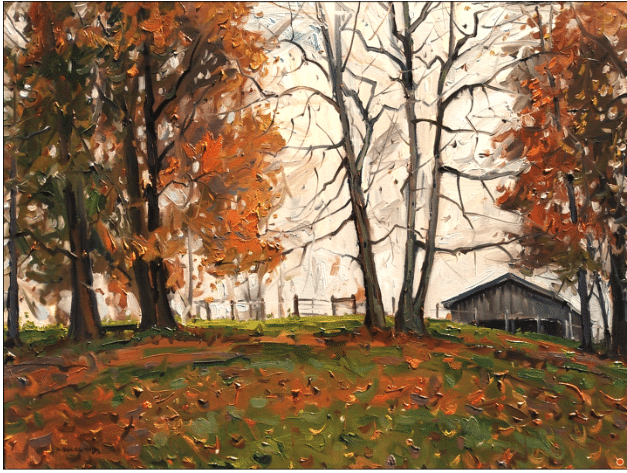
Erik Koeppel, “Autumn in the Woods,” Oil, 18 x 24 in.
Yes, “it would be so much simpler just to live in the moment as it is, knowing nothing of what has passed,” writes Sufi teacher Llewellyn Vaughan-Lee, “to believe that what we experience now is all there is, like a child who knows only city streets and has never seen a meadow of spring flowers or a forest golden in the autumn. Yet love and laughter remain; tears and heartache keep the soul alive. And in our hearts, there is a seed of a future that returns to the beginning, to when the Source ran free and names of creation sang in the wind.” (Excerpt from “Seeding the Future,” a free e-book, readable here.
(*Note: People love to point out that Thoreau’s Walden woods cabin was a short walk from his mother’s house and that she did his laundry. She did, but most men in the nineteenth-century did not do their own laundry. True, the cabin was only a 20-minute walk from Concord. However, visiting her son was perhaps a mother’s way of staying connected while grieving the death of her other boy, Thoreau’s big brother, who’d recently passed at just 27 years old. As usual, the real picture is more nuanced and problematic than it’s initially made out to be – and often the dismissal just a poor excuse for being too lazy to read the book.)
If you’re ready to nurture your love for the natural world, learning to paint it isn’t a bad a way to go. Should you be looking for instruction, check out the landscape painting videos by the professional artists featured in this issue (Kyle Buckland, Rich Gallego, and more, available here.)
Plein Air Live, the three-day online learning event to beat the band, starts THIS THURSDAY, Nov. 6. Check it out here!
Nov. Also, this year’s autumn plein air painting “event of the season,” Fall Color Week, wrapped up earlier this month. Registration is open now for next year’s 2026 Fall Color Week. Learn more and sign yourself up right here.
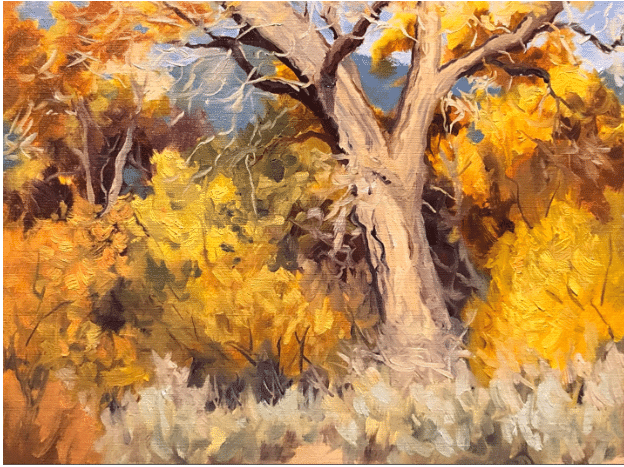
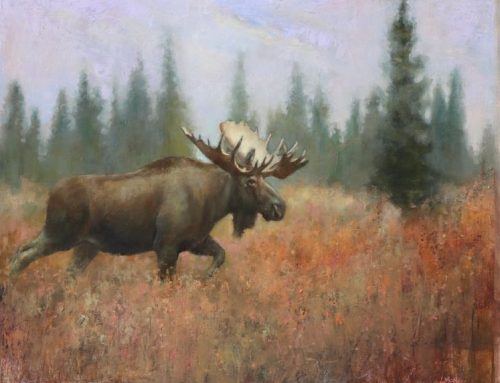
Rich Gallego, “Autumn Encore,” Oil, 9 x 12 in.