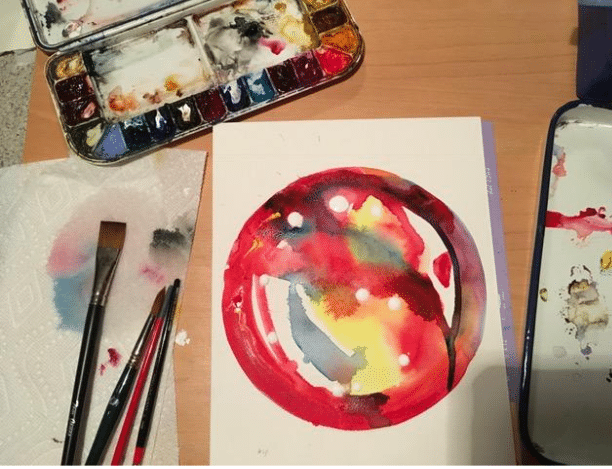
Lisa Argentieri made a New Year’s resolution to make a painting a day. She also wanted to begin practicing mindfulness. A creative exercise by Betsy Dillard Stroud gave her the means to do both. Now Lisa ends each day by creating a watercolor mandala, providing her with a daily check-in with her creative spirit and a much-needed quiet moment to reflect on her life. Here she details the what, why, and how of creating a mandala.
What is a mandala?
“The word mandala means ‘circle,’ ” says Lisa. “First adopted by Hindus as a spiritual tool, mandalas are used for meditation purposes and to promote healing and other positive states of being. They can be used to symbolize an individual’s journey through life.
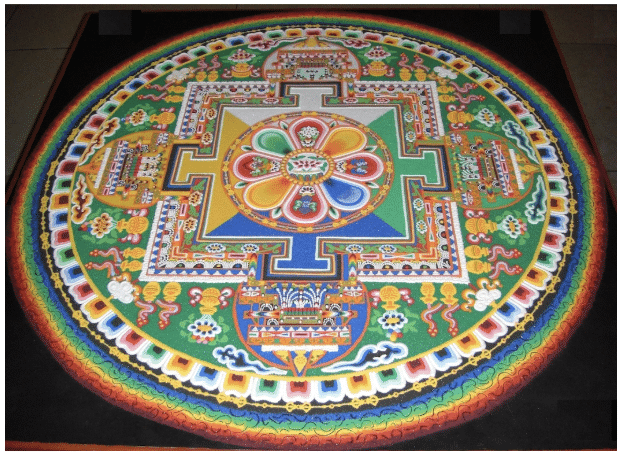
Sand Mandala created and exhibited by the House of Commons of the United Kingdom for the visit of the 14th Dalai Lama, May 2008. CC, Wikipedia
Why did the idea appeal to me?
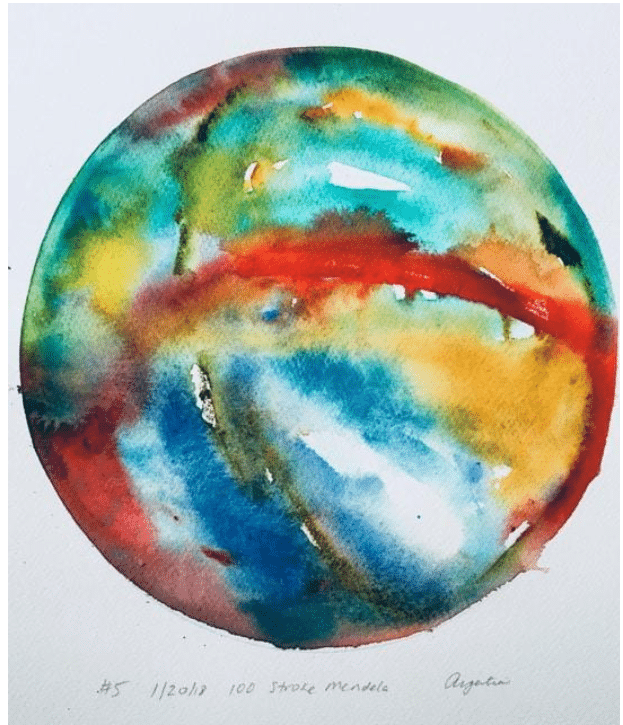
“I had made a New Year’s resolution to make a painting a day, but was having difficulty finding a subject that didn’t bore me and sticking to a routine. Luckily, I happened upon a book by artist Betsy Dillard Stroud, which not only suggested using a mandala as a creative exercise to loosen up before painting, but also included the additional challenge of making exactly 100 brushstrokes within the circle.
Every application of paint would need to be a continuous line or shape and count as one stroke. Wetting the paper with water also counted as a stroke. I realized that creating a series of mandalas would satisfy my resolution, offer an opportunity to reflect and meditate, and serve as a visual diary of my emotions.
How do I go about creating a mandala?
“To increase mindfulness and contemplate on the day’s events and challenges, I chose the end of each day for this exercise.
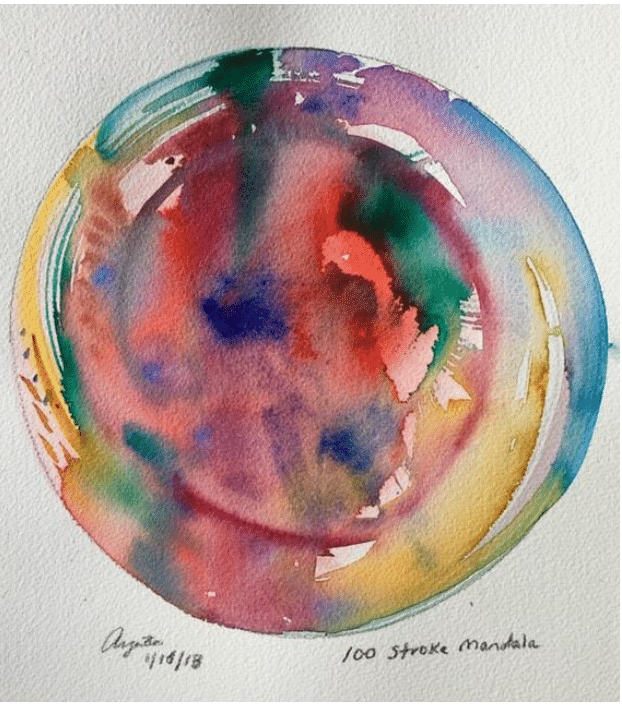
“When I paint, I must be alone, without any distractions (cell phone, music etc.). I begin with dry watercolor paper and draw (with a compass or by tracing a plate) an 8-inch circle on the paper. I then squeeze out fresh watercolor paints, instinctively picking out colors that reflect my mood at that moment. I find relaxation as soon as I start this preparation stage. Mandalas are known to help manifest one’s desires and sometimes I would paint with a goal or wish in mind. Reflecting on the day, I would instinctively reach for a color and make a shape within the circle. The whole process of painting these mandalas is therapeutic and hypnotic, as I don’t know in advance what they will look like until they are done. I get so lost in painting them!
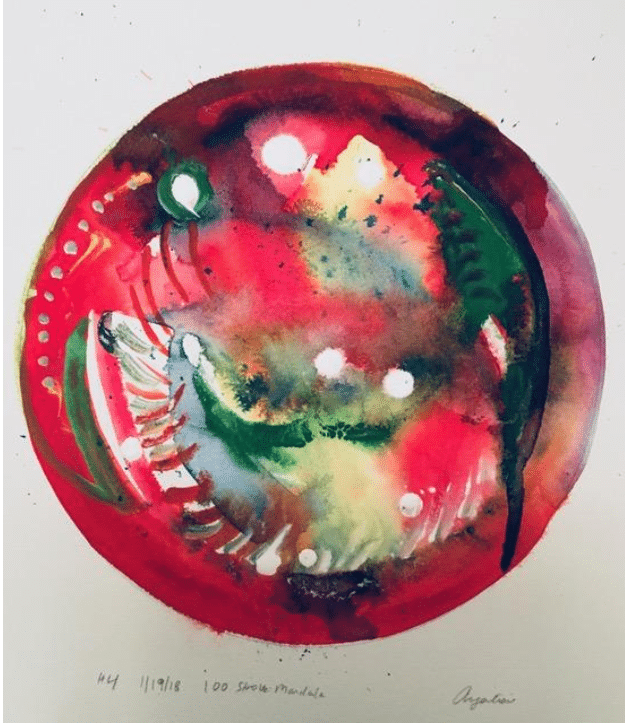
“Traditional mandalas are very symmetrical and intricately designed. I wanted mine to be unique and random. Watercolor seemed the perfect medium to achieve this. I’m having a lot of fun with this series and love seeing how these paintings look the next day after drying.”
For more great articles, subscribe to our free sister publication, American Watercolor.
And if watercolor is your thing, don’t miss out on this year’s online teaching event Watercolor Live – happening in a little over a week! Reserve your spot here.
In the Off-Chance You Didn’t Know About These Art Scam Emails
We all know that art scam emails have been around since email became a thing in the 1990s, when I was in college and the biggest inconvenience in this regard was getting paper junk mail. Now, of course, we have to be diligent. In the fifteen years or so that I’ve been an Online Editor for the arts, I’ve seen various scams targeting artists, which I then share with you to keep you, your money, and your art safe.
Just recently I received yet another spammy email, which tells me that some artists are still falling for them because otherwise, the scammers would move on to a different method. We saw this recently with the false text messages about drivers owing money for highway tolls. The news reported that so many innocent people were continuing to receive these because there were enough people falling for it.
So I’m sharing this now, not for the first time and not for the last time, I’m sure. The following is a screenshot of the most recent art scam email I received, with the indicators highlighted:
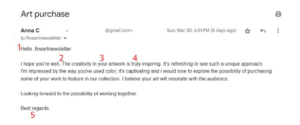
- The punctuation is wrong in the greeting, and they used “fineartnewsletter” as my name.
- Another punctuation error (more to come, but I’ll stop pointing them out – you get it by now).
- I can tell this is spam because they’re complimenting my artwork, when I’m never the artist featured here. (My art is writing, hence my career here as a writer / editor.)
- Which leads us to the highly complimentary nature of the email. These are usually over the top with their praise, so don’t let your ego be stroked to the point that you fail to question the source.
- No signature, only “Best regards.”
I removed the sender’s last name and email address just in case they used the real name of an innocent person and somehow spoofed* an email address.
*What is email spoofing? It’s when a scammer makes it look like an email is coming from a legitimate address, when it’s really not.
What should you do when you receive art scam emails? Block the sender and delete the email. Take it a step further by sharing a screenshot of it on social media to warn your friends.
Have you seen other examples of scams directed at artists? Share them with us in the comments section below.
Discover more art business advice with these free articles at RealismToday.com.
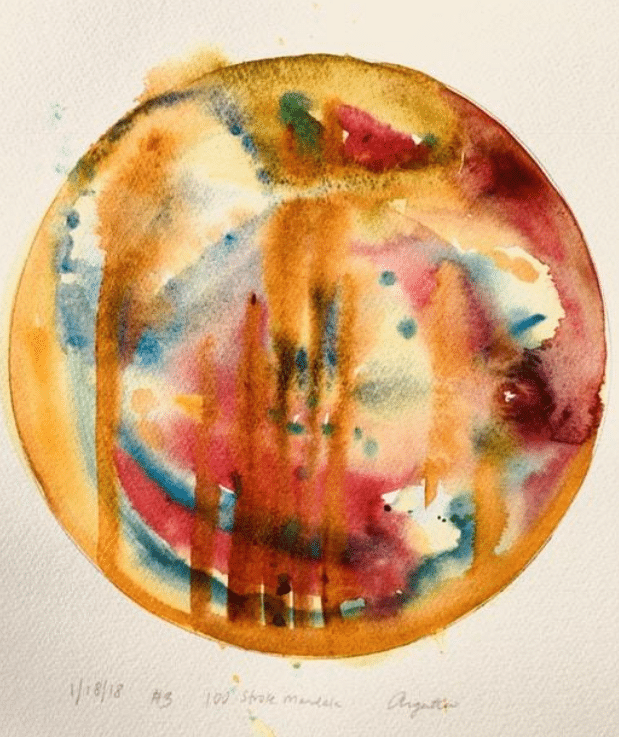
How will you resolve to start your own mindfulness practice and put brush to paper every day.