“Our sweetest songs are those that tell of saddest thought.” – Shelley
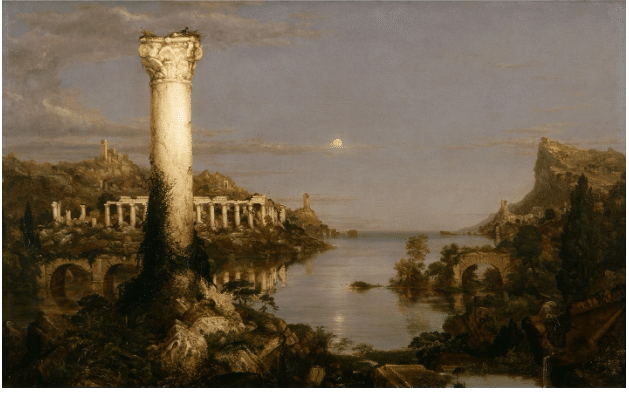
Thomas Cole melts our hearts when he ends his Course of Empire cycle with a hazy moon rising peacefully over the marble ruins of a classical city (above). There is such a thing in art as “delicious tears … the tears of unfathomable sadness.” “Sweet sadness” is a paradoxical experience of finding comfort or even pleasure in the sad or melancholic state.
Such art can evoke empathy, remind us of the larger cycles of nature and time, connect us to others, and perhaps help process negative emotions without experiencing the pain of real loss. Think of minor keys and slow phrases in music that composers use to evoke melancholy while also being aesthetically pleasing.
Capturing melancholy in art goes back at least as far as 1501, when Albrecht Durer pictured melancholy, defined as “a sad or pensive state,” as a dispirited angel gazing at a sunset.

Albrecht Dürer, “Melencolia I,” engraving, 1513.
Depictions of Romantic ruins – wistful images of nature taking over the eroding columns and foundations of once-thriving human achievement – abound in art.
The motif of ruins in painting begins in the 1600s Lorraine and Poussin, the Dutch, the English, and American including Cole, right up to the present day. Brain scientists agree. MRI studies have found that sad music activates brain areas involved in emotion, as well as areas involved in pleasure.
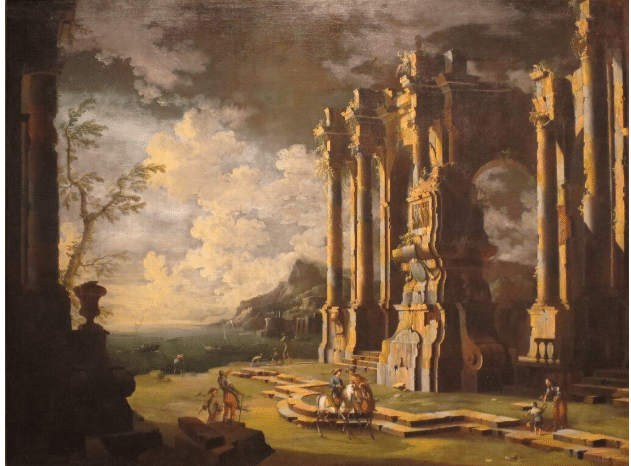
Leonardo Coccorante. 1700s
Leonardo Coccorante was an 18th century Italian painter who made a career painting “capriccios” (tr. fantasies) of imaginary ruins, often situated on the shores of imaginary seas.
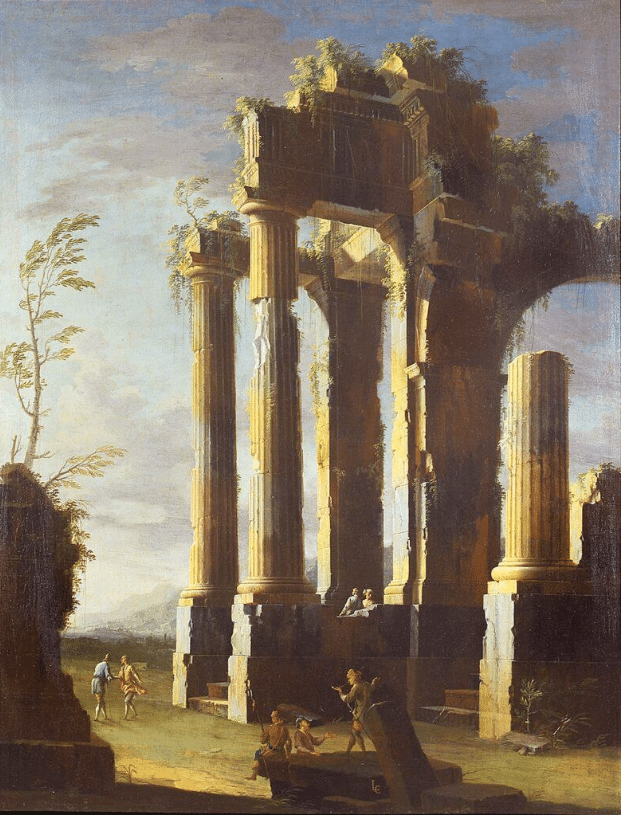
Leonardo Coccorante, Capriccio. 1700s
Corrorante wasn’t the only one, nor was he by any means the first, last, or best to haunt such sanctuaries of Sorrow in their work. Many artists have created paintings of various kinds of ruins.
Why ruins? There is a long and celebrated tradition in art, poetry and music dedicated not just to ruins, but to the larger theme they fall under: the passing of time. The sense of mortality, when intertwined with beauty, can transform a ruined, overgrown shrine into “a temple more divinely desolate,” in the words of Romantic poet George Gordon, Lord Byron.
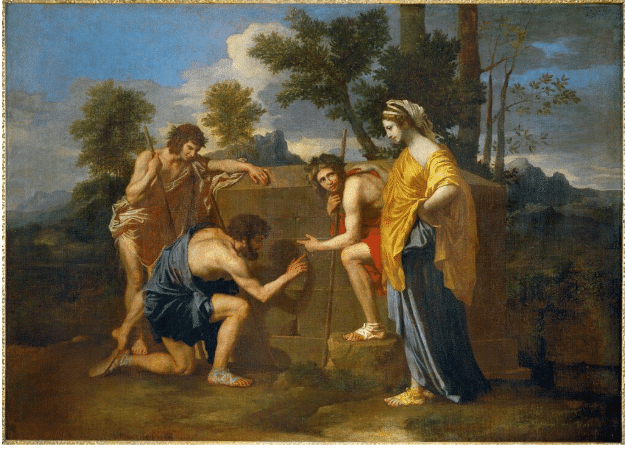
Nicolas Poussin, Et in Arcadia Ego, c. 1637
In the famous painting “Et in Arcadia Ego” by post-Renaissance French master Nicolas Poussin, classical-era shepherds and a maiden gather about the ruins of an ancient tomb. The inscription in the stone the figures are pointing, reads (per the title) “Et in Arcadia Ego,” a Latin phrase that here suggests the inevitability of mortality and the long passage of historical time amid the fleeting nature of life.
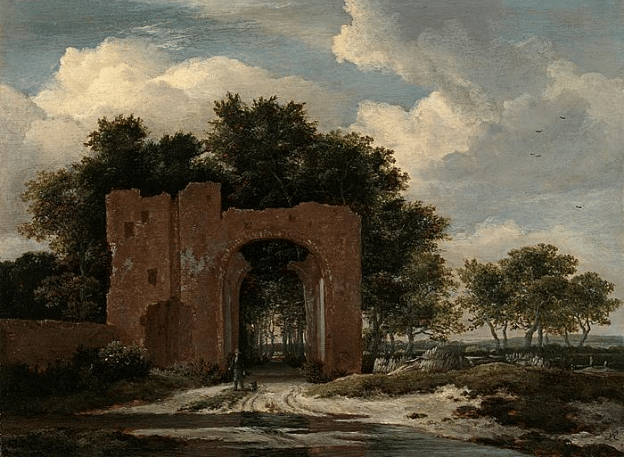
Jacob van Ruisdael, “A ruined Castle gateway, possibly the Archway of Huis Ter Kleef,” c. 1653
In landscape painting, viewers often read departing storms and clearing skies as the return of hope and good things on the horizon. One art historian notes that in some paintings of ruins , particularly by Ruisdael such as the one above, the sky “seems to suggest the transience not only of life but also of death and despair. After death comes rebirth and renewal.”
One of the absolute masters of evocative ruins has to be nineteenth-century German Romantic painter Casper David Friedrich.

Casper David Friedrich, 1744-1840
He specialized in the ruins of Abbeys – monasteries in desolate places that might suggest that not even the mighty “House of the Lord” could withstand the ravages of time and earthly weather.

Casper David Friedrich, 1744-1840
Illuminated as they are by the light, a sense of the spiritual – and certainly the beautiful – nonetheless emanates from these melancholy paintings.

Casper David Friedrich, 1744-1840

John Constable, “Hadleigh Castle, The Mouth of the Thames–Morning after a Stormy Night,” 1829, oil, 121.9 cm × 164.5 cm (48.0 in × 64.8 in) Yale Center for British Art, New Haven
Romantic artists in England and elsewhere picked up the gauntlet. The painting above is by Constable, the one below by Thomas Cole.

Thomas Cole, “Italian Coast with Ruined Tower,” 1838, oil,
Cole, generally considered America’s first important landscape painter, first traveled to Europe in 1829. In London that year he saw and admired the English painter John Constable’s great Hadleigh Castle: The Mouth of the Thames–Morning after a Stormy Night, (above), with its ruined medieval tower standing on a high hill. While in Italy in 1831-1832, Cole saw and sketched similar scenes and upon his return to America painted a number of fine pictures of circular towers set in lonely landscapes.
Specific ancient Greek and Roman sites make appearances alongside all the many imaginary and composite images in historical Pastoral and Romantic paintings. Not just Cole but several other Hudson River painters tried their hand.

Frederick Church, “The Parthenon,” 1871

Sanford Robinson Gifford, “Ruins of the Parthenon,” 1880
In Gifford’s rendering of the Parthenon in Athens (above), the sky’s nearly invisible transitions from pale pinks near the horizon to deep blues above evidence the artist’s frequent remark to his brother that of all of his paintings, this one demanded the most “painstaking labor.” He considered it his crowning achievement as an artist.

Johnnie Liliedahl, “Appian Way, Italy,”
Contemporary artists continue to paint ruins. Johnnie Liliedahl, an oil painter who was greatly influenced by the 18th and 19th century Realists, renders a famous landmark of ancient Rome in “Appian Way, Italy” above. For a step by step look at how to paint such works yourself, check out Liliedahl’s video on Scottish Landscapes.
Contemporary ruins may look quite different than those of the Old World, but they can carry a similar resonance. Tennessee native Lori Putnam evokes a sense of the passage of time with her rusty truck and ramshackle gas station in this painting of the old and now decommissioned cross-country highway Route 66.

Lori Putnam finds the ancient pathos in modern “ruins” in her oil painting “Route 66” –
Lori Putnum shares her techniques for color and loose, bold brushwork in her teaching video, “Bold Brush Strokes and Confident Color.”