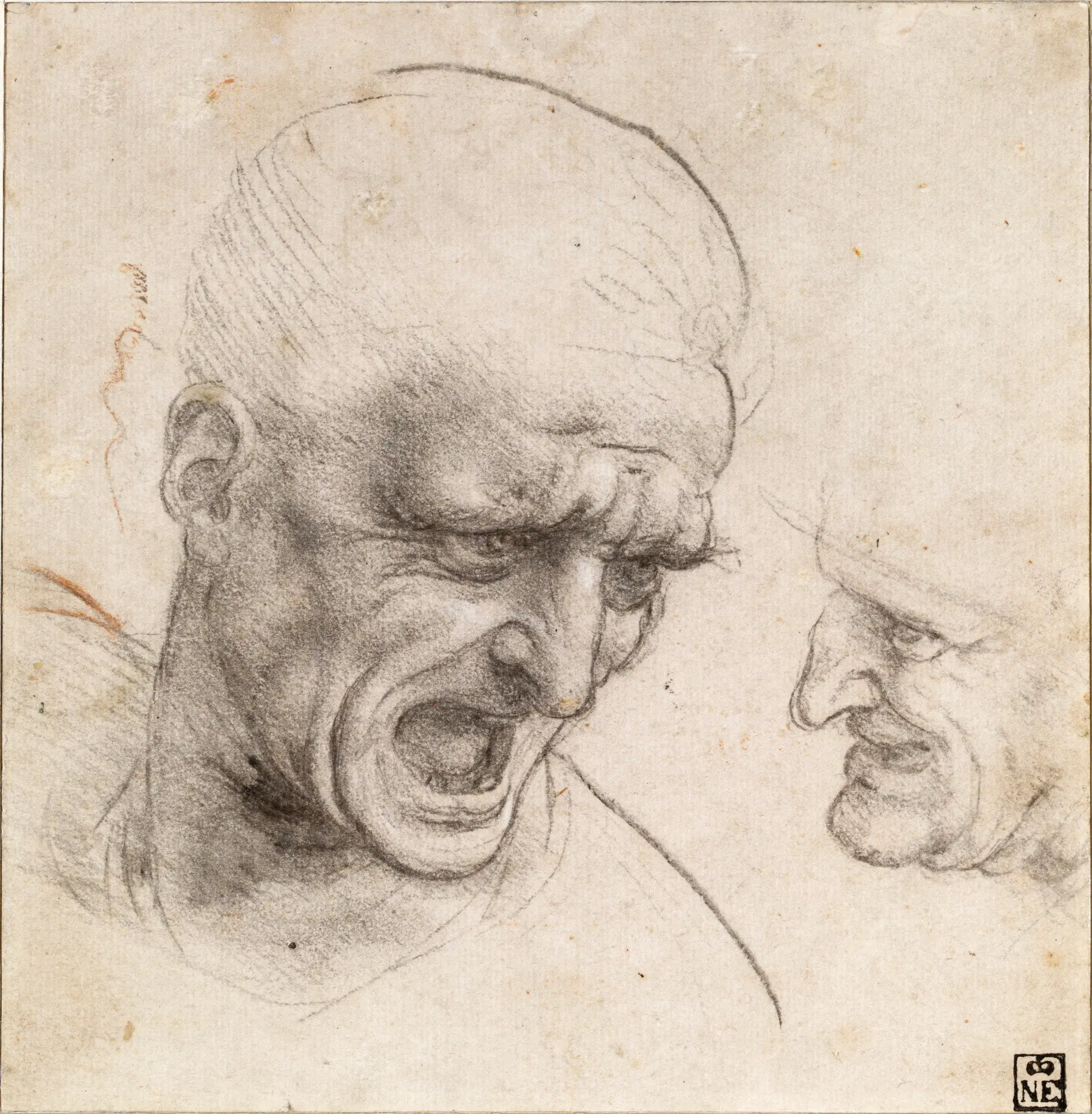
When most of us think of Leonardo da Vinci, we picture the serene beauty of the Mona Lisa, the perfect geometry of the Vitruvian Man. But for centuries, the images that defined him were something else entirely: weird faces with bulbous noses, protruding foreheads, sunken chins, and wide-open laughing mouths.
Although today we celebrate Leonardo as one of history’s great Renaissance minds (painter, scientist, architect, anatomist, engineer), one of his most revealing pursuits was far more private: an obsessive, lifelong fascination with the human face in all its strange and varied glory.
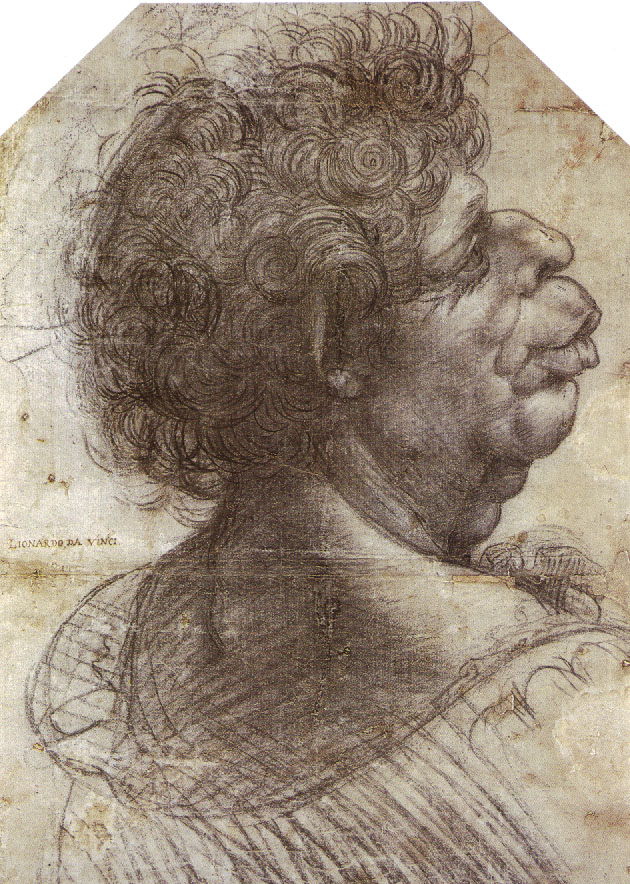
Leonardo da Vinci, “A Grotesque Head,” c.1502; Italy, chalk on paper, 15 x 11 in., Christ Church, Oxford, UK
THE ESSENCE OF LEONARDO
Until the 19th century, Leonardo’s most famous work was largely hidden — his portraits in private hands, The Last Supper sequestered in a Milan convent. What circulated widely — and was eagerly copied by artists across Europe — were his drawings of figures with grotesquely exaggerated features. Leonardo called them visi mostruosi: monstrous faces.
“Artists of his time saw these as ‘the essence of Leonardo,’” says Martin Clayton, head of the prints and drawings collection at Windsor Castle, which holds 555 Leonardo drawings as part of the British Royal Collection Trust.
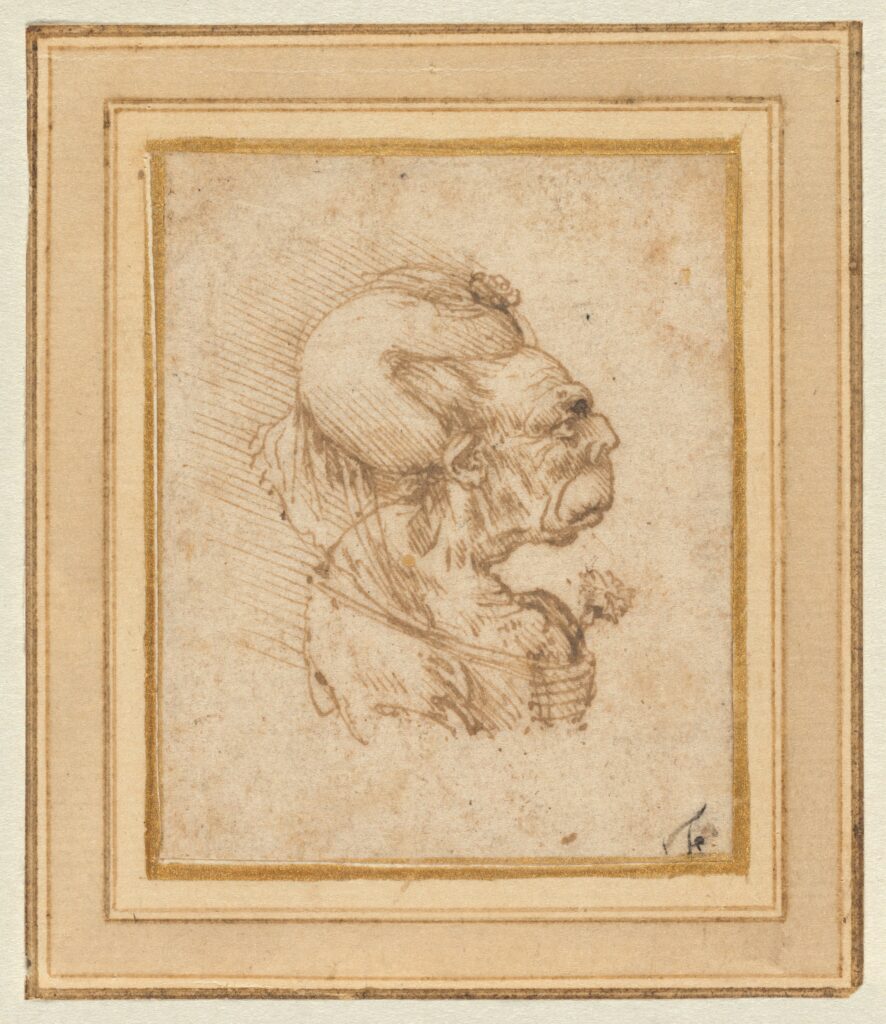
Leonardo da Vinci, “Grotesque Head of an Old Woman,” 1489/1490, pen and brown ink on laid paper; laid down, 2 1/2 x 2 in., National Gallery of Art, Gift of Dian Woodner
A COLLECTOR OF FACES
Leonardo was an avid and sometimes eccentric student of human physiognomy. He wrote extensively about the importance of facial diversity in art. He followed interesting-looking strangers through the streets, committing their features to memory so he could sketch them later. On at least one occasion, according to Teylers Museum curator Michiel Plomp, Leonardo invited strangers into his home, told them jokes to make them laugh, and drew their expressions afterward.
Yet for all his study of unusual faces, he rarely — if ever — put them in his paintings. “If you look at the few paintings he made,” Plomp notes, “there are angelic faces everywhere.”
Utrecht University art history professor Michael Kwakkelstein has spent years attempting to classify Leonardo’s grotesques by intent. Some, he believes, were purely for entertainment — comic figures designed to amuse their creator, and perhaps eventually to be printed and shared. Others were serious explorations of emotion and character. “Human emotion and human character is an essential characteristic of Leonardo’s art,” Kwakkelstein says. “He was essentially interested in body language and how it’s related to emotions and character.”
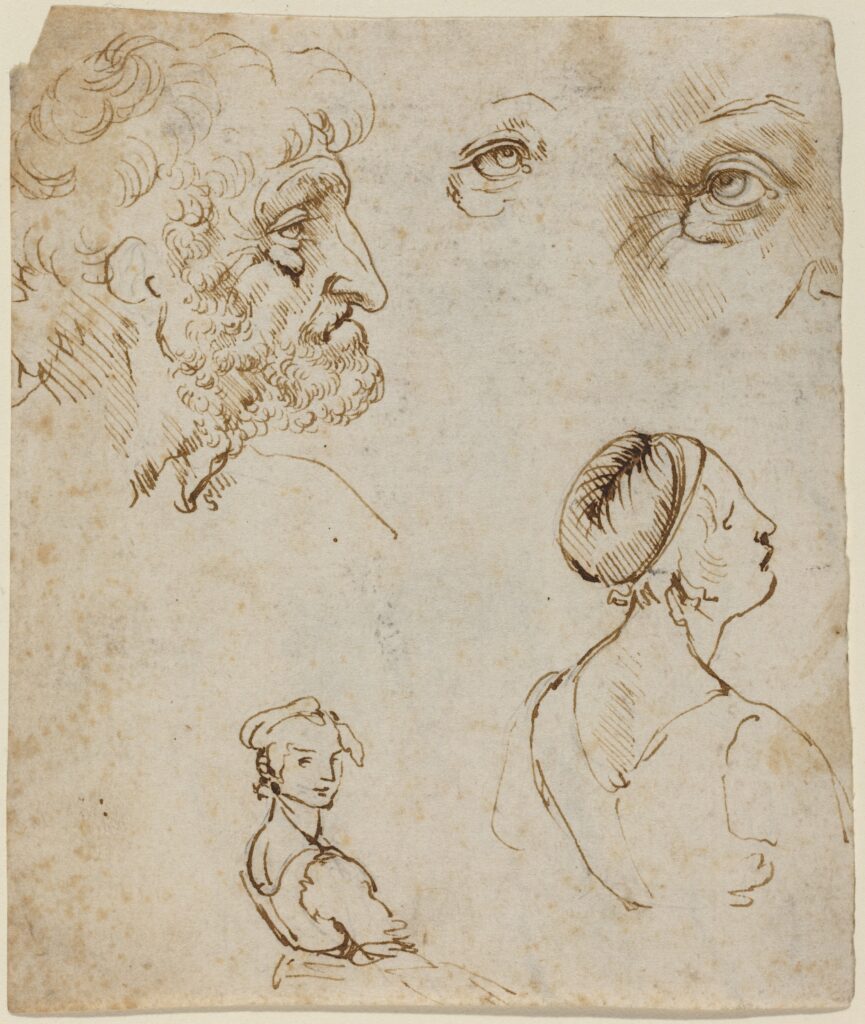
Leonardo da Vinci, “Sheet of Studies [recto],” probably 1470/1480, pen and brown ink over leadpoint with blind stylus on laid paper, 6 7/16 x 5 1/2 in., National Gallery of Art, The Armand Hammer Collection
FROM THE ABSURD TO THE SUBLIME
For Leonardo, it turns out, the path to the sublime ran straight through the absurd. The monstrous faces and the angelic ones were never opposites — they were always two sides of the same lifelong question: what can the human face hold, and what can a painter make it reveal.
Five hundred and seventy-four years after his birth (April 15, 1452), the question feels as open as ever.
Follow in the Master’s Footsteps
The kind of relentless inquiry Leonardo embodied — the willingness to follow a face down the street, to invite strangers in, to fill notebooks with a variety of looks — is what separates a working artist from a great one. It’s also the spirit behind Realism Live, our virtual art conference dedicated to the pursuit of mastery in realist painting. Join us November 11-13, 2026!