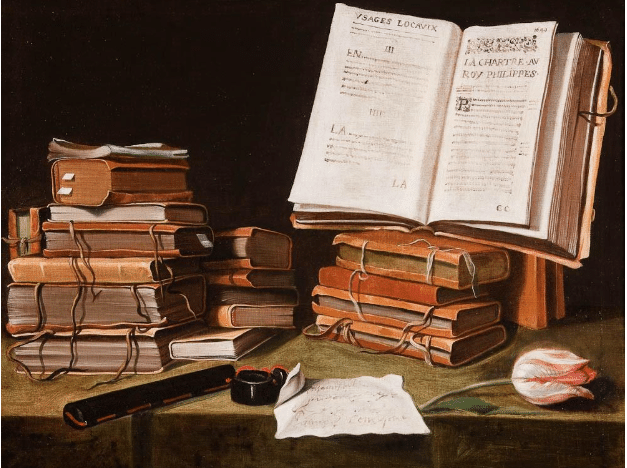
This is PART 2 of our roundup of the best and most inspiring books for artists. You can read PART 1 here.
We’re open to hearing your picks, so if we missed your faves please don’t hesitate to send ‘em in.
Most Inspiring Artists’ Books #3. On Becoming an Artist by Ellen J. Langer
Psychology professor Ellen J. Langer experienced a major personal renaissance later in life when she began painting on a whim and never stopped. In her book On Becoming an Artist, she shares an accessible and inspiring artistic process born of her revelation that, “each of us has the potential for a renaissance, an age defined by a creative, purposeful, and engaged life.”
The key is mindfulness, she writes, the science and art of being fully in the moment. Leaning into process over product sidesteps the constant stream of unproductive chatter (always concerning either the past or the future neither of which actually exist) which tends to play like an endless tape loop in the back for our heads, squashing joy and creative productivity.
When Langer unexpectedly found herself becoming an artist, she did not somehow “discover a hidden talent,” she’d say. Nor did she follow any rules (she didn’t know any). She simply did not allow judgment, hers or anyone else’s, to get in her way at any stage in the process.
The opposite of mindful creativity is fussing and worrying about “getting it right.” Listening to self-defeating mind-chatter and comparing oneself to others are among the biggest roadblocks to living that ongoing “personal renaissance.”
“If I fear making mistakes,” writes Langer, “I won’t fully engage myself in the task. Instead, I mindlessly follow a script for how to avoid them. If I am following a script, then I am not centered in the present, which could easily result in my making more ‘mistakes.’ And so the cycle continues.”
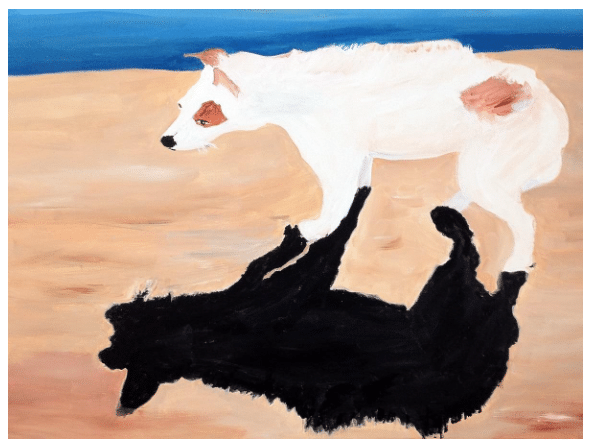
Ellen J. Langer, Me and My Shadow
“Once examined through this new lens, many of our ‘problems’ fall by the roadside,” she writes. “We can, it turns out, pursue art for art’s sake and art for life’s sake, and it matters little what that art is. Any creative activity can have a powerful effect on our lives if we pursue it mindfully and recognize the ways in which old familiar fears and habits can be set aside to make room for the personal renaissance we seek.”
Langer has generously made the introduction and entire first chapter of On Becoming an Artist readable for free online. It’s been an important book to me personally, and I highly recommend it.
Most Inspiring Artists’ Books #4. Art & Fear by David Bayles
This book is very good at inspiring artistic confidence and creativity. “Fears about yourself prevent you from doing your best work,” Bayles writes, “while fears about your reception by others prevent you from doing your own work” (that feels authentically like yours).
Turn that around, he writes, and you discover that “uncertainty is a virtue;” it’s a necessary part of stretching, growing and feeling your way into yourself as an artist. One of the surest-fire ways to battle crippling fear and doubt is to stop thinking and stay working. When you doubt whether what you’re doing is “good” or “original” enough, the thing to do is to not to stop but to do the opposite: “make more pots.”
Bayles tells a story about a ceramics class at Columbia University in which the teacher stat4ed that all those on the left side of the studio would be graded solely on the quantity of work they produced, all those on the right solely on its quality. The “quality” side spent most of its time researching and tinkering and fussing to make that one “perfect” pot. The “quantity” team, however, ended up getting a higher grade. However, not only did they fulfill the quantity requirement, it also turned out they made the more beautiful, higher quality pot. In the process of making their many pots, they learned from each one how to make the next one better.
“You make good work by (among other things) making lots of work that isn’t very good, and gradually weeding out the parts that aren’t good, the parts that aren’t yours,” writes Bayles. “It’s called feedback (as in “positive feedback loop”), and it’s the most direct route to learning about your own vision. It’s also called doing your work. After all, someone has to do your work, and you’re the closest person around.”
This books makes a compelling case for getting out of your own way, so you can lean into the joy of making and find your own voice in the process. We featured Bayles’ no-nonsense approach to productive creativity and the education of the artist in an earlier article in Inside Art.
Most Inspiring Artists’ Books #5. On Painting and Drawing by William Morris Hunt
This one is more practical than the others on this list, but it’s still chockfull of gems and hints that can lead to a happier, more inspired and impassioned life as a painter. Hunt’s an odd figure, an incorrigible rebel, (got kicked out of Harvard) a maverick painter (rejected classical tradition), a rogue teacher (was the first to admit women to art classes), and all around an important , if low key, figure in the history of art; he basically introduced French Barbizon and Impressionist art to America despite hostile opposition from artists and critics alike.
It’s an odd book too, cobbled together from a series of “Talks on Art” Hunt gave in the 1870s which artist Charles Novali published in book form 100 years later. (Dover Press, 1971). It’s a rambling mashup of advice, exhortation, exasperation, technical instruction and celebration of artistic freedom. “Put down frankly what you believe!” Hunt insists. “Put it down as you think it is, and it will be a great deal nearer right than if done in any other way.”
In painting the stem of a flower,” he writes, “put your brush in the right place and draw it down at once, firmly. Don’t go along tick, tick, tick ! and don’t be afraid of it!” Here are some more gems plucked at random from Hunt’s book:
Forget about what you’re supposed to be doing, and do it as you honestly think it is: “Hang duty – in drawing and painting! Duty never painted a picture, nor wrote a poem, nor built a fire. Do it as it seems to you to be!”

The imaginative and emotive Hunt, along with George Inness, pretty much invented American Tonalism.
“Put in what you need to express the thing! Everything is beautiful! That’s what’s the matter! People wouldn’t see the beauty of this floor, with its light shade and color. The would only see dirt and spots!”
“It isn’t what you see it’s what you feel that will make your work interesting. You can look at a thing and see it, but that’s nothing. You can look at something which may give you an emotion. That’s feeling!
“Facts don’t amount to anything. Encyclopedias are full of them. It’s an individual’s expression of a thing that’s interesting.”
“If the truth isn’t the fundamental part, there’s no use in adding it as embroidery! Tinkering isn’t painting!”

Hunt’s massive Niagara Falls picture at the MFA in Boston.
We’ll have another round of great books for artists, but I think these are the CLASSIC inspirational ones (sneak peek: we’ll talk about “Landscape Painting” by Birge Harrison, “John Carlson’s Guide to Landscape Painting,” “The War of Art” and “Steal Like an Artist” upcoming posts.
Meanwhile, Streamline has a whole shelf of instructional books to browse. Videos are amazing, but sometimes we like the go-at-your-own-pace old schoold intimacy of turning pages too. Check out the books for artists on offer right here.