Internationally known artist Matt Ryder works out of the coastal-mountain region around the city of Dubai, U.A.E. Originally from the UK, he found himself in Dubai a bit more than 15 years ago (life choices unrelated to art). And he liked it, so he decided to stay and build a career there.
Though he has branched into portraits and seascapes of late, early on he settled into two main subjects to make his own that at first seem an unlikely pairing – glowing florals and sun-bleached desert rock. He paints as much as possible from life, but he is always ready to put artistic vision ahead of transcription when working en plein air.
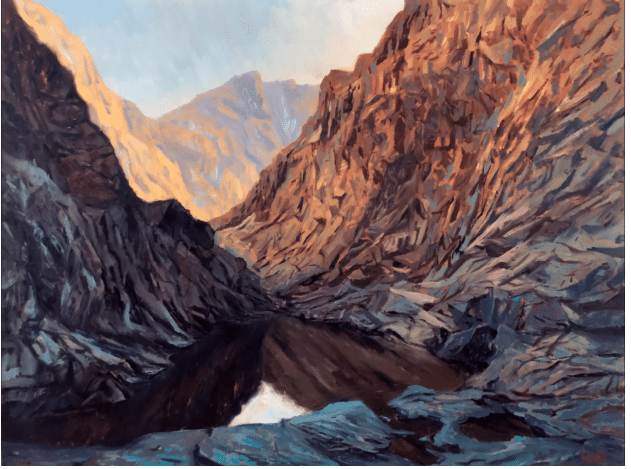
Matt Ryder, “Early Light in Wadi Shawka,” oil, 120cn x 90cm
“Composition is top priority when I’m coming up with concepts. I’m not afraid to move things around,” he says, “I’m also not afraid to push color and exaggerate contrast if I think it’s going to help lead the eye around a painting. The first thing I try to do in terms of composition is look for elements I can move around, blasts of sunlight or strong contrasts that will lead you around the painting, that will lead the eye where I want it to go.”
“I have my go-to compositions that I like, such as the circular composition, where maybe a rock stops you or an area of light and your eye is kept within the circle of the painting. I also favor triangular compositions. When I’m painting plein air, I’ll just make the decisions there and then as to what is going to work.”
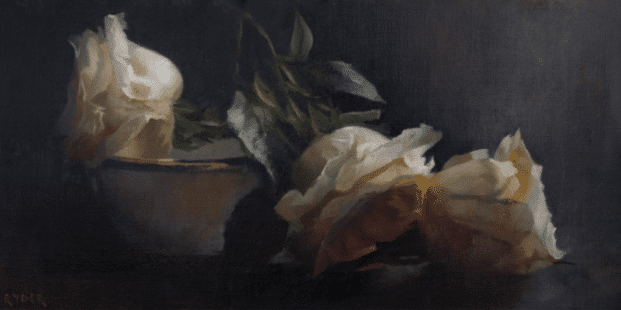
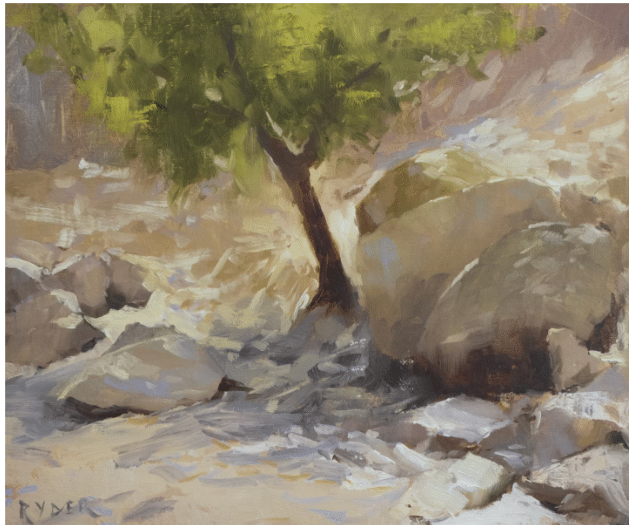
Matt Ryder, Fallen, 10 x 20 inches
In the Middle East, plein air season runs from September to March because of how hot it is the rest of the year. He’s got a jeep to get him up into the mountains with an awning he can pull out to catch a little shade while he paints. He spends the summer on larger works in the studio, often for commissions from city hotels and the like. About 90 percent of his studio work, he says, is based off of his plein air paintings and his paintings from life.
“If I said to you painting a rock in sunlight is like painting a soft flower your’d probably think I was crazy.” he says. “But the main thing with both of them, painting flowers and painting rocks, is there’s so much color and bounced and reflected light all around.”
Ryder loves painting rocks because there is an added element of augmented and diversified color as well.
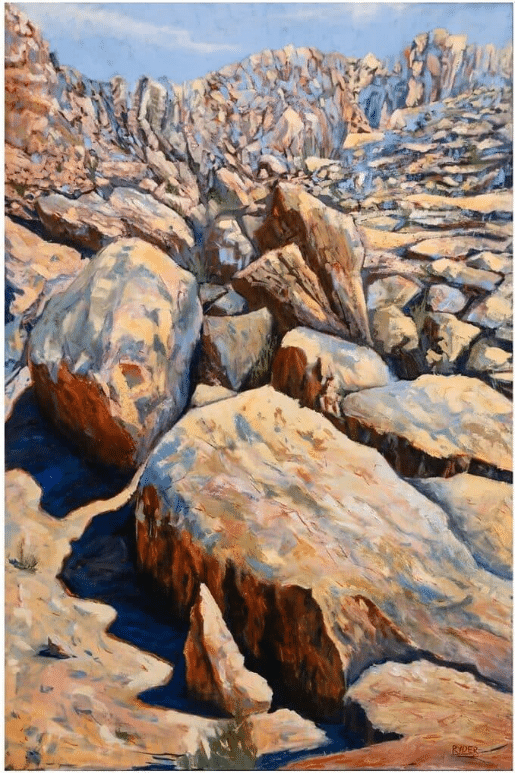
Matt Ryder, “Jebel Hafee Climb,” oil 150cm x 100cm
“With flowers (and I tend to paint a lot of roses, in particular lighter colored roses, that’s what I’m drawn to), you’ve just got all this light coming through (the petals),” he says. “And then when you’re painting rocks in sunlight, which is the other thing which I really enjoy painting, you’ve got all the outside elements that are creating these areas of bounced light and just reflected color coming up into the rocks. Strangely enough, I find it a very similar subject matter,” he says. “It’s hard to say which I prefer more. They’re very much on par.”
One of the major things that ties them together for Ryder is pattern – rhythmic arrangements of smaller forms within a mass. “The other thing that ties them together is groupings. I do a lot of multiple-builder paintings, and I do clusters of flowers, clusters of roses. I try to bring in abstract elements in either cases”
“The way I approach a rock painting is I will mass-in an area, so I’m not painting individual rocks, just trying to carve shapes within that area, putting in the correct value, the correct shape, and the correct bounce of light,” he says. “With flowers, groups of flowers and with petals, it’s the exact same thing. I’ll mass-in an area and then just work around it with correct color, correct value, and create this illusion that something is there. It’s a natural crossover for me.”
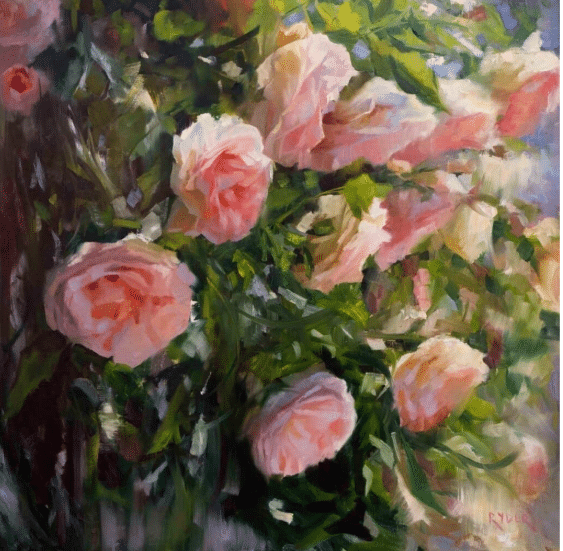
Matt Ryder, “It’s All Sunshine and Roses,” Oil on linen, 20″ x 20″
“It really is about light for me,” he says. “I’m always painting things in bright sunlight. It’s really the qualities of natural light that I’m after.”
If you struggle to paint believable rocks, look into Matt’s video Painting Rocks & Sunlight. Matt shows how to simplify a group of rocks (or complex subject) by increasing your understanding and use of values. This will help your rocky scenes look real, showcase the right amount of detail, and increase your confidence in painting sunlight — things any number of artists find difficult.
Matt also has a new video out, this time on painting the gorgeous roses for which he’s equally well-known. Check out his video, Painting Roses Simplified, here.