There’s more than meets the eye in James McNeil Whistler’s painting originally titled The Woman in White after a popular mystery novel of the day by Willkie Collins. “This is modeling as performance art,” wrote a recent British art historian in a comment worth quoting at length:
“The pure white dress, you see, is a joke. There’s nothing virginal about (Joanna) Hiffernan in Whistler’s 1862 icon Symphony in White, No 1. She stands above you confidently, and Whistler makes the supposedly modest dress suggest her nakedness underneath. That’s because she is standing on a bearskin rug whose soft fur leads your eyes to the rim of the dress, to picture her naked feet nestling in it – a traditional image of sensuality in sculpture that goes back to Renaissance images of the triumphant David with his foot in Goliath’s hair.” (Jonathan Jones, writing for The Guardian)
Joanna Hiffernan, the woman in Whistler’s painting, was a well-known beauty who appears in numerous works by Whistler and other artists (e.g. Courbet – see below) during the 1860s. At the time he painted her, she was Whistler’s primary model, his studio manager, and his mistress.
Artists exhibiting pictures of their models with whom they were rumored to be having affairs wasn’t unheard of at the time, and there was more to the public and critical outrage over this painting. The reasons for it were at once more obvious and more subtly ingrained.
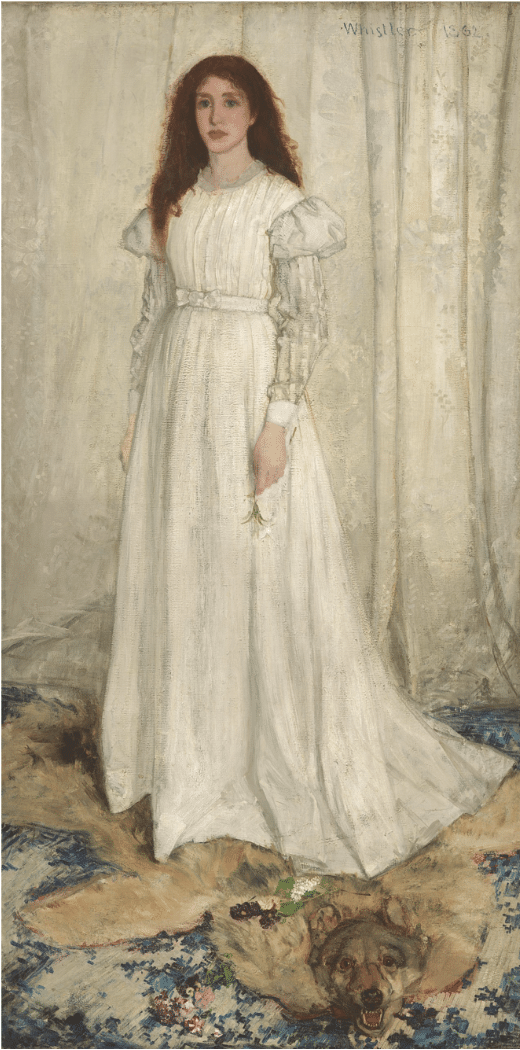
James McNeill Whistler – Symphony in White, No. 1: The White Girl
The 27-year-old Whistler, still establishing his reputation, painted The White Girl in 1862 as his debut in the prestigious Royal Academy of Arts exhibition in London. It was supposed to announce his talents to the world; but he was to be cruelly disappointed.
Glowing with confidence and excitement, Whistler visited the Academy galleries a week before the salon opened to the public. But he had to search room after room for his work, until at last he found it leaning against a wall amid the rejects. Shocked and wounded, he consoled himself with the thought that “she was still beautiful” and still his. But this slow-motion disaster was only getting started.
What it mostly came down to was class. Whistler had only painted his lover as bold and beautiful as he saw her in life. But Joanna, or Jo as he called her, was the daughter of Irish immigrants who’d fled poverty and famine by coming to America. Devoting a life-size, full-length portrait to someone who didn’t come from money was an affront – it said to portraiture’s high-society matrons, Look, you aren’t so elite after all – any old person can be portrayed on the same level as you. But there was even more in it than that, too.
The picture was shown about a month later at Morgan’s, a commercial gallery in London, with the “rejected” designation. There it was savaged in the press as “bizarre” and “incomplete,” and the painting continued on this path: again rejected, this time by the 1863 Paris Salon, it ended up in the Salon des Refusés, a protest exhibition organized by sore losers (notably Courbet) who felt unjustly spurned by the conservative jurists of the French Salon.
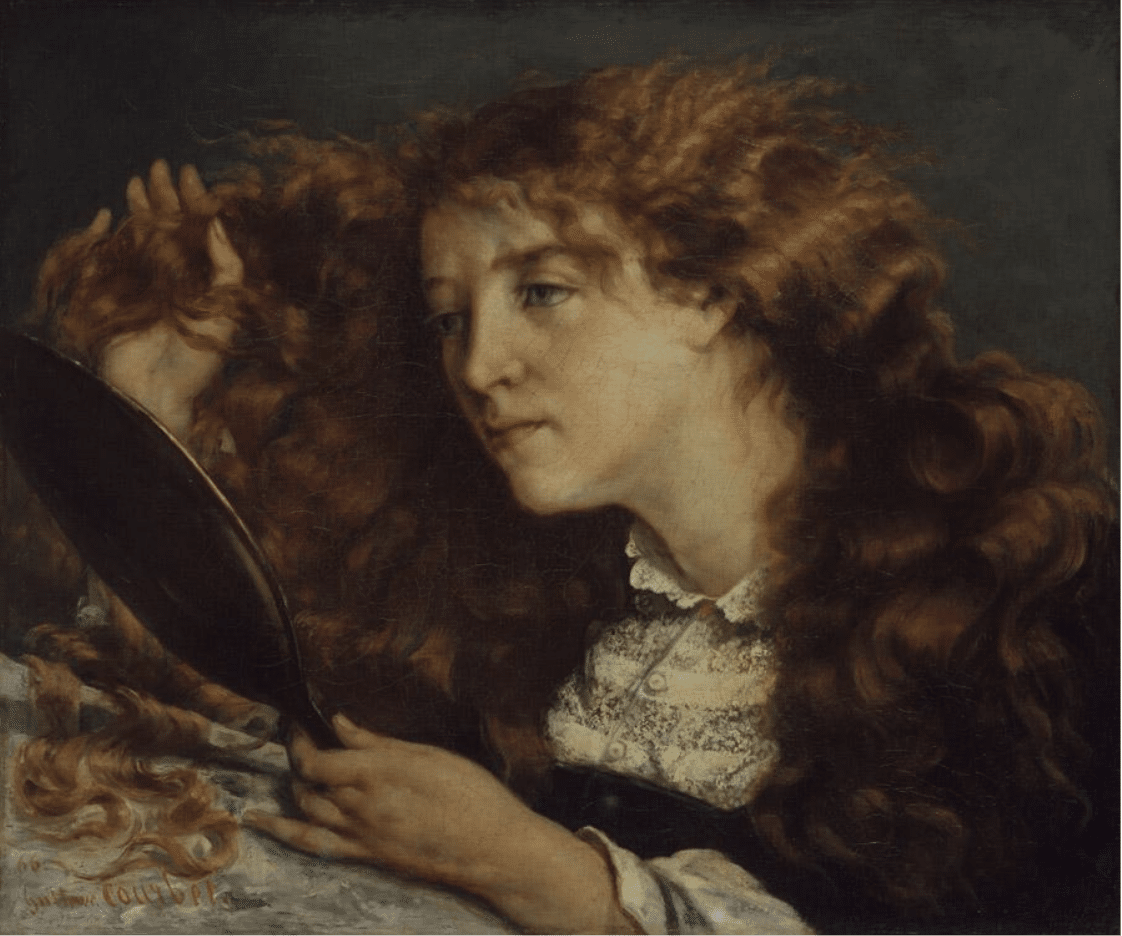
Gustave Courbet, Jo, la belle Irlandaise, 1865–1866, oil on canvas, The Metropolitan Museum of Art, H. O. Havemeyer Collection, Bequest of Mrs. H. O. Havemeyer, 1929, 29.100.63
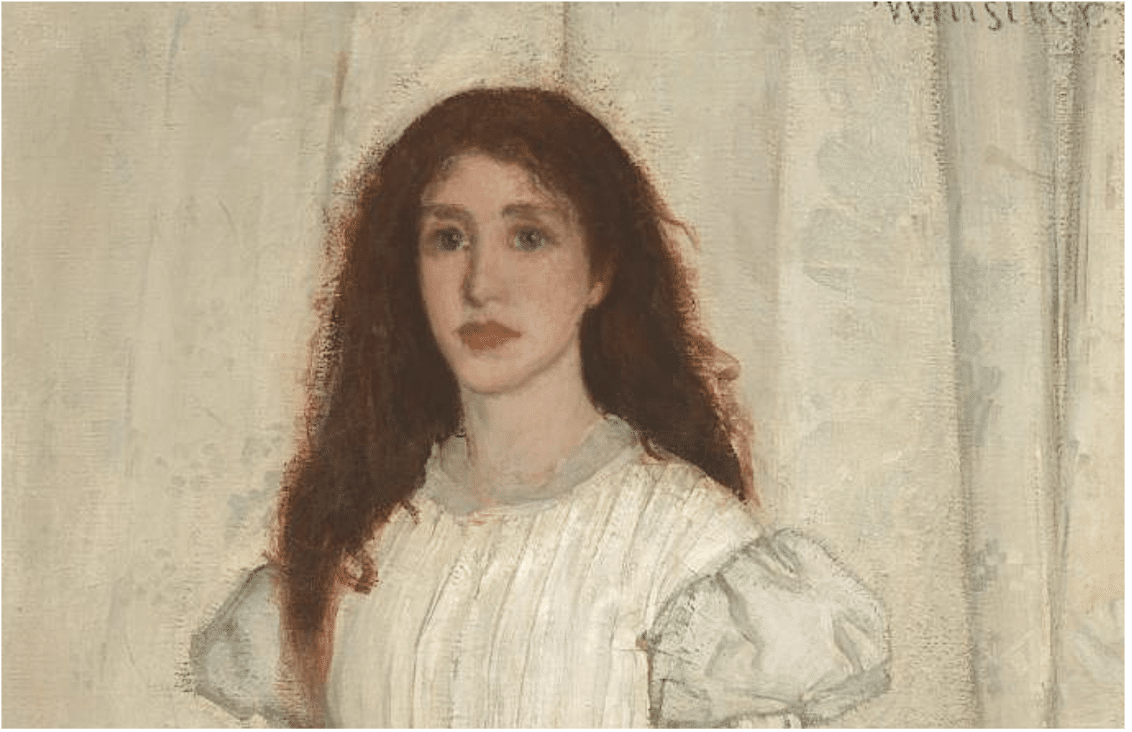
Whistler depicts Jo wearing a thin cambric outfit, something women only wore in private. Her red hair is unbrushed, wild and loose, contrasting vividly with the tonal white interior setting and dress. What London audiences found particularly disconcerting was the painting’s imposing presence. Whistler had shown the affront of presenting, on a scale reserved for the grand manner portraits of wealthy and powerful subjects, a full-scale portrait of an unkempt working-class Irish immigrant girl in a housedress (Heaven forbid!).
If such reactions seem to us overblown, we must look beyond the subject to the treatment. Whistler’s The White Girl flouted numerous conventions and standards of portraiture. All we see today is a striking portrait. But for 1860s audiences, it was a strange – and very modern – cocktail of defiance, indifference, and ferocity that seemed an insult to the placid contours of educated taste in art.
Gazing impassively, Jo’s expression is vacant and unfocused: She doesn’t demure to us, she doesn’t charm us, in fact she isn’t here for us at all. And yet she rivets our attention. She stands on a bearskin rug (some say it’s a wolf) with a toothy, animalistic gaze that clashes with her own blank look. Flowers, regularly a symbol of purtity, drop languidly from her hands to the floor.
To many Victorian viewers, these attributes made Hiffernan’s worldliness and lack of innocence explicit and shocking. The rest were simply mystified. The White Girl offered only hints of context.
In 1867, after creating two more paintings of Hiffernan in white dresses, Whistler grouped the three together under a shared musical vision: he called them “Symphonies in White,” numbers one, two and three. In doing so, the paintings were first and foremost “aesthetic experiences,” he insisted, in the same way as an absorbing piece of orchestral music.
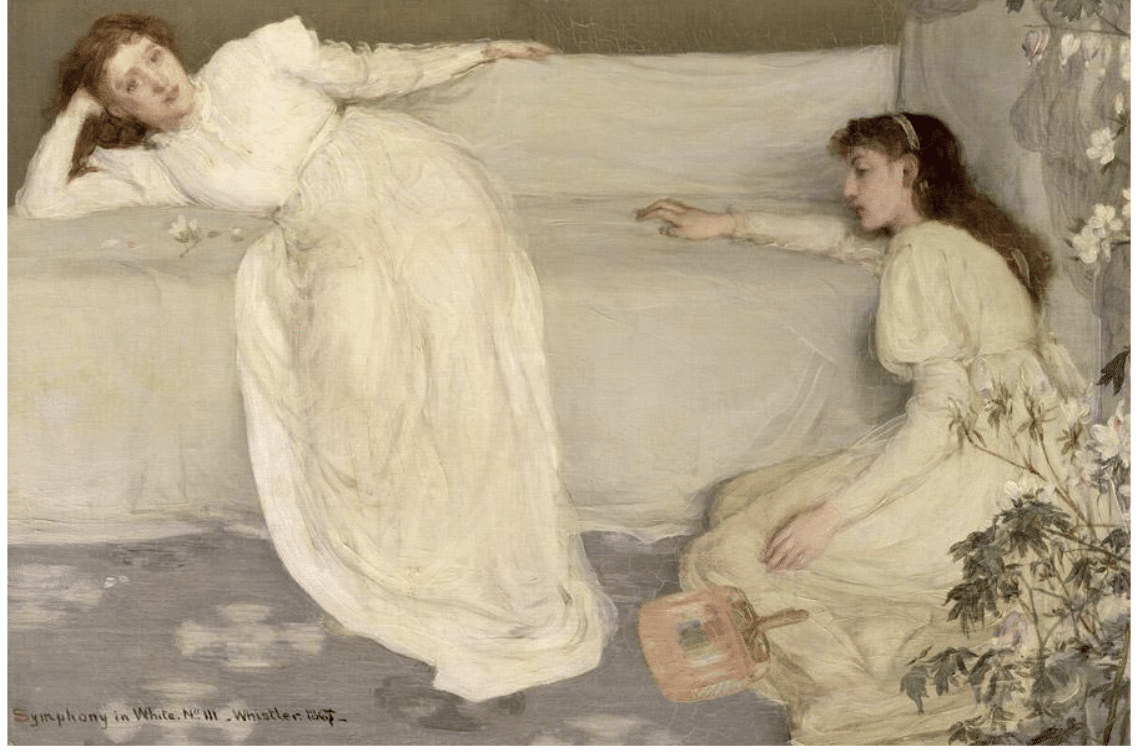
James McNeill Whistler, Symphony in White, No. 3, 1865–1867, oil on canvas, The Henry Barber Trust, The Barber Institute of Fine Arts, The University of Birmingham, 39.24. Image: Bridgeman Images (That’s “Jo” on the left, of course)
The new title, “Symphony in White,” focused attention on what Whistler viewed as the true subject of all three: his handling of the thick white paint, its textures and subtle tonal contrasts.
Together, these “symphonies in white” heralded the then-radical mantra “art for art’s sake” — the artist’s effort to represent purely aesthetic concerns of tone, color, and form without high-brow technique or preachy moral content.
Subsequent artists painted their own “women in white.” But few had the impact on art history that Whistler did. A shot across the bow for a brasher, more democratic, direct and arguably more honest approach, Symphony in White No. 1, The White Girl and its radical break with traditions of portraiture make it worth knowing as an important painting and bellwether of modern art.
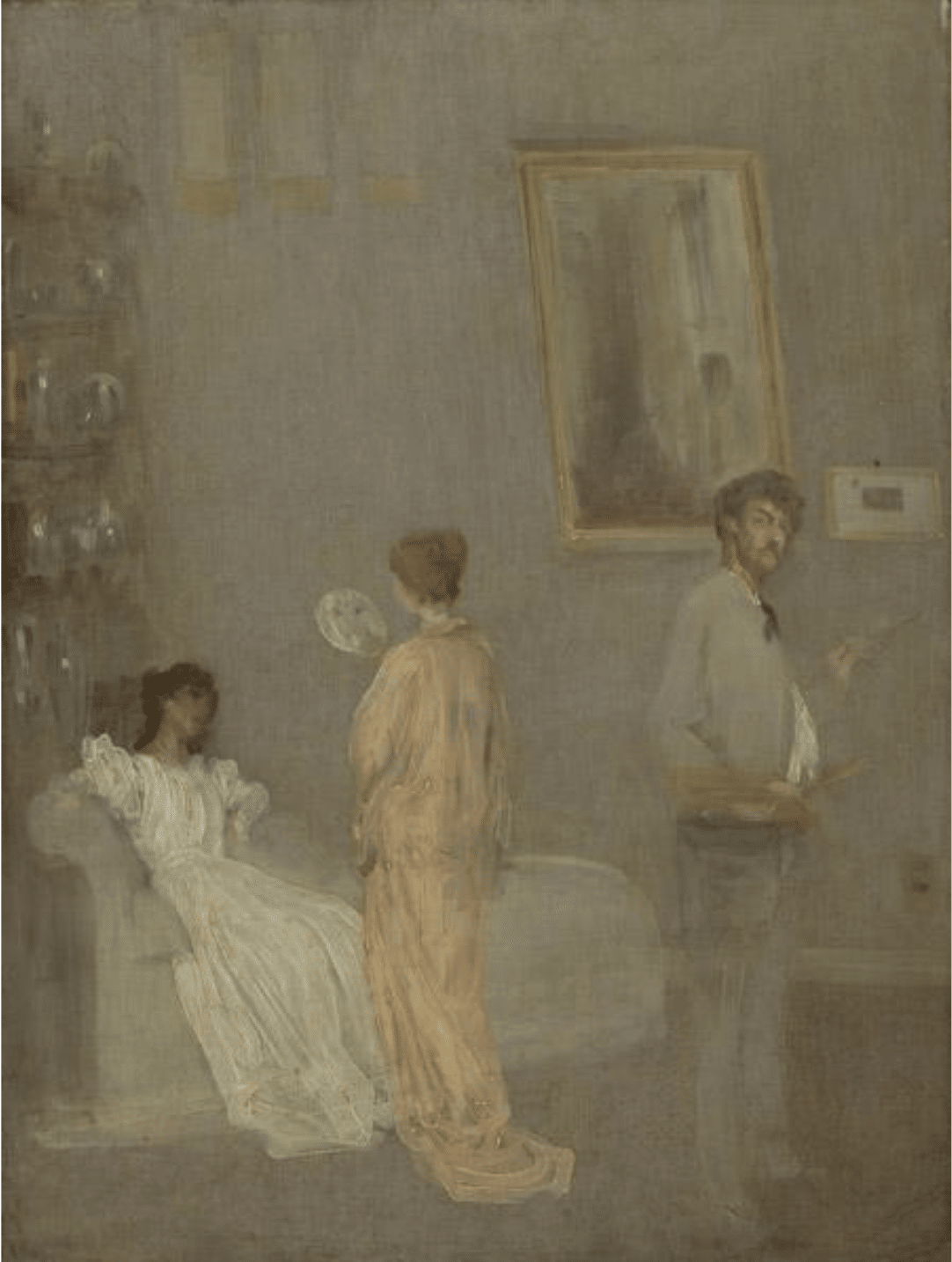
James McNeill Whistler, The Artist in His Studio (Whistler in His Studio), 1865/1872, 1895, oil on paper mounted on panel, The Art Institute of Chicago, Friends of American Art Collection, 1912.141. Image: The Art Institute of Chicago/Art Resource, NY
If you’re interested in classical portraiture, follow along with Joshua LaRock’s portrait of a redheaded model in his video Classical Portraits.
Tell a Story With Your Figure Paintings
By Kelly Kane
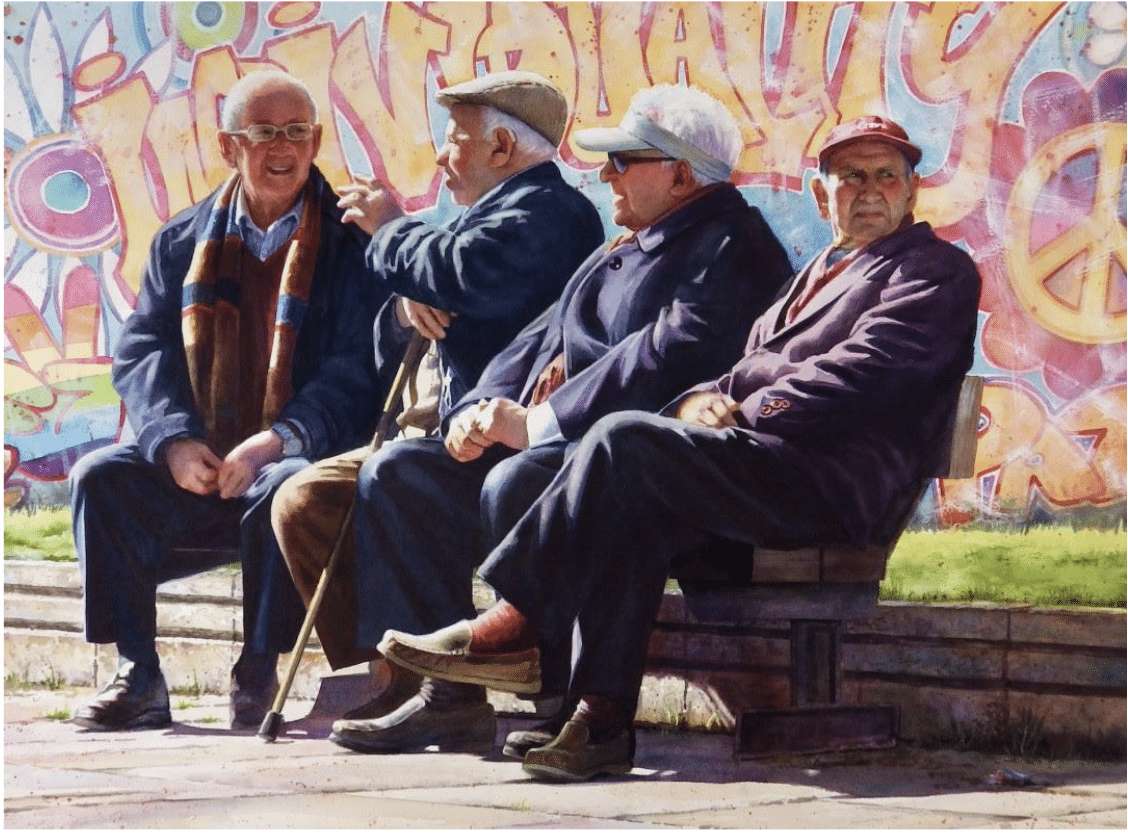
“Individuality” (watercolor, 21 x 29 in.)
“When I saw these four gentlemen sitting on a bench in Spain, it struck me how different their personalities and demeanor were,” says Lana Privitera. “To me, they didn’t feel like just another group of “seniors.” I saw them as individual human beings — each one with unique qualities and abilities to be admired, each one with a unique story of love and pain to tell.
“The background presented my biggest challenge. In my original reference photo, the men were sitting in front of a white wall, but I knew that I wanted to use the background as an integral part of my message not just as a decorative element. So I took my time to design it, to make it meaningful. The ’60s-like graffiti is an allusion to what a different life this group might have experienced when they were younger.
“I painted the group of men first. Normally I only use transparent watercolors for my work, so it took multiple light glazes of quinacridone hues to get those dark values on their clothes. When I was finally ready to paint the background, I decided to use a variety of hues that were already present in their faces, to unify and link both areas.
“Still, I wanted those faces to stand out, so I created further contrast between the group of men and the background by giving some texture to the wall. First I used scrubbers to lift some color and most of the hard edges. I finished by applying a large amount of random strokes of titanium white, creating a softer, hazier look on the wall, which lowered the value range and reduced the definition, thus increasing the contrast with the darker figures.”
COMPETITION ADVICE
“Individuality” won Best Figure & Portrait in the September PleinAir Salon art competition. “We artists need help to get recognition in the art world at large,” says Privitera. “In my case, art competitions have propelled my art career internationally. Don’t get discouraged if you don’t get on the top lists for quite a while. Getting there takes time. The more hours you dedicate to painting, the better you’ll get at it. But remember, technical skills alone won’t win awards. Make sure you learn as much as possible about interesting compositions. Mastering composition will bring your paintings to the next level!”
Lana Privitera has just joined the faculty for Watercolor Live, your ticket to three days of premium watercolor instruction!