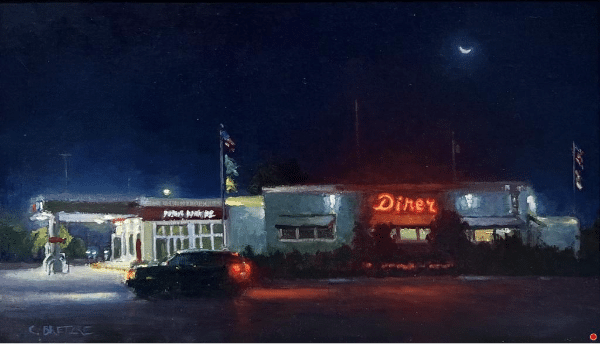
Carl Bretzke’s painting Diner After Dark (above), resonates with a timeless quiet.
We could be anywhere in America. Maybe at first we expect a nostalgic moment of vanished drive-ins and Hopper-esque iconography, but a closer look has us moving between past and present. This gas station is no Route 66 single-pump stop but a modern 24-hour credit card island, complete with a (currently closed) mini-mart. The vehicle is contemporary too. This is a between-place; presumably the gas station’s closed but the diner’s still open, the car either coming or going but certainly not staying long.
There are so many kinds of light here – neon, interior incandescent, outdoor spotlights, ambient and reflected light, sodium lights over the pumps, the car’s headlights and brake lights, and the sideways moon poised above it all. That’s the thing about nocturnes – they’re not really about the dark but about light.
Bretzke specializes in urban and night scenes and plein air landscapes. He is a member of The Plein Air Painters Of America since 2021. The Washington Post describes his work as “simultaneously intimate and detached…The artist’s unadorned style recalls Edward Hopper and The Ashcan school.”

Bretzke teaches the nocturne technique in his video, Nocturnes, Painting the Night available from Streamline Publishing. Mood, atmosphere – and time – take center stage in the paintings of another lover-of-the-night, Michael Guinane (b. 1978). Guinane, whose work was recently featured in Realism Today uses a multilayered approach to capture the feeling of a particular place and time.
“I spend a lot of time thinking about how we are suspended between past and future,” Guinane told writer Brandon Rosas in the Realism Today piece. “I love showing viewers a moment in time that allows them to imagine what has happened or is about to happen.”
As a teenager, Guinane took figure drawing classes at the Milwaukee Institute of Art & Design and was chosen for a high school program that allowed him to spend half of each day of his senior year at the Milwaukee Art Museum. “It was through these activities that I fell in love with art and realized it was what I wanted to pursue,” he recalls.
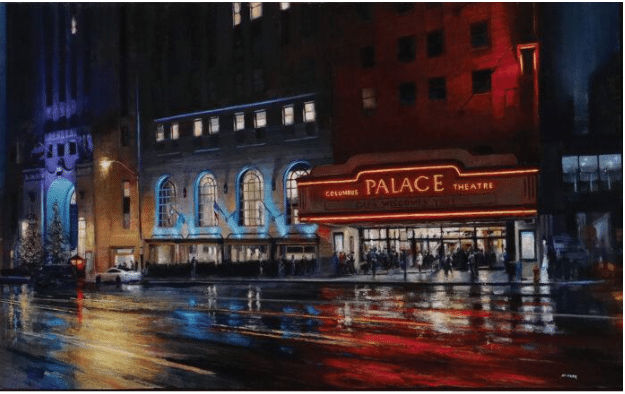
Michael Guinane, “Opening Night,” 2021, acrylic and watercolor drybrush on panel, 20 x 32 in., private collection
Originally enamored with indirect oil painting techniques, Guinane later developed a method that allows him to achieve the effects of oil with acrylic and watercolor. “Using multiple layers and glazes, I can control the value relationships and overall tonal effects slowly as I build up an image,” he told Rosas. “My style of painting truly lends itself to creating strong atmosphere and light effects.”
Rosa points out that these effects are on full display in the nocturne cityscape “Opening Night” (above) in which the rain-slicked streets outside Columbus’s Palace Theatre glow with the neon reflections of a bustling downtown district. “I love going to the theater and feeling the excitement of the night,” says the artist. “You see all kinds of people under the bright lights, and the way they are dressed creates classic silhouettes that feel timeless.”
It was Lowell, Mass.-born expat James McNeill Whistler who coined the term “nocturne,” borrowing it from the Polish Romantic composer Frédéric Chopin. Whistler thought painting should affect viewers much the way music does, not just by depicting beautiful or moving things but by depicting things in a beautiful and moving way. That approach grew out of the late nineteenth century’s “art for art’s sake” philosophy, which gave priority to artistic form rather than content.
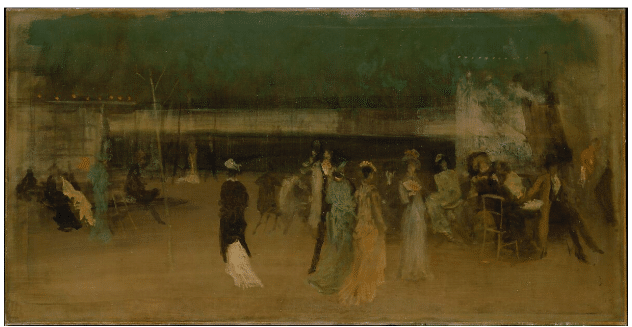
James McNeill Whistler, Cremorne Gardens, No. 2, oil on canvas, 27 x 53 in.
Whistler’s subjects, however, were often seen to be as radical as his ethereal color harmonies. In the nocturne above, painted in London’s Cremorne Gardens (near Whistler’s Chelsea home-studio), he explores, with a radical abstract directness of design, the theme of modern life embraced by many of his European associates, especially the French Impressionists. The Gardens, an elegant, manicured park that drew fashionable strollers during the daytime hours, transformed itself at evening into a softly lit setting for lively music, dancing, and fireworks, where people of all classes could mingle and enjoy the night.
The Artist’s Dilemma: A Color Snapshot

Angela Bandurka, Chromatophilia, acrylic on cradled panel.
Angela Bandurka painted the work above, titled “Chromatophilia” in 2021. The word chromatophilia refers to the love of color.
“It’s a sensation I’ve felt since I was a child,” the artist says. “This painting was created from a photograph I had taken inside the gorgeous art supply store L Cornelissen & Son in London, England. The way they have displayed raw pigment and tubes of paint is just so delicious – you want to live inside that store! I loved every inch of it.”
The figure, complete with a subtle halo of illumination around his head, “represents all of us artists” she says, prone to the state of being “indecisive and at the same time energized and in awe.”
Angela Bandurka took her place among the many teaching artists who shared their painting techniques in the first Acrylic Live that took place this past March. It’ll happen again next year, so put it on the calendar if acrylics are your passion.