Now, this is one proud monk! The miniature below (the whole thing’s maybe 9 inches tall) resides in the Currier Museum of Art in Manchester, NH., where it’s a small precious gem within that worthy collection. Leo Herrmann’s Butterfly Hunting is a really delightful painting.
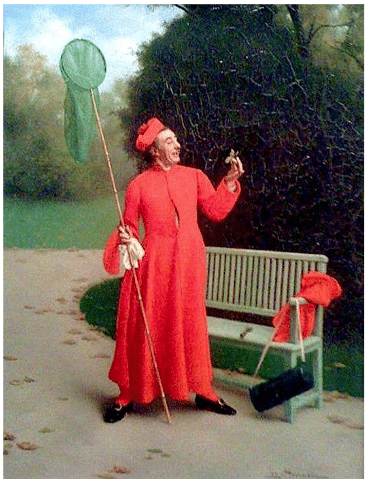
Léo Herrmann, Butterfly Hunting, 1850s
A cardinal (a senior member of the clergy of the Catholic Church) in vibrant red robes stands grinning at his catch – savoring the moment 0f triumph during the proud interval between removing the butterfly from his net and stashing it in the leather collecting kit slung over the armrest of the bench. Close inspection reveals a comical gap between two of the upper teeth in the monk’s unguarded grin. You can’t see it and not answer the cardinal’s smile with your own -at least a little!
Léo Hermann (French, 1853-1927) exhibited genre paintings (scenes from life) such as the above at the Paris Salon from 1875. He made a tidy living as a commercial artist and became very well known for his portrayals of French Catholic clergy, often in gently humorous scenarios that charmingly reveal their protagonists’ humanity. One web source notes that, “his work is as sought after today as it was in his own lifetime,” and it’s not too hard to see why.
There’s so much going on here! First of all, it makes you smile just thinking about what this monk is doing outside the monastery chasing butterflies instead of praying earnestly! His body language exclaims how very proud he is of his catch – and isn’t pride supposed to be a sin? And think about the butterfly – in Western painting, it’s traditionally a symbol of the soul’s transformation from mortal husk to blessed afterlife. And yet, we have a man of God callously (proudly!) snatching the creature from the air to snuff out its life and pop it into his collection!
How do we read the painting from there? First, let’s deal with that ridiculous gap-tooth grin. That alone tells us straight up that however holy the monk, the man is still human. Hermann used similar devices often in this series, where other supposedly pious monks can be found lounging, gossiping, and playing poker. Paintings such as these don’t make any huge claims. Rather, they do the opposite – they’re mischievous and clever takedowns of ordinarily heavy subject matter and delightful objects in themselves.
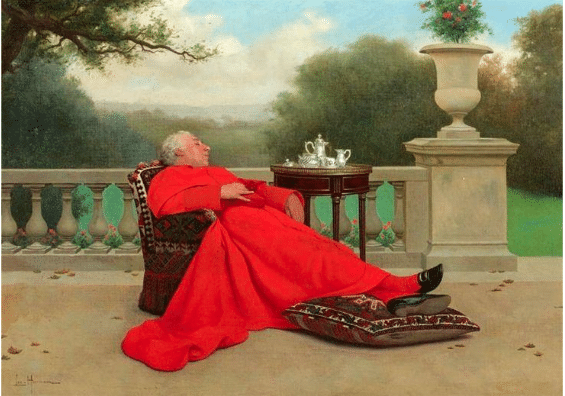
Leo Herrmann, The Cardinal’s Nap, 1850s
Much of these paintings’ success involves the way the figures unselfconscious, earthly comforts eclipse the subtle, well-under-the-surface contradictions: the spiritual and the earthly, man and nature and God off their guard: The habitually serious caught in boyish play, the holy man of God ensnared in the mesh of our common humanity.
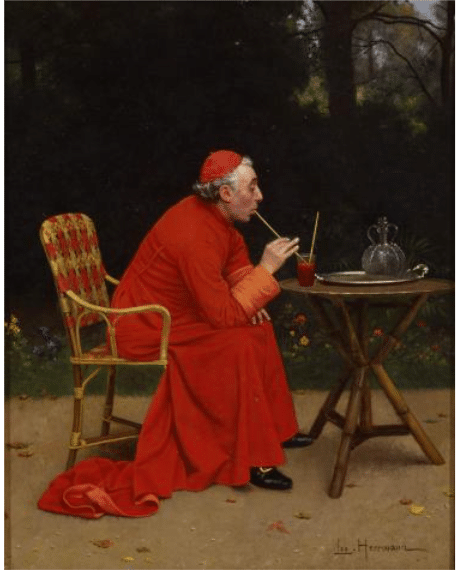
Léo Herrmann, The Cardinal, Oil on canvas, 9 x 7 “
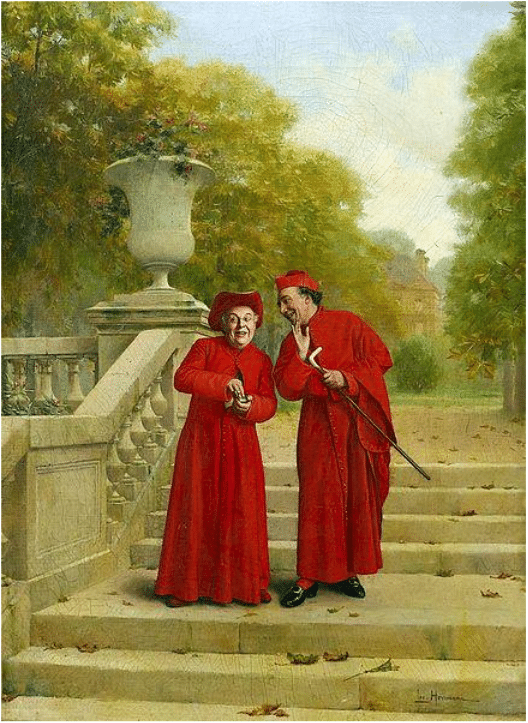
Leo Herrmann, Two Cardinals, 1850s
Cardinal paintings, sometimes also called anti-clerical art, quickly became a sought-after genre in its own right. Works like Herrmann’s by a number of other artists delighted contemporary audiences with gentle humor and remain just as beloved today.
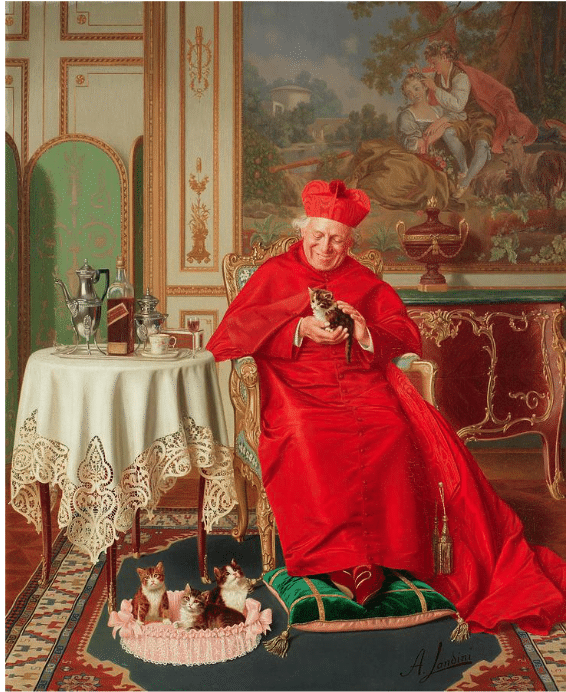
Andrea Landini, The Cardinal’s Favorite, 1850s (Note the echo between the cardinal doting on his kitten and characters in the painting on the wall behind him)
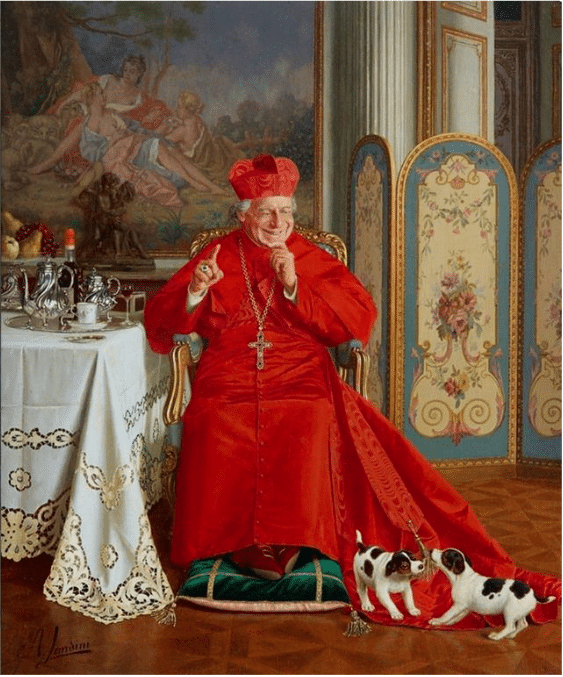
Andrea Landini, A Good Tussle (OMG puppies playing tug-o-war with the gold-threaded tassel on his vestments!)
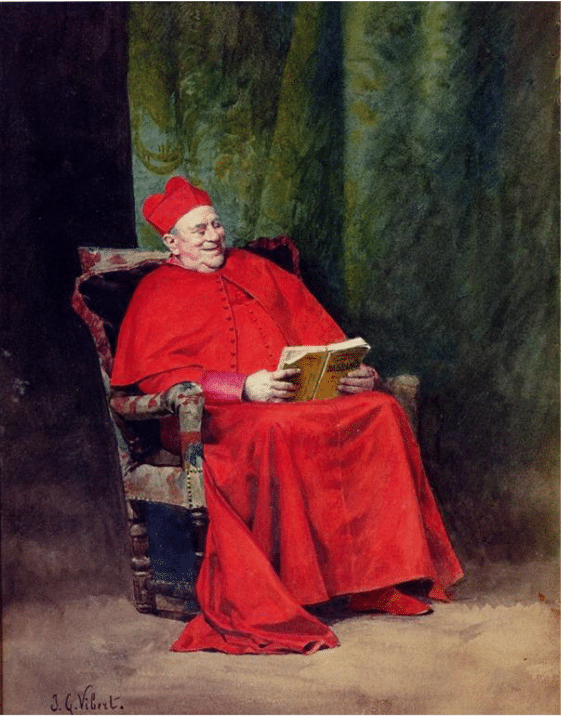
Jehan-Georges Vibert, A Good Read
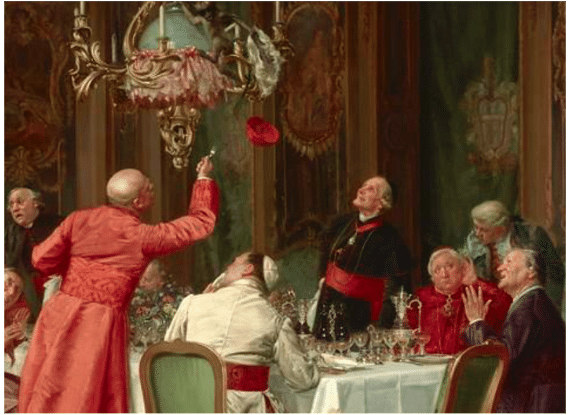
DETIAL: François Brunery, His Eminence’s Monkey
In François Brunery’s His Eminence’s Monkey, chaos erupts at a clerical dinner as a bald cardinal threatens a monkey with a fork while chasing after it to retrieve his stolen cap.
But after Herrmann’s Butterfly Hunting, this next one’s my favorite. The cardinal, who evidently paints as a hobby, sits back and admires his own handiwork – with a modest amount of pride ☺
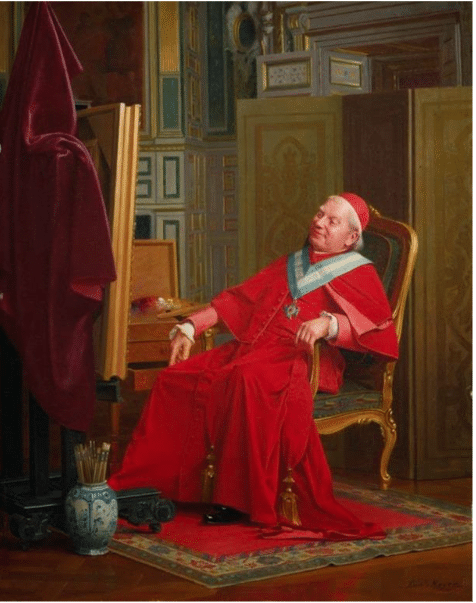
Emile Meyer, A Painting Cardinal
‘BEHIND THE SCENES’ ART TRIPS
Fine Art Connoisseur magazine’s “Behind the Scenes” art trips view great works from a new perspective. Beyond excursions to museums, these are visits with artists and iconic art experiences that leverage deep contacts in the art world. Guarant
eed to create lifetime memories. This year’s trip is to Spain. Hosted by Fine Art Connoisseur Publisher Eric Rhoads and Editor-in-Chief Peter Trippi, it’s a continuation of an eleven year tradition. Learn more here.
How Many Beaver?
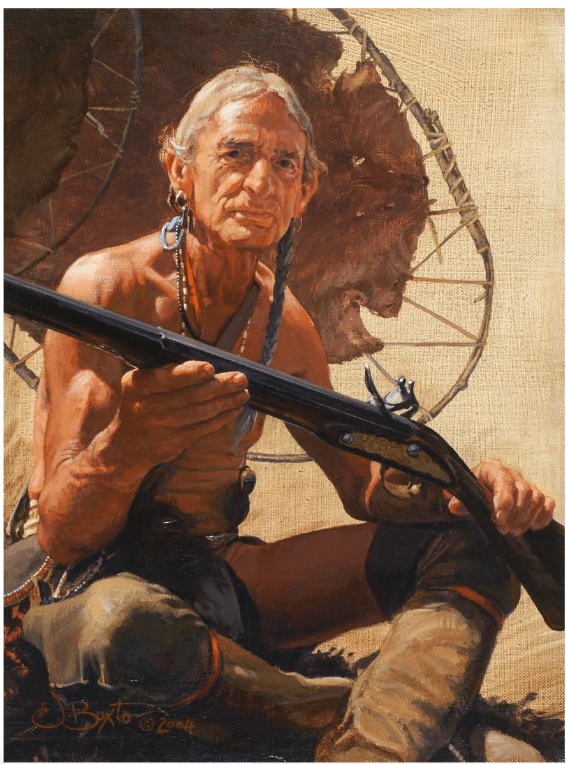
This striking portrait by John Buxton of a Native American bartering for a rifle took first place overall in the September monthly Salon sponsored by PlienAir Magazine.
The monthly PleinAir Salon rewards artists with over $33,000 in cash prizes and exposure of their work. A winning painting, chosen annually from the monthly winners, is featured on the cover of PleinAir magazine.
The deadline is ongoing, so visit PleinAirSalon.com to learn more.