
A Midsummer Night’s Dream is Shakespeare’s most lyrical play. A delicious dream of love and magic, it inspired an entire sub-genre of ‘faery painting’ which flourished in Victorian England, that is, during the latter half of the nineteenth century.
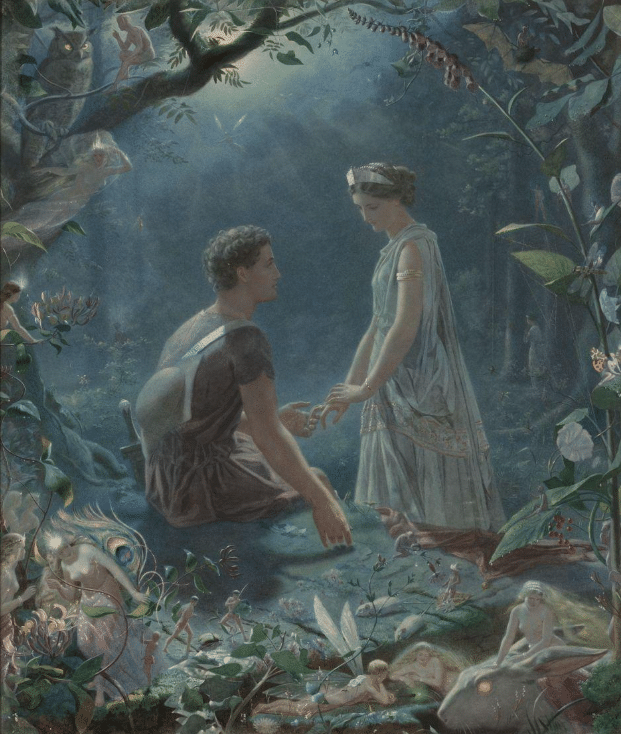
John Simmons (1823–1876), Hermia and Lysander (1870), watercolor heightened with gouache on paper laid down on canvas, 89 x 74 cm, Private collection. Wikimedia Commons.
In the play, four young Athenians from the court of King Egeus run off to the forest – two who wish to elope named Hermia and Lysander, followed by a man named Demetrius and a woman named Helena who is in love with him (Demetrius). John Simmons’ watercolor of Hermia and Lysander from 1870 (above) shows the couple in a thoroughly enchanted wood, with an owl, a peacock feather, foxgloves, cobwebs, and sundry tiny fairies, winged and otherwise.
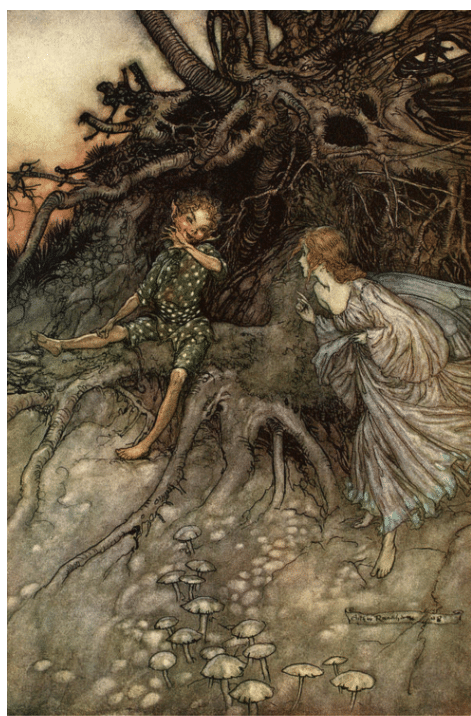
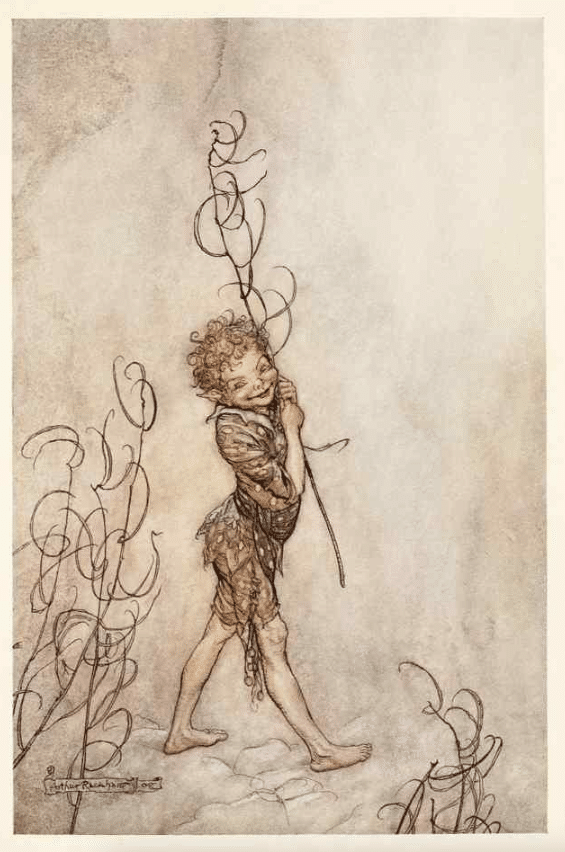
An illustration of Puck by Arthur Rackham, an artist who worked during the “Golden Age” of British book illustration at the turn of the twentieth century.
In the warm summer woods nearby, there’s another couple having love trouble. Oberon, King of the Fairies, has quarreled with his queen, Titania. He enlists the help of a mischievous fairy named Puck to play a trick on her.

Joseph Noel Paton (1821–1901), The Quarrel of Oberon and Titania (1849), oil on canvas, 99 x 152 cm, National Gallery of Scotland, Edinburgh, Scotland. Wikimedia Commons.
Joseph Noel Paton’s The Quarrel of Oberon and Titania (1849) is an elaborate fantasy work typical of faery painting. It captures a sense of the magic, whimsy, and mischief afoot in the play. Though he does not appear in Shakespear’s play, the giant figure of the god Pan appears as a statue coming to life way off the to the right with his musical pipes. He looks quite pleased with the goings-on. Magic is in the air.
With this field-dew consecrate,
Every fairy take his gait;
And each several chamber bless,
Through this palace, with sweet peace;
And the owner of it blest,
Ever shall in safety rest.
Trip away; make no stay;
Meet me all by break of day.
(Shakespeare, A Midsummer Night’s Dream Act V.)
English oil painter Richard Dadd’s Puck was exhibited at the Society of British Artists in 1841, accompanied by a quotation from Act 2 Scene 1:

Richard Dadd (1817–1886), Puck (1841), oil on canvas, 59.2 x 59.2 cm, Harris Museum and Art Gallery, Preston, England. Source of image not known.
I do wander every where
Swifter than the moon’s sphere,
And I serve the fairy queen,
To dew her orbs upon the green.
-Puck (Shakespeare, A Midsummer Night’s Dream)
Dadd shows us Puck sitting on a toadstool with a troupe of nude fairies dancing around it. In the four corners are figures resembling river gods from Greek and Roman mythology.
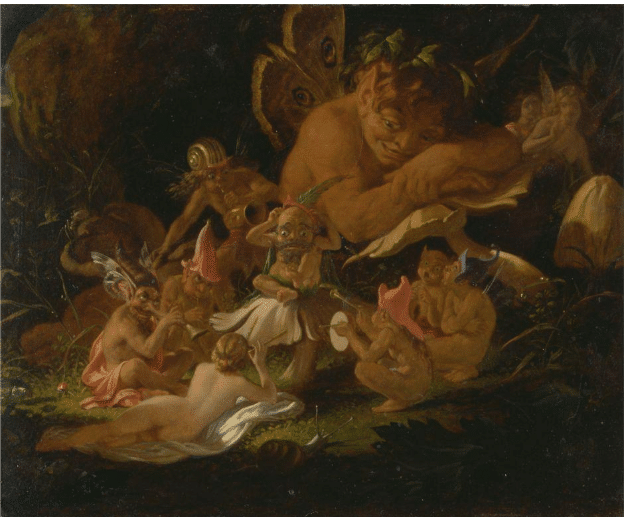
Joseph Noel Paton (1821–1901), Puck and Fairies, from “A Midsummer Night’s Dream” (c 1850), oil on millboard, 26.4 x 31.1 cm, Yale Center for British Art, New Haven, CT. Wikimedia Commons.
Joseph Noel Paton’s Puck and Fairies, from “A Midsummer Night’s Dream” from about 1850, (immediately above) pictures a group of grotesque figures beneath a large toadstool, with a nude fairy piper reclining in the foreground and a paler nude fairy with wings in the background. In this scene, mischievous fairies blast a grimacing victim with cacophonous music and noise while a sleepy yet amused Puck looks on.
Back in the court of the Fairy King, Oberon ramps up his prankery: he decides to rub magic herbal juice into the queen’s eyelids when she’s asleep, to make her fall in love with the first creature she sees upon waking up.

Things go awry, and fun and confusion follow, including the wrong people falling in love due to fairy potions and Queen Titania doting upon a workman who’s under fairy spell that turned his head into that of a donkey. In the end, Oberon and Titania take pity on the poor mortals. Puck reverses the magic, the couples reconcile and marry, and the fairies return to bless the palace and its people, proving the famous phrase from the very first scene prophetic of the unnecessary fuss:
Lord, what fools these mortals be!
— A MIDSUMMER NIGHT’S DREAM, ACT 1 SCENE 1
The poetry of summer shines in Shakespeare’s play, arguably unrivalled to this day by the work of subsequent poets the world over.

Susan Bourdet, Quail and Rose Hips, Watercolor, 13-3/4” x 20”
I know a bank where the wild thyme blows,
Where oxlips and the nodding violet grows,
Quite over-canopied with luscious woodbine,
With sweet musk-roses and with eglantine:
There sleeps Titania (the faery queen)
Sometime of the night
Lull’d in these flowers with dances and delight…
(Shakespeare, MS.N.D., Act II, Scene II)
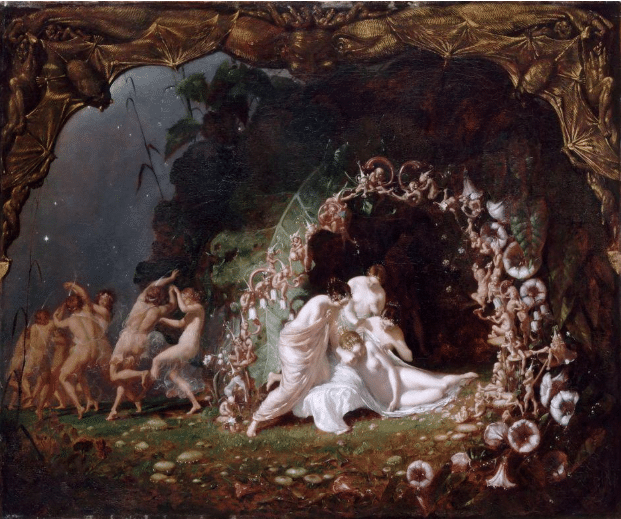
Richard Dadd (1817–1886), Titania Sleeping (c 1841), oil on canvas, 59.7 x 77.5 cm, Private collection. Wikimedia Commons.
One of the most famous of all “Midsummer Night’s Dream” paintings is Henry Fuseli’s “Titania, Bottom and the Fairies” (below). Painted in the 1790s, it’s the earliest of the images we’re looking at today.
Direct and spare. where many works in this genre tend to be elaborate and crowded, this painting has quite an impact on the imagination. Fuesli shows the queen with her arms around the unfortunate Bottom, with whom she’s fawningly in love, while attendant fairies serenade the absurd couple with song and dance and the two courtiers, presumably Hermia and Helena, look on.
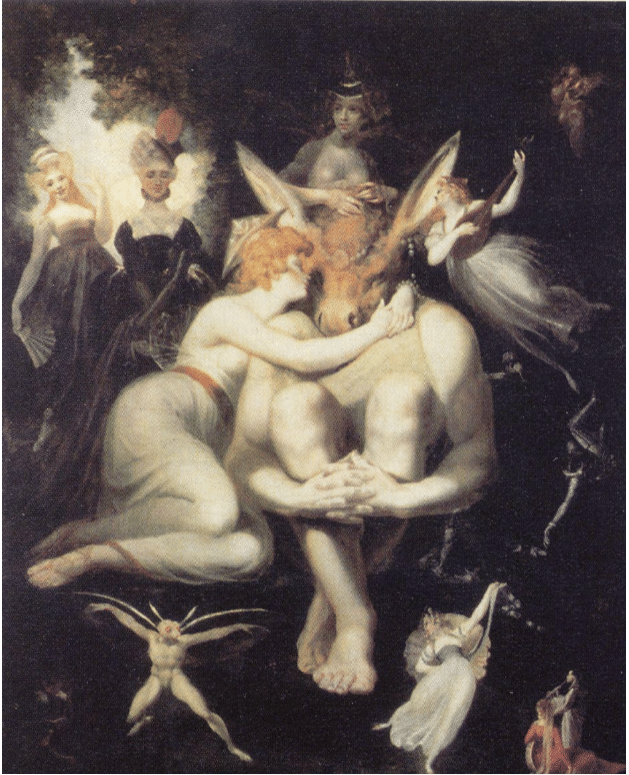
>Henry Fuseli (1741–1825), “Titania, Bottom and the Fairies” (1793-94), oil on canvas, 169 x 135 cm, Kunsthaus Zürich, Zürich, Switzerland. Wikimedia Commons.
Fuseli totally captures what Shakespeare was going for in his contrast between the doting fairy queen’s delicate beauty and the big, if lovable figure of Bottom-as-Donkey.
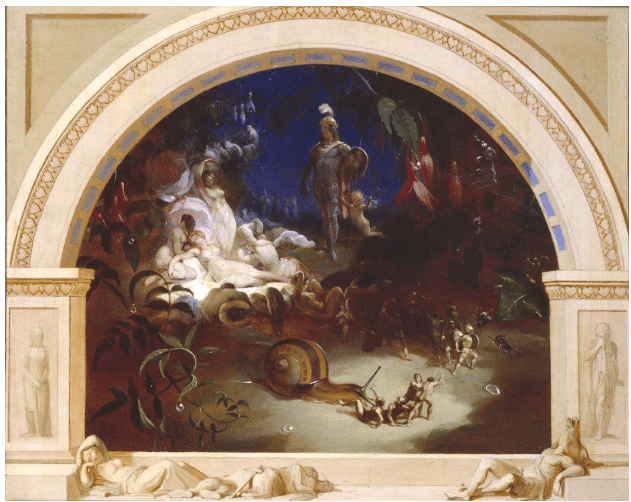
Robert Huskisson (1820-1861), The Midsummer Night’s Fairies (1847), oil on mahogany, 28.9 x 34.3 cm.
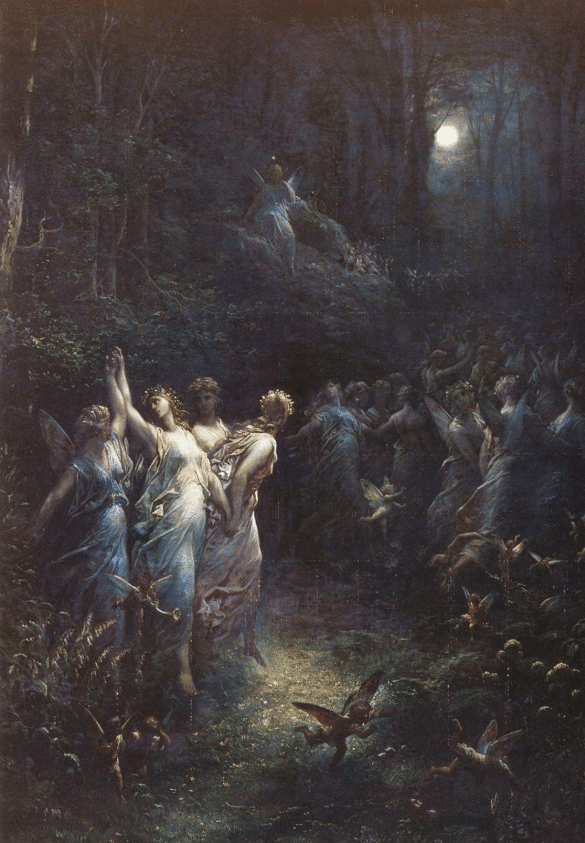
Gustave Doré’s A Midsummer Night’s Dream from about 1870 depicts a full moon shining through the trees of the wood.
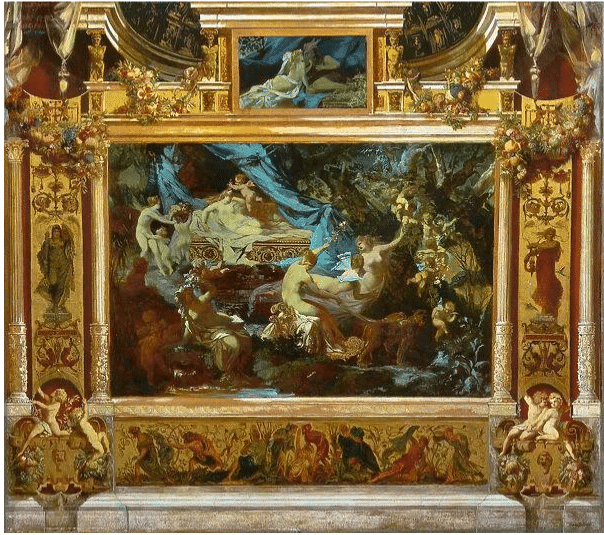
Design for Theater Curtain (A Midsummer Nights Dream), 1872. Found in the collection of the Vienna Museum
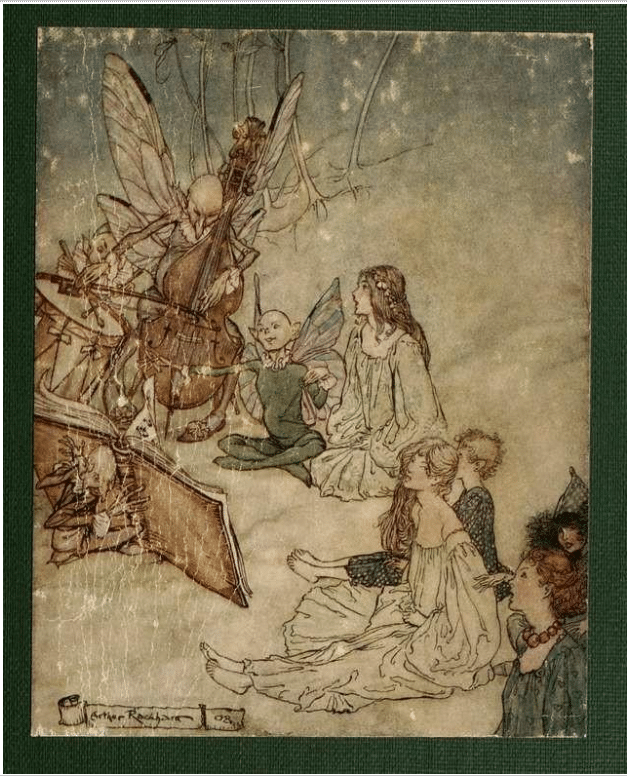
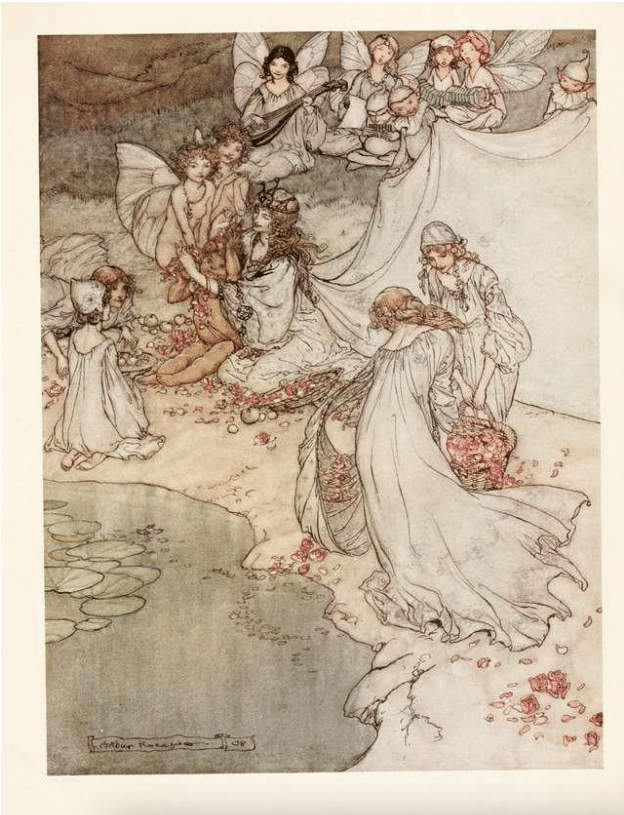
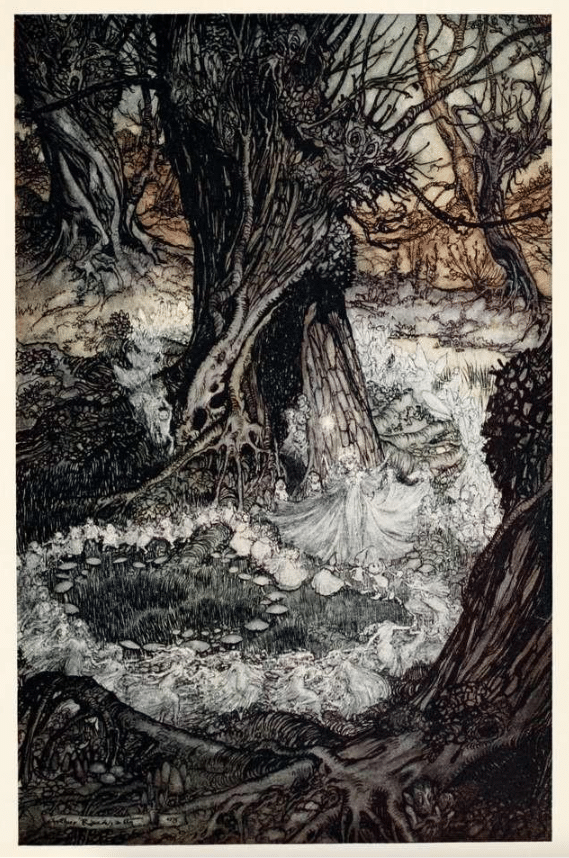
Arthur Rackham, Fairies and Fairy Rings (above)
Create Your Own Summertime Magic with Watercolors
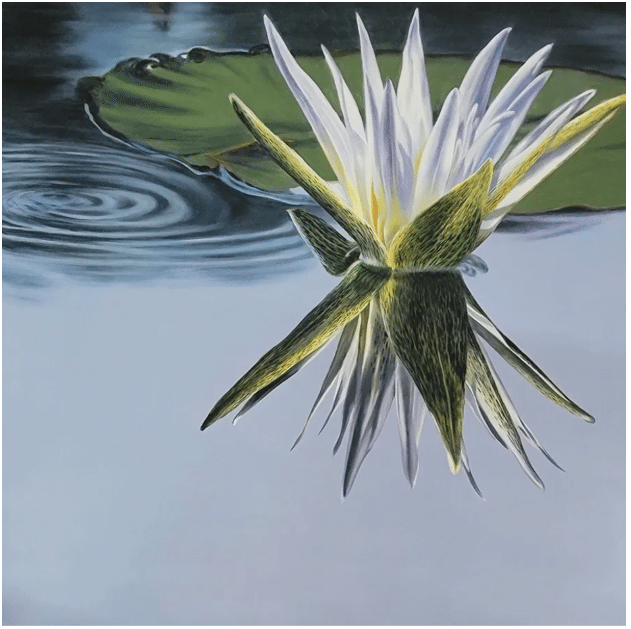
Soon Y. Warren, waterlily in watercolor
Soon Y. Warren invites the very soul of summer into the room with her floral watercolor paintings. Follow along with her teaching video, Soon Y. Warren: Vibrant Watercolor Techniques – Painting Flowers.
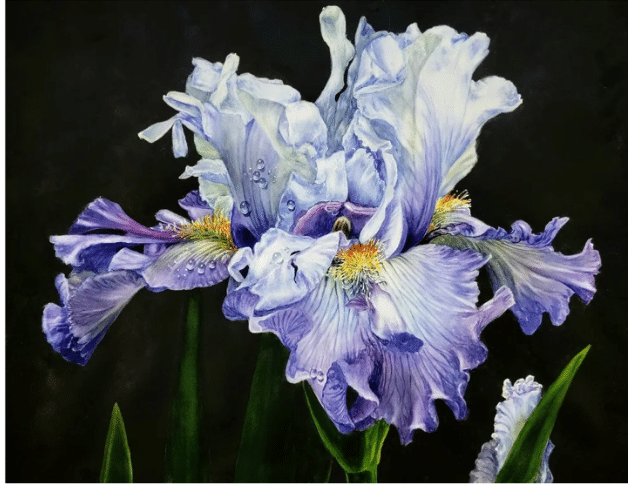
Soon Y. Warren, blue flag iris in watercolo
Susan Bourdet has a love and a special talent for painting birds. Her watercolors brin with colo and life. Learn her method with her teaching video, Bold & Beautiful: Backyard Wildlife in Watercolor.
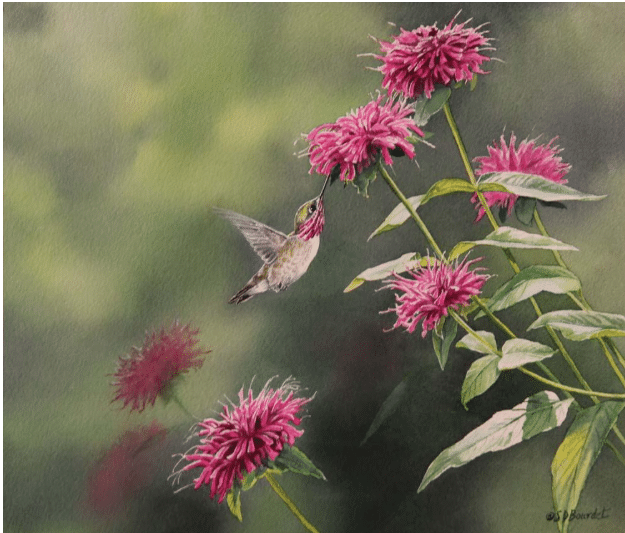
“Calliope Hummingbird in Bee Balm” Original Watercolor Image size is 13-1/2” x14-1/2”