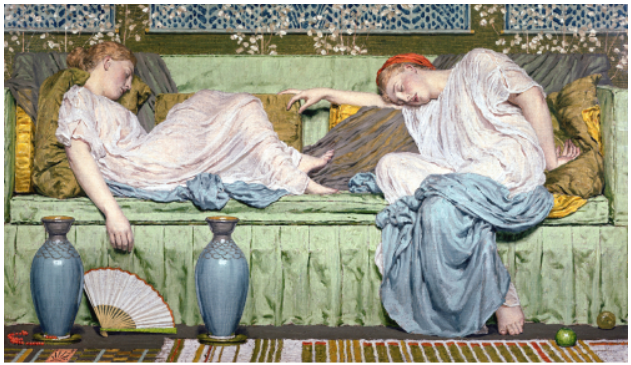
English Pre-Raphaelite Albert Joseph Moore, A.R.W.S. (1841-1893) painted “Apples” (above) in 1875. Moore was a painter of the “art for art’s sake” variety; he sought classical beauty first and foremost, avoiding strong statement or deeper meaning. His paintings, like those of his good friend James McNeill Whistler, are professedly experiments with formal elements such as color and composition before they are anything else.
As noted by Christie’s, the auction house which sold the painting to its present owner for $160,650 in 2002, “Apples” exemplifies Moore’s habit of painting multiple versions of his compositions, altering the color schemes and making minor adjustments to the design. “Apples” is one of three versions of the subject, all identical in size, which the artist painted in 1875. Moore titled the other two “Beads” and “A Sofa.” The differences between them makes for an interesting study in color harmonies and composition.
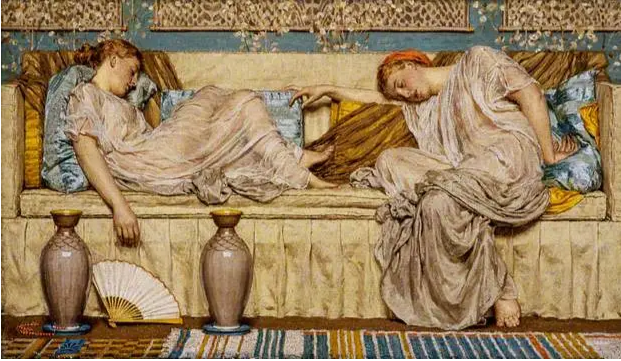
Albert Joseph Moore, “Beads,” ca. 1875, Oil on canvas, 11.5 x 20 in. (29 x 51 cm.)
Yale Center for British Art, Paul Mellon Fund, B1982.10. (The “beads” of the title are on the floor between the vase and the edge of the painting in the bottom left corner,
The figures in each painting, along with the two vases and the fan, stay the same. The only “major” changes are the color palette and the presence or absence of tiny details – such as the eponymous apples or beads at the foot of the couch in “Apples” and “Beads” respectively.
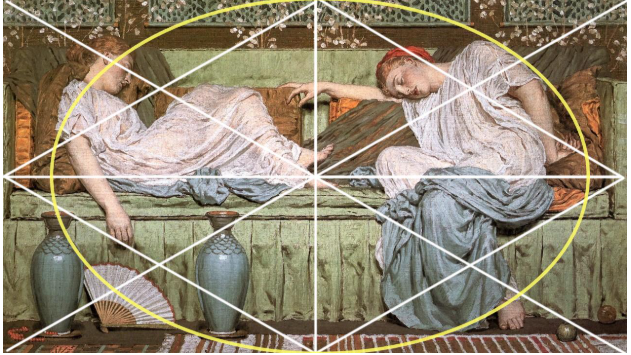
If we divide the (identical) composition into quarters we discover there’s a circular (well, technically oval) composition at work beneath the surface. We find three main shapes below the mid-point: the grouping of the two vases and fan on the left, balanced against the one larger mass of the loose drapery on the right.
The shapes of the two female figures (in rather uncomfortable poses I think, if we’re to assume they’re sleeping) relate to each other within the curvature while striking a balance between the horizontal form on the left and the relatively vertical upright pose on the right.
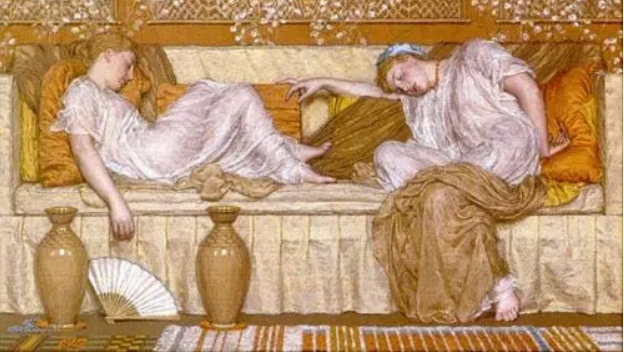
Albert Joseph Moore, “A Sofa,” ca. 1875, Oil on canvas, 11.5 x 20 in. (29 x 51 cm.). Yale Center for British Art, Paul Mellon Fund, B1982.10.
In the absence of beads and apples, Moore titled the third and final work we’re looking at in this series with reference to the sofa itself. Why don’t any of these titles refer to the sleeping women? Likely it’s because Moore saw his figures primarily as nothing more than forms, “formal elements” in an abstract arrangement of colors and shapes, rather than people. Evidently, his figures’ emotions, personalities, or histories were not, in his view, the purview of the artist.
It’s rare to see such complex, detailed figure painting in three entirely different color palettes. What are we to take away from the variation between the relative warm monotones in “A Sofa,” the complementary warm and cool colors (orange and blue) in “Beads,” and the arguably more integrated and subtle, yet no less “harmonious,” cool color arrangement in “Apples”?
Each painting seems to work beautifully on its own, despite all the radical (and not so radical) differences. Is any one of them “better” or “worse” than another? Ah, but now we’re wading into deeper territory concerning mysteries like the elusive nature of beauty and how color and composition make us feel one thing and not another. Such questions, perhaps, are best left to the eye of the (artistic) beholder.
For a great crash course in design and composition, check out William A. Schneider’s video, “Design of the Masters: The Key to Successful Painting.”