Leonardo da Vinci is said to have maintained that “painting is poetry that is seen rather than felt, and poetry is a painting that is felt rather than seen.”
Indeed, painting and poetry often seem able to shed light on each other. Some 300 years after Leonardo, another Italian painter, Tito Lessi, pointed out (rather poetically, I think) that painting and poetry are similar in that they both make “absent things present.”
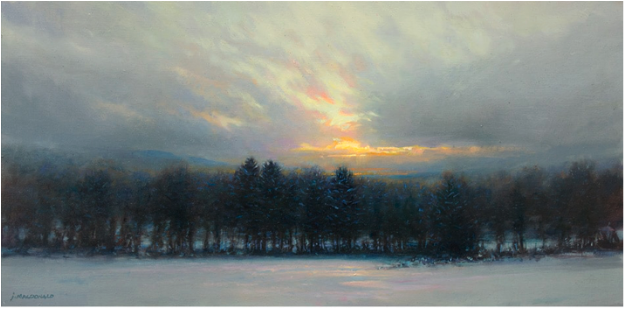
Take artist John MacDonald’s snowy evening landscape above. A painter with a “poetic sensibility” aims to paint what is present (backlit trees in a winter dusk) with the intention of evoking (in the paint and thus in the viewer) precisely what is not present – in a word, the feeling of being fully present to that moment, not only physically, but emotionally and perhaps “philosophically” as well.
That’s why not only vision or even emotion, but also quieting the mind, are primary aspects of “poetic” painting. We value such works for what we call beauty, feeling, or emotion but it’s really about a sensitive human being expressing something at once sensual and essential – in a word meaningful – in visual form. Such work evokes as much or more “feeling” than it delineates in “believable” detail.
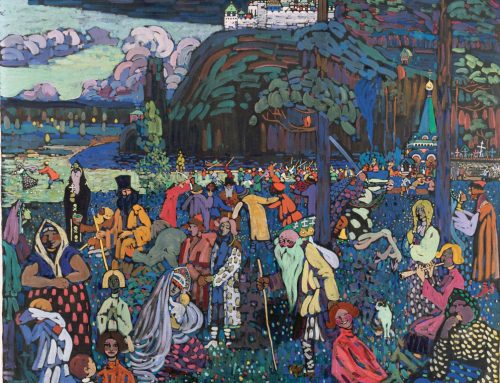
Wassily Kandinsky, one of the major artist-theorists of 20th century art, felt that all painters should be poets. “I value those artists who embody the expression of their life,” he said.
“Color is the keyboard, the eyes are the harmonies, and the soul is the piano with many strings. The artist is the hand that plays, touching one key or another, to cause vibrations in the soul.”
“No need for intellectualization or use of the reason,” insisted Kandinsky. “You lift me beyond the carnal matter to the realm of pure feelings. Thus, I return to my primitive instinctual realm to produce a pictorial language that is essentially poetic.
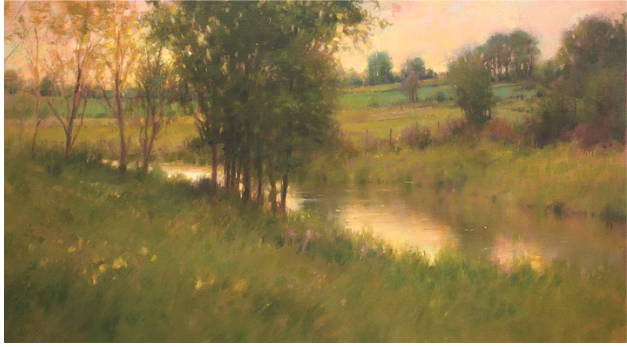
John MacDonald, “Summer Fields,” oil, 20 x 36 in.
“I strive to say as much as possible with as little as possible – to subtly suggest rather than to overtly describe,” MacDonald says. “My subject matter is the mood that arises from the ego-less contemplation of landscape, a mood of not-knowing that leaves some mystery in a painting, something unresolved that allows the viewer to explore the painting and make discoveries within it.”
How to feel that “mystery”? English poet William Wordsworth suggested the following:
With an eye made quiet
By the power of Harmony
And the deep power of Joy,
We see into the life of things.
~ W. Wordsworth
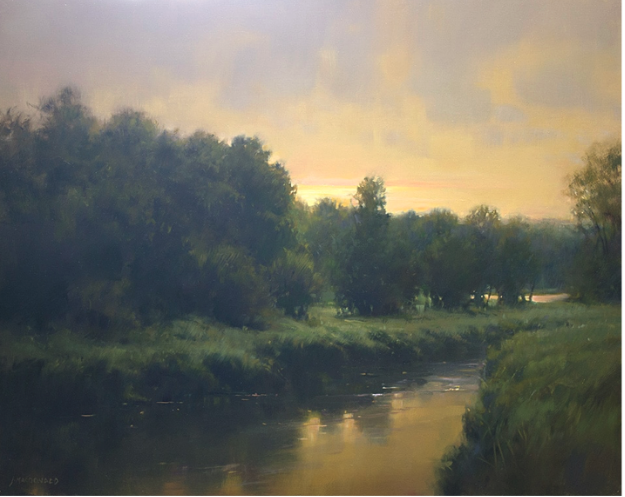
John MacDonald, “Summer Twilight,” oil, 24×30 in.
“To the attentive eye, each moment of the year has its own beauty, and in the same field, it beholds, every hour, a picture which was never seen before, and which shall never be seen again.” ~ Ralph Waldo Emerson
“We must uncenter our minds from ourselves; We must unhumanize our views a little, and become confident / As the rock and ocean that we were made from.” ~ Robinson Jeffers
MacDonald shares a seven-step “emotion-first” process to painting landscapes in his video Poetic Landscapes.