
Monet’s water lily paintings, “Les Nymphéas,” invite us to dream. It’s easy to become lost in their bejeweled surfaces and shadowy depths, where watery reflections flow beneath the dissolving forms of flowers.
“Those with nerves exhausted by work would relax there, following the restful examples of the still waters,” Monet wrote about the planned 360 installation of his water lilies at Paris’s L’Orangerie in the early 1920s, “and to whoever entered it, the room would provide a refuge of peaceful meditation in the middle of a flowering aquarium.”
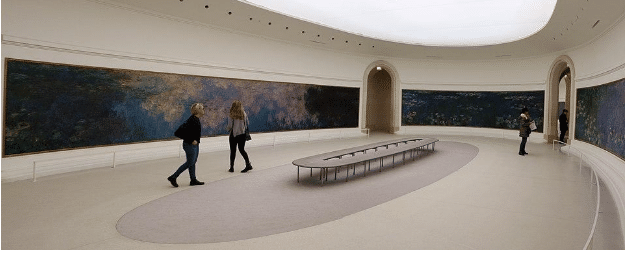
The L’Orangie’s two oval rooms with rounded walls contain huge decorative panels inspired by the water garden Monet created in his home in Giverny. This project, gifted to the nation to celebrate the coming of peace after WW I, surely constitutes his greatest achievement as a painter.
“Without a doubt,” says the website franceguide.info, “the water lily cycle stands as one of the greatest monumental achievements in 20th century painting… a dreamy water landscape, embellished with water lilies, willow branches, reflections of plants and clouds. You will be surrounded and enveloped by an all-round representation, which will give you, in the words of the artist himself, “the illusion of an endless whole, of a wave with no horizon and no shoreline.”
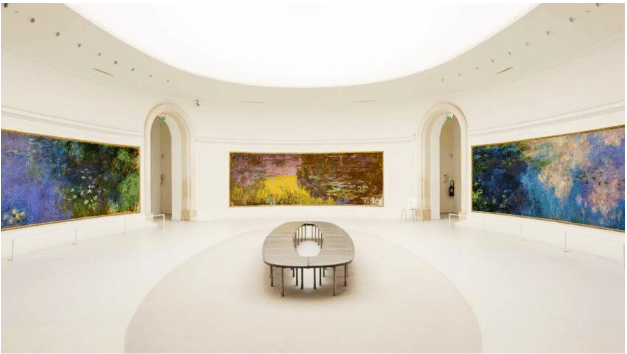
Source: franceguide.info
The sense of slow, unbounded flow is so strong that art writers rarely feel compelled to discuss them in terms of composition. Doing so, however, proves the perennial point: all good paintings rely upon strong composition and design, whether they obey the common “rules” we all know or not.
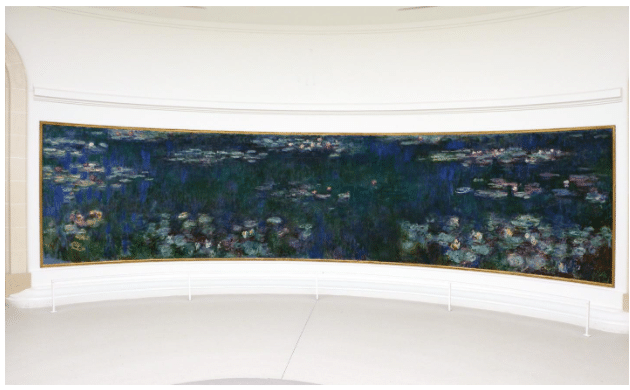
It’s not immediately apparent what the composition is doing in a Monet like this. That’s because the composition is NOT doing the expected, “standard issue” things we’re used to finding. The panel above is typical:
- absence of a focal point,
- zero directional lines or big shapes,
- missing “rule of thirds,”
- lack of delineated rhythm or movement and
- less than dynamic arrangement of visual space.
- Its also “too symmetrical” by current standards.
But there’s a simple underlying composition nonetheless, and it’s one that supports Monet’s intention – to express what he called “the illusion of an endless whole.”
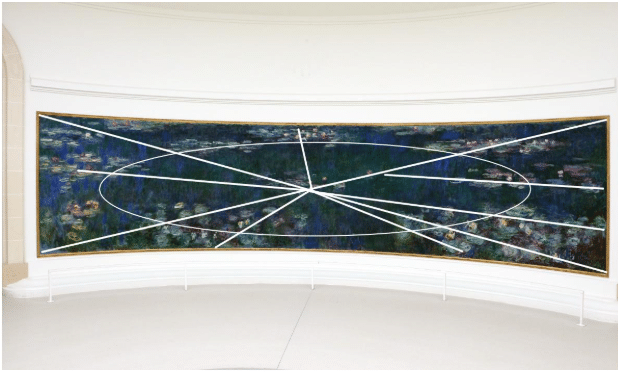
It’s a circle (an oval actually), centered on a small cluster of floating flowers. You notice the larger clusters of flowers on all four sides and the smaller ones above and below if you connect them with lines radiating from the center. The effect is to hold us both situated in the center and mesmerized by the periphery. To avoid making this obvious and static, Monet uses good design – the varied arrangement of the individual flowers within and just outside the clusters and around the edges – to break up any solidity with what feels like a gentle scattering or sprinkling here and there across the surface.
Let’s flatten out another one of the Orangerie panels, the one called “The Clouds.” This time we do see distinct larger shapes, directional lines, a division into thirds, and a stronger sense of symmetry. Here we get large central shapes flanked by two smaller, much darker rectangles on either end.

Claude Monet, “The Water Lilies – The Clouds,” 1920–1926, Musée de l’Orangerie, Paris
The center area of cloud reflections form a shape that’s subtly asymmetrical and divided into thirds, as visible below. (The vertical turquoise lines show the asymmetrical division; the white lines follow the directional lines or “eye-pointers,” diagonally or radially arranged, that the edges assume as they “point” down and move out away from the center):

We know the arrangement is far from accidental or improvisational on Monet’s part, because he repeated it from a previous version – a full-size oil painting on three joined canvases now on view at the Museum of Modern Art in New York. It’s a design plan Monet used many times – a larger element on one side balanced by a scattering of smaller elements on the other.
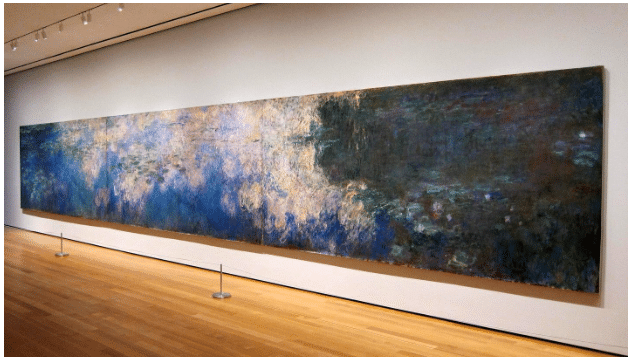
Claude Monet, “Reflections of Clouds on the Water-Lily Pond,” c. 1920, 200 × 1276 cm (78.74 × 502.36 in), oil on canvas, Museum of Modern Art, New York City.
Here are these two paintings, one in France the other in NYC, side by side:

Claude Monet, “The Water Lilies – The Clouds,” 1920–1926, Musée de l’Orangerie, Paris

Claude Monet, “Reflections of Clouds on the Water-Lily Pond,” c. 1920, 200 × 1276 cm (78.74 × 502.36 in), oil on canvas, Museum of Modern Art, New York City.
They’re both exasperatingly beautiful – what more need one say? Oh Monet’s Waterlilies. What could be more entrancing? Thankfully they’re just a click away thanks to the Musée de l’Orangerie’s virtual tour, now available on the museum’s official website, and accessible here.
Looking for instruction on composition? Look no further than these videos professional working artists, available here.