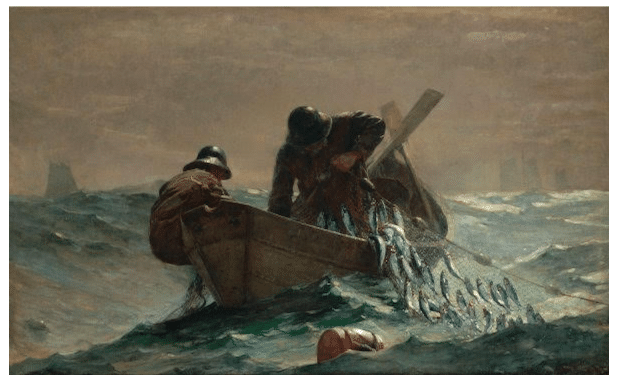
In 1883 Winslow Homer moved to the small coastal village of Prouts Neck, Maine, where he created a series of paintings of the sea unparalleled in American art, says the Art Institute of Chicago, which owns Homer’s oil painting titled “The Herring Net” (above).
“Long inspired by the subject, Homer had spent summers visiting New England fishing villages during the 1870s, and in 1881–82 he made a trip to a fishing community in Cullercoats, England, that fundamentally changed his work and his life.”
“The paintings he created after 1882 focus almost exclusively on humankind’s age-old contest with nature. Here Homer depicted the heroic efforts of fishermen at their daily work, hauling in an abundant catch of herring. In a small dory, two figures loom large against the mist on the horizon, through which the sails of the distant mother schooners are dimly visible. While one fisherman hauls in the netted and glistening herring, the other unloads the catch. Utilizing the teamwork necessary for survival, both strive to steady the precarious boat as it rides the incoming swells. Homer’s isolation of these two figures underscores the monumentality of their task: the elemental struggle against a sea that both nurtures and deprives.”
In terms of composition, Homer isolates the figures by darkening and centering them. He pulls them and the boat right up close to the viewer to heighten the drama, leaving no question what this painting is about. Herring fishermen, sure, but given what we can’t help feel about those men, we get something of humanity’s “age-old contest” with nature – the fundamental rift between ourselves and the planetary biosystem that we’re part of underlined by the universe’s indifference to all human effort. The figures, marked in green, form little pyramids – said to be the most stable of all geometric shapes – in opposition to the multidirectionality of the roiling sea.
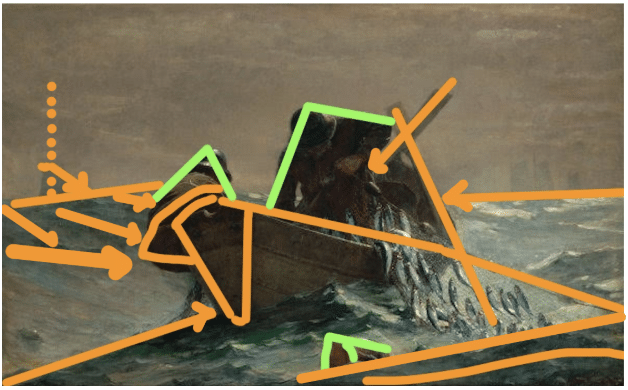
The rest of the composition is about giving structural support to the central mass with directional lines (in orange) pointing inward toward the center from the sides and corners. The general rule is that if there’s a diagonal line pointing up toward the horizon line it’s pointing inward toward the center of the painting, and diagonals coming down from above it are pointing in as well.
The rule is almost violated on the lefthand side. There’s a dip on the horizon line’s far left slanting down from the horizon line, threatening to point us out of the painting. However, there are multiple smaller diagonals that counter this line and also a horizontal element (distant ship – dotted line) to create a barrier before we do slip out of the painting. Everything else straightforwardly keeps our eyes on the central group.
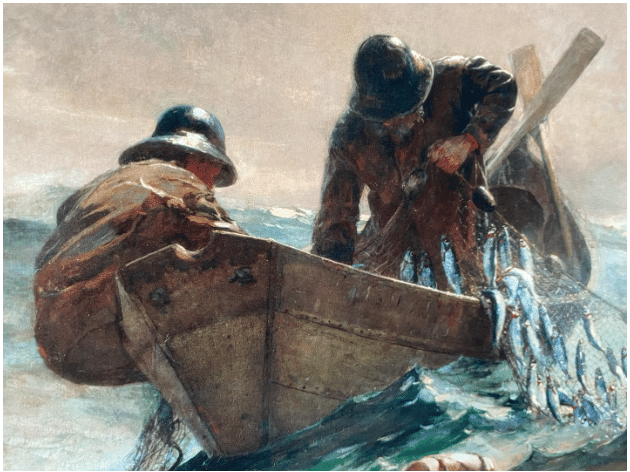
It’s easy to miss one of the coolest things about this painting – the shape of the man’s crouching body on the left. He’s simultaneously hauling in and acting as a human counterweight to the loaded nets the other guy’s pulling up on the right. What’s so great is how he’s just hanging out there, suspended over the void. That detail says it all right there.
We get a far more becalmed “fish story” in “Man in a Punt, Fishing,” also by Homer. This watercolor (below), painted in 1874, is more typical of the “outdoorsmen” themed illustrations and paintings that folks were used to seeing from Homer before the 1880s. There’s not a lot of existential dread or drama in it. The composition, though, is quite strong.
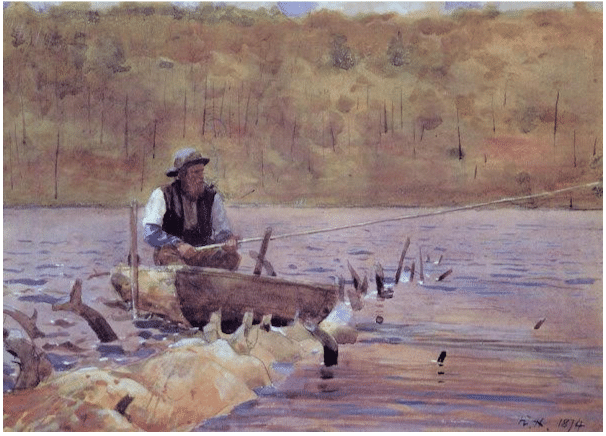
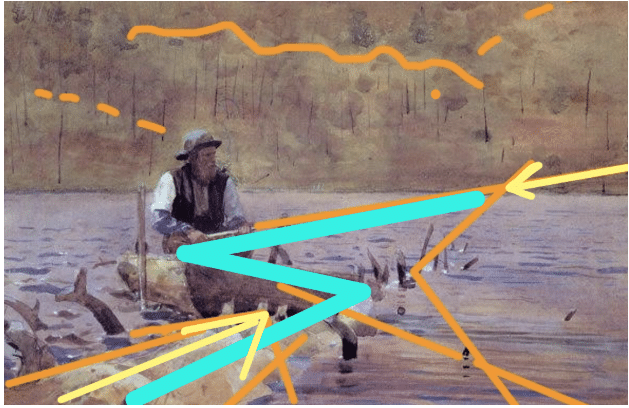
There’s a big zigzagging “S” shape supporting the central figure formed by the sandy triangle (outlined in aqua below). It points up from the near lefthand corner and down on the right from the fishing pole, both ending in the fisherman and his boat. This gives a rare a combination of dynamism and stability to the composition, a paradoxical formulation that might just be the very definition of great design. Such are the tools one acquires by performing this kind of close looking at paintings by great masters of the past. It wasn’t until I diagrammed it that I noticed the subtle inward-pointing curved lines in the background foliage.
Homer’s watercolors are the subject of a major show at the Museum of Fine Arts in Boston now until the middle of January. We’ll focus on that show in an issue coming up shortly.
If you’re ready to improve your skills at painting moving water, check out Scott Hamill’s teaching video, “Crashing Waves and Bold Strokes – Master Dynamic Seascapes in Oil.”
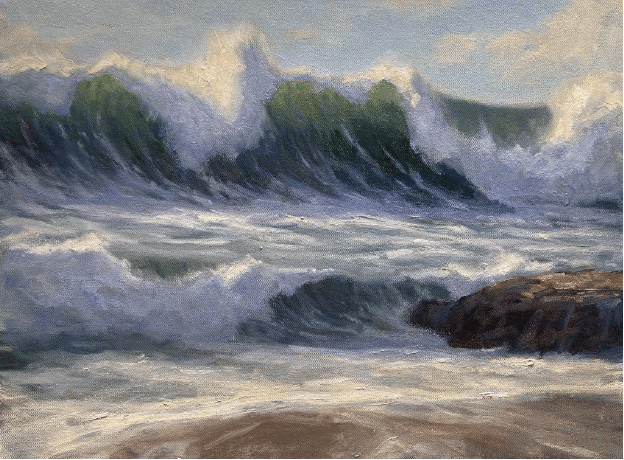
Scott Hamill, “The Power of the Sea,” oil, 18 x 24 in.