Dan McCaw is a contemporary American artist who lives and works in Torrance, California, alongside his two accomplished artist sons, John and Danny. Together, they share a studio environment that fosters exploration, dialogue, and a continual reexamination of what painting can be. Trained in classical methods and influenced by the great masters at an early age, McCaw’s journey has led him toward a more interpretive and expressive visual language—one rooted in design, emotion, abstraction, and atmosphere rather than strict representation. Here Dan shares insight into the imaginative creative approach that drives his art.
By Guest Contributor Dan McCaw
Imagination is the most powerful creative tool we possess— limitless in its scope, it is the birthplace for all great ideas. And the more we challenge and use it, the greater our imagination
can become.
No painting, sculpture, writing, poetry, film, architecture, music, dance—nothing creative, as Carl Jung said—has ever yet come to light without the play of imagination.
How many thoughts run through our minds each day? We are constantly thinking of one thing or another. We daydream, fantasize, plot, remember, distort, create, question, suppose,
brainstorm, perceive and invent. In each case we are drawing from our experiences, and our perceptions of those experiences.
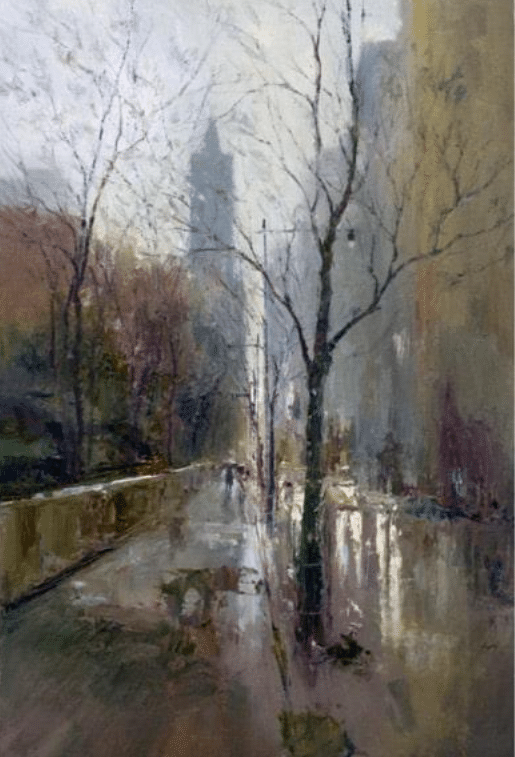
Dan McCaw, NYC Rain, 36 x 24
In our imaginations, cows can fly, and trees can be purple. Children’s imaginations run wild, abstracting the knowledge and information they have acquired— bending, distorting and exaggerating, dreaming and fantasizing. Our imaginations make us uniquely individual. We can do and be anything in our imaginations without fear of failure or judgment.
Our imaginations are a safe place where we can play and let any thoughts have their space to run without limits, boundaries or risk. In your imagination you can go on any journey—no roadmap or compass needed. It is a journey that only you can take; you determine its course and how far you will travel. As your experiences broaden, your imagination will likewise expand.
Imagination can also be turned in destructive ways, and that beautiful, safe place can become a haven for negative thoughts—thoughts that can become destructive and habitual; a place where we imagine negative things about ourselves and others.
And just as our imaginations can be a haven for creativity and beauty, one negative thought can build on the next, creating unnecessary fears and distortions that circulate and overwhelm positive thoughts.
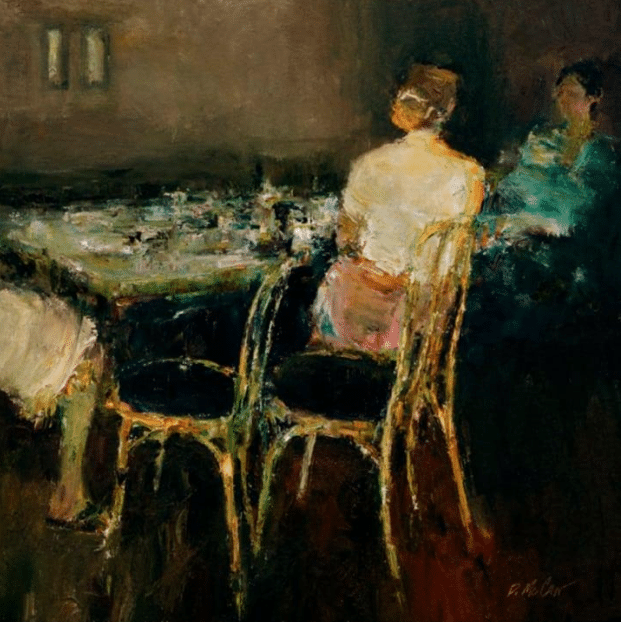
Dan McCaw, Conversation, 30 x 30
It is really up to each of us which we focus on. Whether positive or negative, thoughts can ultimately become our reality if that is what we constantly focus on. We are who we think and perceive we are. We are in constant dialog with ourselves, always asking and answering questions.
My mind focuses on the questions I ask and searches for an answer. If I ask good questions—“What is good about this painting?”— my mind will search for good answers. If I ask negative questions —“Why am I such a bad painter?”— my mind will search for negative answers. Our realty is what we are focusing on at the moment. All our thinking becomes compressed into that small direction of thought.
Some people see a rainy day as gloomy, cold and depressing. Others may experience it as crisp smells, or as beautiful reflections with patterns of umbrellas that make interesting designs. Same event, different perceptions. If we broaden our perceptions we will have choices, and within these choices we will find things that are closer to our true nature.
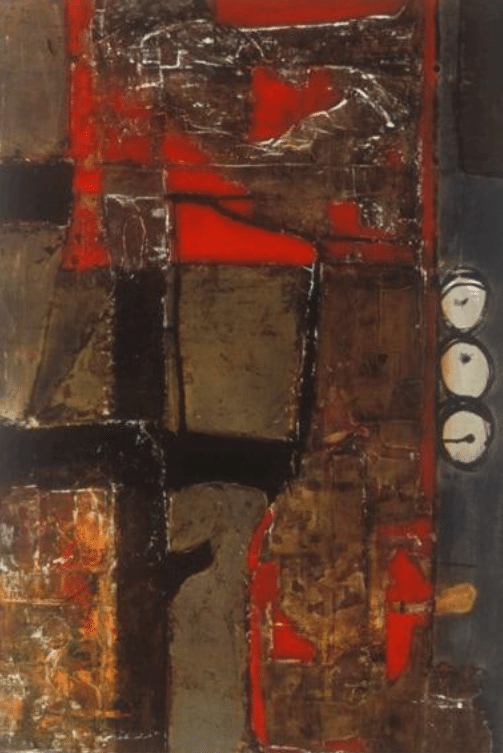
John McCaw, Derailed, 36 x 24
John Allen sums up the potential of the mind and imagination in his book As a Man Thinketh:
“Man is made or unmade by himself. In the armory of thought he forges the weapons by which he destroys himself. He also fashions the tools with which he builds for himself heavenly mansions of joy and strength and peace. Between these two extremes are all the grades of character, and man is their maker and master.”
The importance of asking ourselves the right questions cannot be overstated. If we dwell on too many negative thoughts we feed a destructive fire that can consume us.
What is it that attracts our attention and imagination? What is it that causes us to think about one thing more than another? What awakens something from our unconscious and brings it to our attention? It is those things that we consider important at that moment that draw and hold our attention.
Our imagination has the ability to form mental images that we construct from the things that we have observed, imagined, remembered, feared and distorted, all the things we have experienced. Many things stimulate our mind and ignite our imagination. It may be an idea, a problem, or a random thought. But we have to do more than think, imagine, fanaticize and daydream—we have to begin to bring our ideas into reality; we have to deal with the fear of failure, rejection or humiliation.
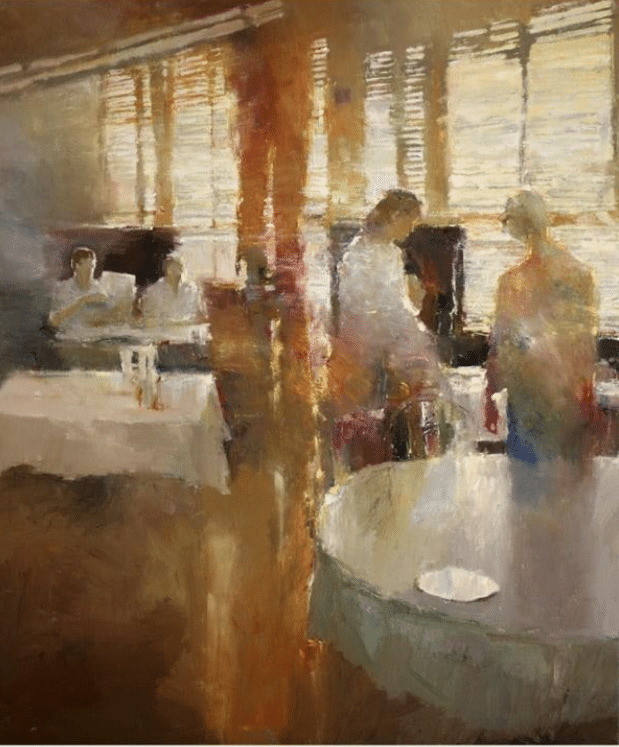
Dan McCaw, Saturation, 48 x 40
Why do some people live only in their fantasies, never crossing that road into reality, never taking a chance, never leaving that safe place, just fantasizing and daydreaming? It is because of fear. Fear can paralyze or motivate. Fear is the single strongest force that stops us from moving forward, fear of failure, fear of rejection, fear of humiliation and so on. It is only when frustration drives the desire for change that we will begin to move forward.
Frustration is a regular contributor to self-doubt but it is also is the great motivator for change. Frustration is a crucial part of anything creative. Without frustration we would stagnate and become complacent in our own satisfaction. We tend to hold onto the safe, familiar and predictable in order to avoid those fears that lie in the shadows of uncertainty. If you do nothing with a great idea you are no better off than someone with no idea at all.
Creativity flourishes in change, it expands when its limits are limitless. The artist must remain open to its possibilities and eliminate the dispassionate. The dignity of art is not in its constants but in the liberation of its possibilities. Creativity is a byproduct of change. You must remain open and curious, to see things from many different points of view, to be willing to fall on your face and get up and try it again and again. When imagination participates in the evolution of the possibilities within a thought, creativity has its greatest opportunity.
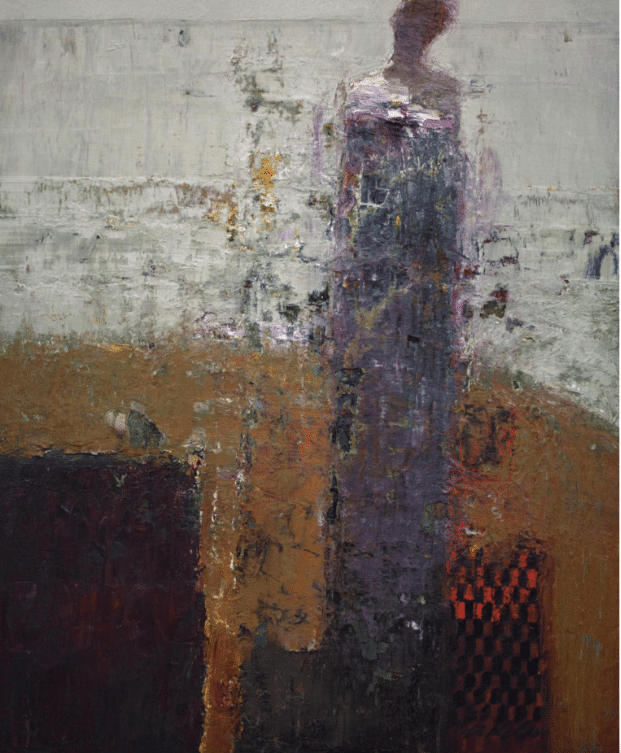
Dan McCaw, Textures, 24 x 18
The more attention we give to an idea the more possibilities reveal themselves and the more real they become. We are like a piece of fabric that has many different threads woven through
it. Each thread represents memories, accomplishments, failures, fears, hopes and dreams. This fabric makes up who we are at this very moment. We wear this fabric as we come to each canvas and as we face each new day.
You must find something that you love—a true passion. This passion is not always obvious; it’s not always right in front of you. You have to search, to be open to new ideas and new ways of seeing and thinking. You have to deal with fear and frustration, you have to be persistent. No one can tell you if it is right or wrong you just have to feel it for yourself—it is your True North.
Pablo Neruda, the great Chilean poet said, “If you hold your hand in the flame long enough, a flower blossoms.” (my paraphrase) This is what passion and persistence is all about, the willingness to bear the pain in order to achieve your goal. I believe that everyone has an inherent desire for individuality and original thought. As artists we search for a tangible manifestation to visually express something within us. It’s not something that we can easily define, but we have faith that it exists in each of us. In the desire for change and in the search for our own True North, creativity is set in motion.
Dan McCaw’s passion for painting comes through in his work and words. Connecting heart, head, and hand is what it’s all about. If you’re looking for a practical way to explore this in your own work, you might consider Frank Webb’s video, Using Your Head Heart and Hand.
Webb will teach you all you need to know about watercolor technique to begin allowing yourself to trust imagination, memory, and intuition as you find your own “True North.”