What is the role of the political dimension in art?
That question is at the heart of a provocative, long-running exhibition opening this week in Washington D.C.
The National Gallery of Art’s Conversations: Kerry James Marshall and John Singleton Copley pairs two icons of American art: 18th century colonial realist John Singleton Copley and 21st century African American revisionist Kerry James Marshall.
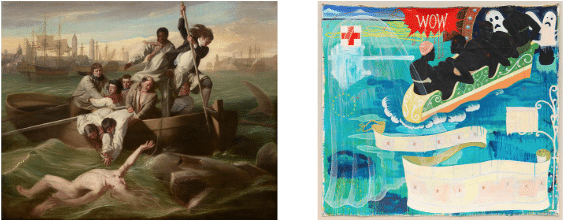
Showing Watson and the Shark by John Singleton Copley side by side with the two paintings Great America and Voyager by Kerry James Marshall illuminates how both artists—centuries apart—reimagined the practice of large-scale, multi-figure history painting in their own time.
The installation is the second in the Conversations series at the National Gallery of Art, which aims to engage visitors and ignite curiosity about the museum’s permanent collection by bringing diverse works from different time periods into dialogue with each other.
Bridging the 18th and 20th centuries, this installation juxtaposes Copley’s and Marshall’s distinct reimaginings of history painting from their individual perspectives—Anglo-American and African American, respectively.
The political content of the Kerry James Marshall painting is plainly evident. In Great America he re-imagines a boat ride into the haunted tunnel of an amusement park as the Middle Passage of slaves from Africa to the New World. What might in other hands be a work of heavy irony becomes instead a delicate interweaving of the histories of painting and race. The painting, which is stretched directly onto the wall, creates a screen or backdrop onto which viewers project their own associations triggered by the diaphanous yet powerful imagery.
Refusing both negative and positive stereotypes of black people, Marshall’s solid figures of “extreme blackness” operate, he explains, “right on the borderline,” challenging the viewer to find nuance and articulation within only apparently black forms.
The historical John Singleton Copley piece is no less political – it’ just harder for our 21st century eyes to see that. In fact, both artists have imbued contemporary subject matter with cultural, religious, and mythological allusions that refer to wider historical crosscurrents. You must understand context to appreciate what’s really going on here.
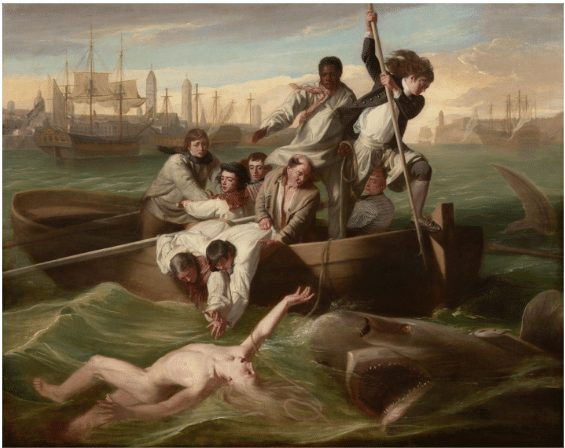
John Singleton Copley, Watson and the Shark (1778) oil, 6′ 0″ x 7′ 6″
It was clear to viewers in the 1700s that in Watson and the Shark John Singleton Copley was depicting an actual event that took place in the major slave trading port of Havana, Cuba. The presence of a West African crewman, whose identity is unknown, near the top of the composition reflects the key role African sailors, both free and enslaved, played in 18th-century maritime commerce and culture.
However, this isn’t just a harrowing adventure on high seas; of that Copley left no doubt by titling his painting as he did. Contemporary audiences knew that Brook Watson, the 14-year-old boy who famously survived the shark attack, later went on to serve in the British Parliament; that very year (1778), his vocal support for the abolition of the slave trade was advancing the cause. In the painting, all he crewmen work together to come to the boy’s aid; the African man has just thrown him a lifeline.
The comparison between Watson and the Black sailor initiates a powerful dialogue with Marshall’s Voyager—a representation of The Wanderer, the penultimate slave ship to land on US shores (illegally) in 1858—and Great America, his depiction of contemporary African Americans on the Middle Passage surrounded by ghosts and a man overboard in an amusement park Tunnel of Love. In that painting, the word “FUN” has literally been whited out. A sign showing the word “Wow” which at first appears to be dripping blood, turns out to be radiating, like fireworks, red streaming stars.
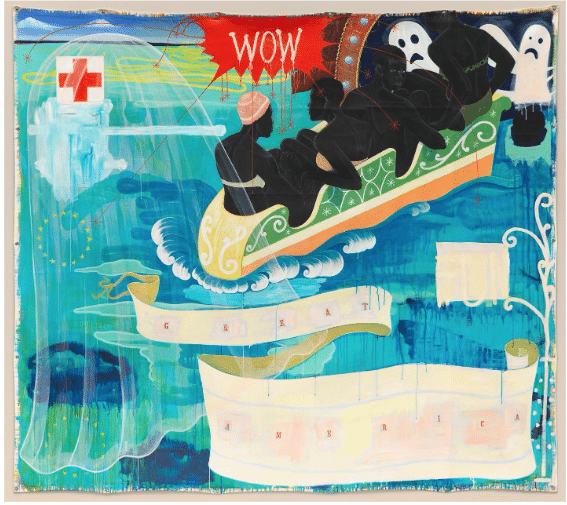
Kerry James Marshall, Great America (1994), acrylic and collage on canvas, 103 x 114 in. Gift of the Collectors Committee.
All three paintings encourage viewers to consider how the violent history and persistent memory of the slave trade has impacted the various figures seen adrift on troubled waters in these resonant images, from the colonial and antebellum eras until the present day.
The exhibition, Conversations: Kerry James Marshall and John Singleton Copley, will be up until January 31, 2025.
More Puppy Love from Montreal

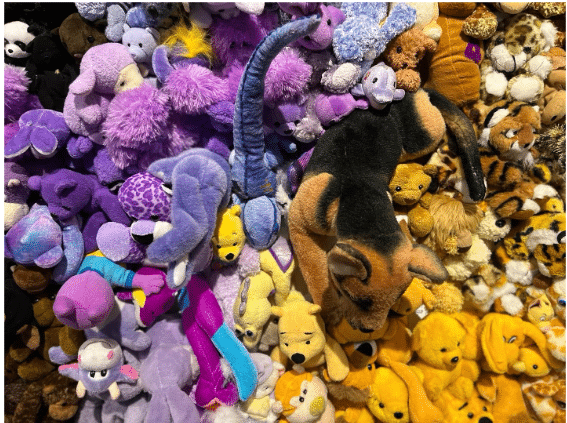
Claude Cormier, Stuffed Animals, 2012, 3,000 stuffed animals, wood
Back by popular demand: we present more detail shots from Canadian artist Claude Cormier’s work Stuffed Animals at the Montreal Museum of Fine Art. A story on Cormier’s work appeared in a recent past issue of Inside Art.
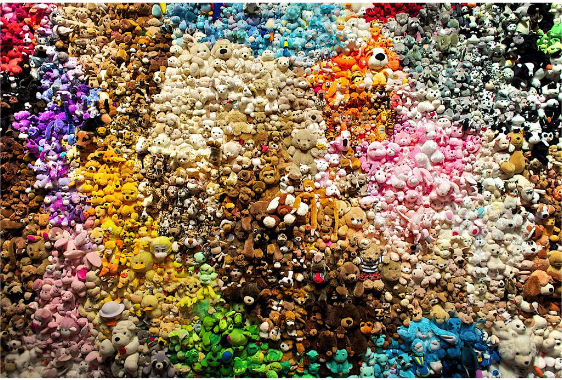
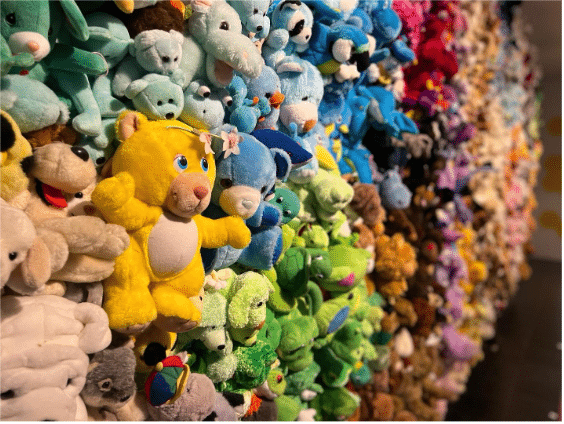
This is the kind of work you want to get up close to, maybe reach out and touch when no one’s looking. From across the museum gallery, it reads like a perfectly normal colorful abstract painting. It’s composed, however, of 3,000 cute and cuddly plushies.
Cormier originally conceived the work for the exhibition Big Bang: Creativity is Given Carte Blanche, held to commemorate the opening of a new wing in the fall of 211. The Montreal museum has it on view and is in the process of purchasing the work for its permanent collection.
This is one conceptual art installation it’s pretty hard not to fall in love with immediately, for obvious reasons.