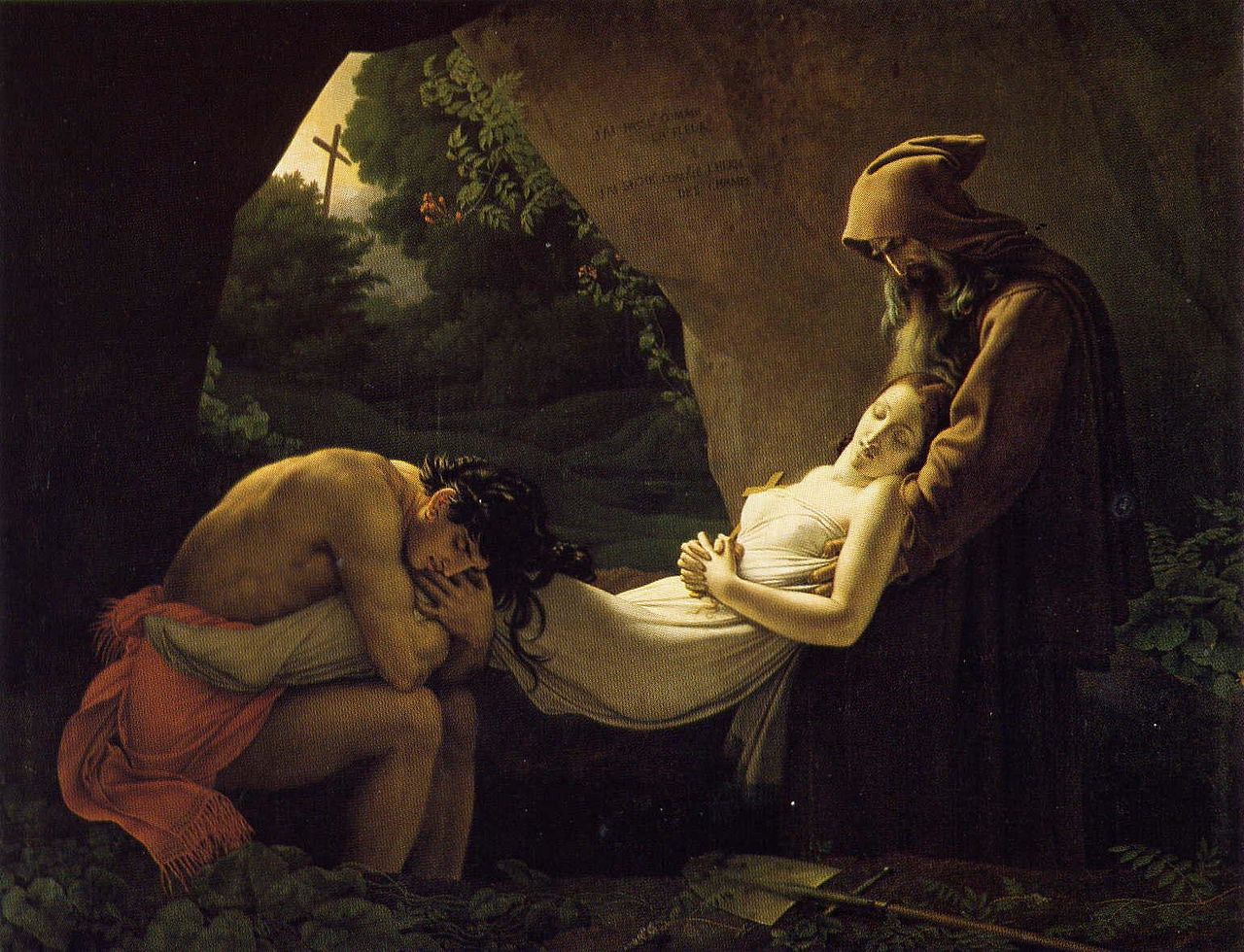
The very large and beguiling oil painting Atala at the Tomb, which hangs at the Louvre, is often called “The Entombment of Atala,” which suggests it belongs to the traditional Christian theme of the Entombment of Christ.
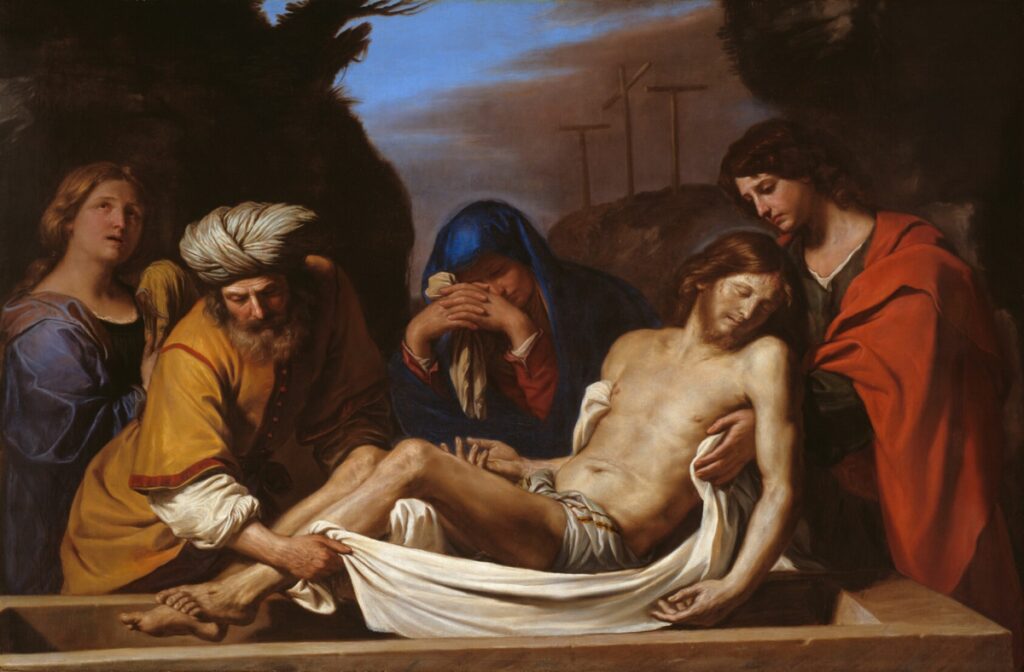
Guercino (Giovanni Francesco Barbieri), The Entombment, 1656
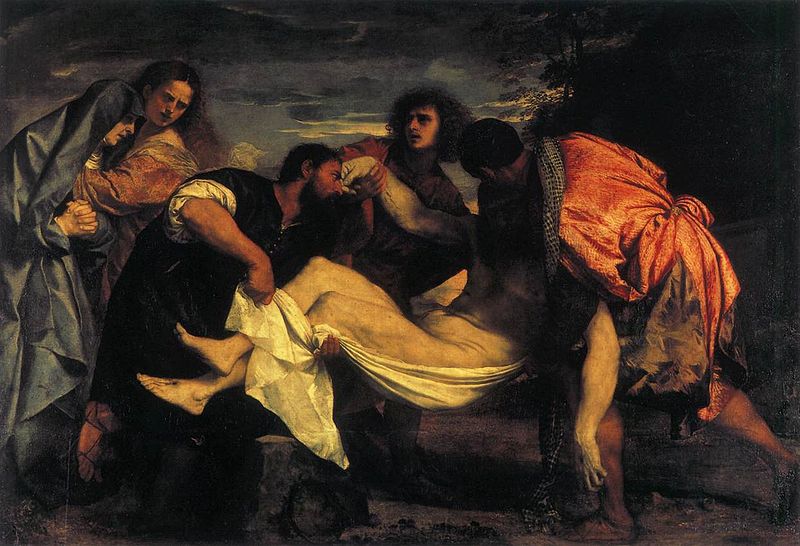
Titian, Entombment of Christ,
And so it does, but there’s a twist; in this version, this “Christ” is a woman. Or rather, this is no Christ at all but an American colonist’s daughter who’s committed suicide after being prevented, by rigid religious attitudes, from uniting with her Native American lover. This Entombment is actually a retelling of Romeo and Juliet in a New World setting, as well as a rebuke to an overly dogmatic version of organized religion.
The painter, Anne-Louia Girodet, sourced Atala at the Tomb, his Salon painting for 1808, from a best-selling novel by a French aristocrat and foreign ambassador named Chateaubriand who wrote about having visited North America in 1791. Among other things, Chateaubriand claimed to have hiked the Mohawk trail to Niagara Falls and spent a month living in the wilderness with a Native American tribe while recovering from a broken arm.
Chateaubriand’s sensational books set in the New World of North America set the French imagination on fire. Of the paintings exhibited at the Paris Salons between 1802 and 1848, 51 took their subjects from Chateaubriand: of these, 18 were taken from his Atala.
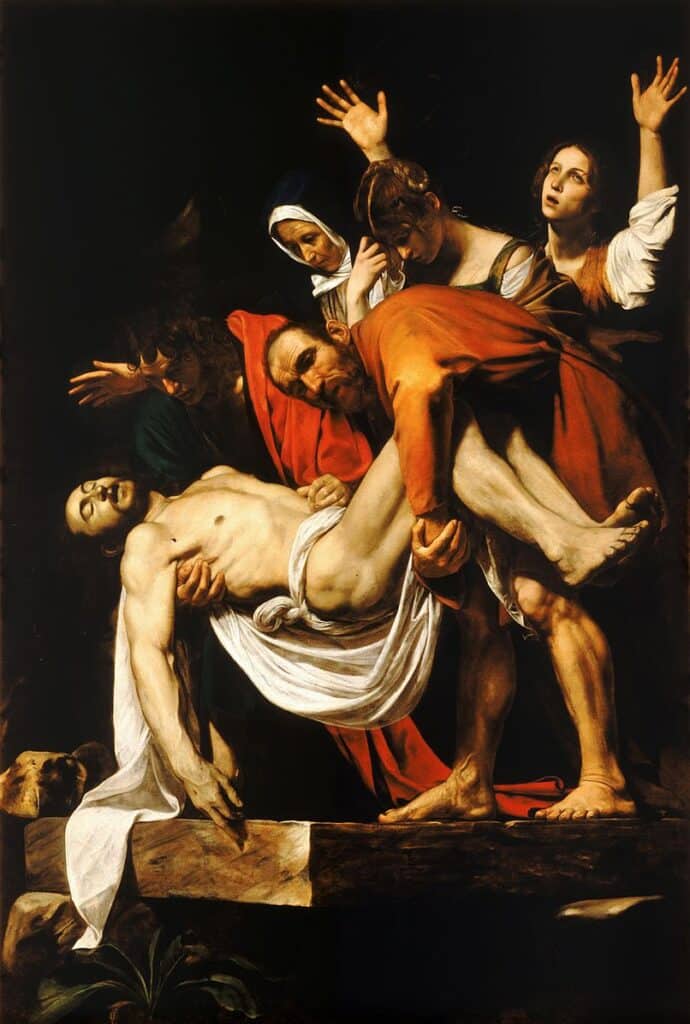
Caravaggio, The Entombment of Christ, 1604
Girodet owes the arrangement of his figures to a long line of artists of Entombment-themed paintings, progressing since the early Italian Renaissance with stops along the way at Mantagna, Titian, Caravaggio, Barbieri, and Girodet’s immediate predecessor, the Italian artist Giovanni David (1743 – 1790), who bookended his painting (below) with youth on one side and old age on the other.

Giovanni David, Entombment of Christ, c. 1750
Girodet, as the Louvre’s Sylvain Bellenger points out, has gone beyond illustrating Chateaubriand’s funereal scene and adapted the traditional Entombment composition to represent three different stages of mourning:
- the spade in the foreground alludes to digging the grave;
- the praying in vigil over the body is suggested by the words from the Book of Job, ‘I have faded like a flower, I have withered like the grass in the fields’ etched into the rock face;
- and the morning light, filtering through the foliage, focuses on the ultimate burial and God’s forgiveness in the afterlife. Girodet drives home the Christian element with a symbolic cross visible in the dawn’s light streaming through an opening in the overhanging rock.
Art historian Friedrich Antal sums up Girodet’s Entombment of Atala within the political and religious context: “Chateaubriand created an exotic atmosphere of Catholicism, filled with beings that consist of lyric emotions with a tinge of sensualism. The unspoilt ‘man of nature’ of (Jean Jaques) Rousseau has become the ‘Christian Red Indian’ of Chateaubriand and Girodet.”
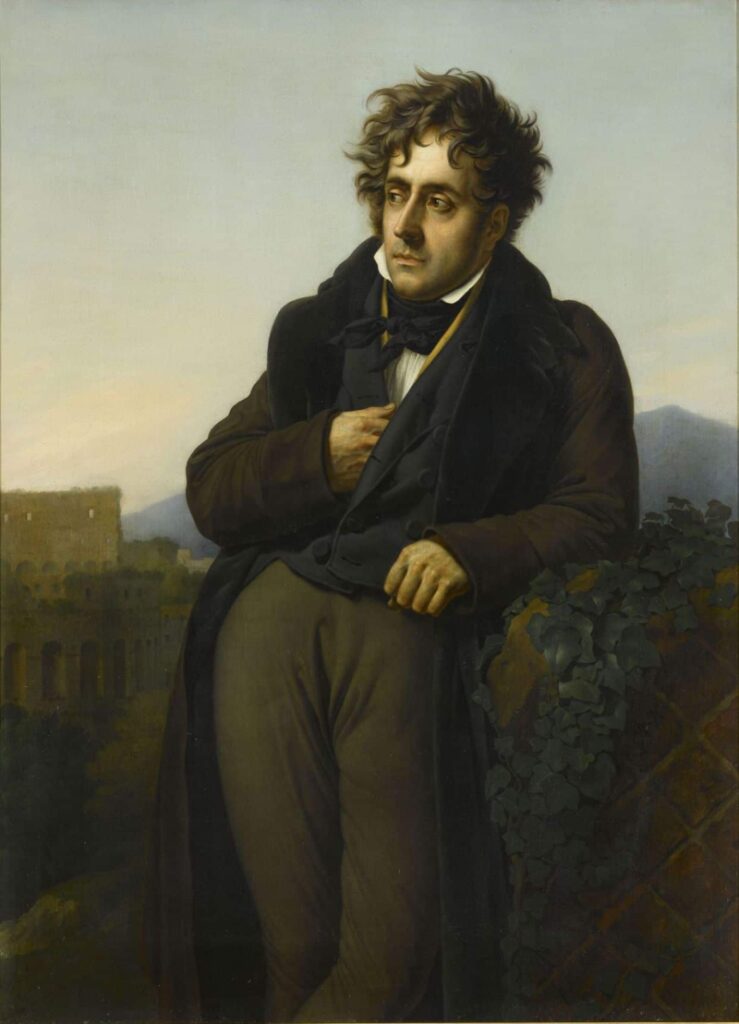
Girodet’s portrait of Chateaubriand
Incidentally, artist and author knew each other, having bonded over their essentially Romantic (imaginative and emotional as opposed to Enlightenment/rational) approach to art, politics, and religion.
Girodet’s above Portrait of Chateaubriand (Museum of Saint-Malo) painted in 1807-08, shows the author in a self-consciously “Napoleonic” pose, reclining against a Roman ruin with the Colosseum on the left. More than merely representing his subject, Girodet’s portrait “epitomized the role in which Chateaubriand cast himself,” says writer David Wakefield, “the solitary genius against the background of eternity.”
- Visit PaintTube.tv to learn how to paint the figure and much more in the style of contemporary realism.
- Join us for the next annual Realism Live virtual art conference and study with the world’s best realism artists.
|
||
|
||
|